 Bellingham
 Roofing in Sunnyland Faces a Specific Set of Conditions
Sunnyland sits close enough to Bellingham Bay that homes here deal with a combination most inland roofs never see: salt-laden air off the water, long stretches of driving rain, and a moss season that runs longer than most homeowners expect. None of these are dramatic on their own, but stacked together year after year, they wear down a roof faster than a general "Pacific Northwest roof replacement" page usually accounts for. If you're planning a replacement in Sunnyland, it's worth understanding what's actually working against your roof before you pick a contractor or a material.
Salt Air and Metal Fatigue
Proximity to the bay means fine salt particles ride the wind and settle on roofing surfaces, flashing, and any exposed fasteners. Over time this accelerates corrosion on lower-grade metal components — nails, drip edge, flashing — well before the field material itself would otherwise need attention. It's a slow process, but it's real, and it's one reason material and fastener selection matters more in Sunnyland than it would ten miles inland.
Driving Rain and Wind-Driven Water
Bellingham doesn't just get a lot of rain — a good portion of it comes in sideways off the bay during winter storms. Wind-driven rain finds weaknesses that vertical rain never would: lifted shingle tabs, marginal flashing laps, gaps around vents and chimneys. A roof that's technically watertight in a calm downpour can still leak in a Sunnyland windstorm if the details weren't built for lateral water.
Moss and Sustained Shade
Whatcom County's moss season is long, and Sunnyland's mature tree cover and north-facing slopes on many lots keep roof surfaces damp and shaded for extended stretches. Moss doesn't just look bad — it holds moisture against the roofing material, works its way under shingle tabs, and lifts edges enough to let water in underneath. Left unchecked over several seasons, moss growth alone can shorten a roof's usable life by years.
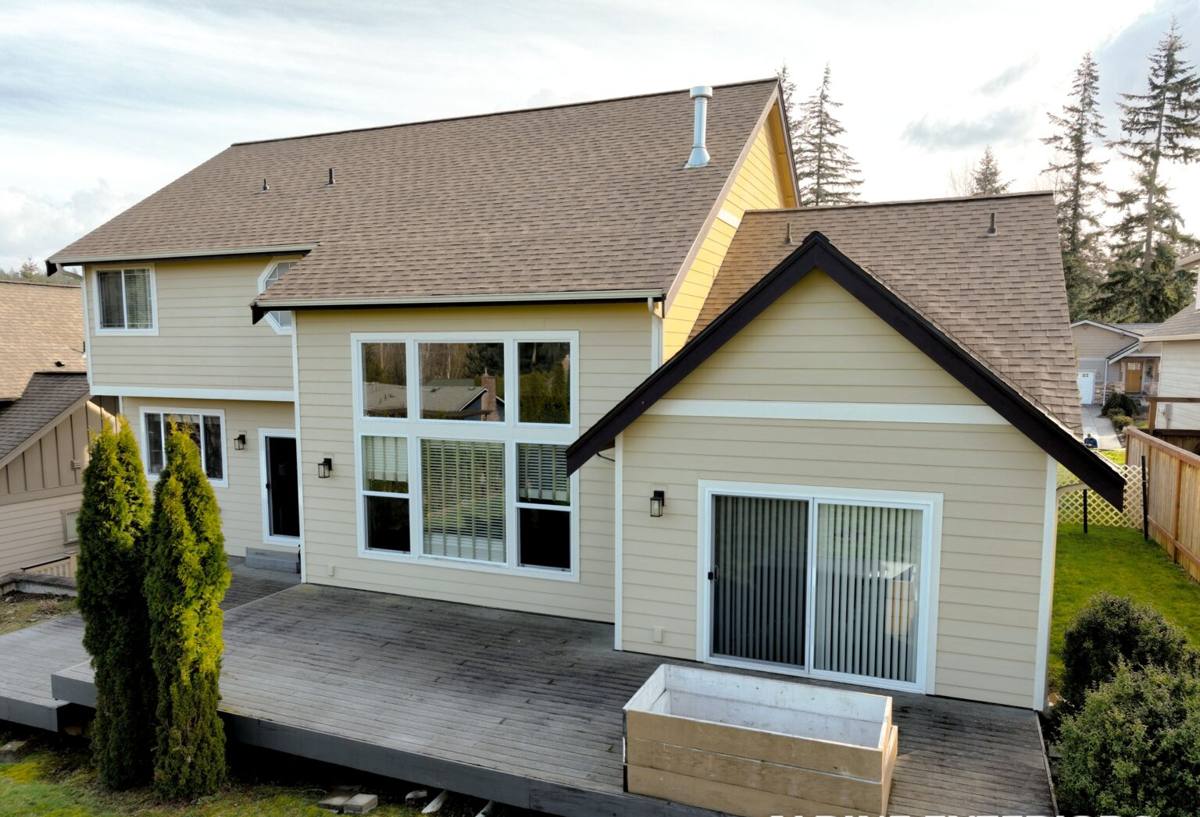
Signs a Sunnyland Roof Needs Replacement, Not Just Repair
Not every roof problem calls for a full replacement, and a straightforward roofer will tell you that. But there's a point where patching individual issues stops making financial sense and a full replacement becomes the honest recommendation. Some signs to watch for:
- Granule loss heavy enough that you're finding shingle granules collecting in gutters or downspouts
- Moss growth that returns within a season or two of cleaning, even after treatment
- Multiple soft spots or visible sagging when walking the roof or viewing it from the attic
- Daylight visible through the roof deck from inside the attic
- Repeated leaks in different locations rather than one isolated spot
- Shingles that are curling, cupping, or cracking across large sections rather than a few isolated tabs
- A roof already past 20-25 years old (for asphalt shingle) showing any of the above
- Flashing that's rusted, separated, or was never properly integrated at the original install
If you're seeing two or more of these, it's worth getting a straight answer on whether repair still makes sense or whether you're past that point.
Choosing a Roofing Material for Sunnyland Conditions
There's no single "best" roofing material for every home — it depends on your roof's slope, shade exposure, budget, and how long you plan to stay in the house. Here's how the common options stack up against Sunnyland's specific conditions:
| Material | Moss Resistance | Wind-Driven Rain Performance | Salt Air Durability | Typical Lifespan |
|---|---|---|---|---|
| Standard 3-tab asphalt shingle | Low — moss establishes easily in shaded areas | Adequate if properly installed | Fasteners need corrosion-resistant coating | 15-20 years |
| Architectural (laminated) asphalt shingle | Moderate; algae-resistant (AR) versions available | Good — thicker profile sheds wind-driven rain better | Fasteners still the weak point without proper spec | 25-30 years |
| Standing seam metal | High — sheds moss with minimal buildup | Excellent when properly flashed | Requires marine-grade or coated fasteners near the bay | 40-50+ years |
| Synthetic/composite shingle | Moderate to high depending on product | Good | Generally stable, check manufacturer fastener specs | 30-40 years |
For most Sunnyland homes, we lean toward algae-resistant architectural shingles as the practical middle ground — better moss and rain resistance than basic 3-tab, without the upfront cost jump of metal. Where a roof has heavy shade, steep pitch, or the homeowner is planning to stay long-term, metal earns a serious look despite the higher initial investment, simply because it holds up to moss and rain with the least ongoing maintenance.
What a Correct Roof Replacement Actually Involves
A roof replacement is more than swapping old shingles for new ones. The parts you don't see are usually what determine whether the roof performs well in Sunnyland's specific weather or ends up with problems in a few years.
Tear-Off and Deck Inspection
We remove the existing roofing down to the deck rather than layering over it. This lets us actually see the sheathing — soft spots, rot, or water staining from long-term moss retention often aren't visible until the old layer is off. Any damaged decking gets replaced before anything new goes down; installing new roofing over a compromised deck just hides the problem for a few more years.
Underlayment and Ice-and-Water Protection
Given how much sustained rain this area sees, underlayment choice matters. We use synthetic underlayment as a water-resistant layer under the field material, with self-adhering ice-and-water shield at vulnerable points — eaves, valleys, around penetrations — where wind-driven rain is most likely to find a way in.
Flashing Details
Flashing around chimneys, skylights, sidewalls, and valleys is where most roof leaks actually originate, not the field shingles themselves. Given the salt air, we spec flashing and fasteners rated for corrosion resistance rather than the minimum the material manufacturer requires, and we integrate flashing properly with the underlayment rather than just caulking over gaps.
Ventilation
Proper intake and exhaust ventilation keeps the attic temperature and moisture in balance, which matters for shingle lifespan and helps reduce the damp, stagnant conditions that let moss take hold in the first place. We check existing ventilation during the estimate and correct it as part of the replacement when it's inadequate.
Our Process, Start to Finish
We keep the process straightforward because a roof replacement is disruptive enough without added confusion about what's happening and when.
- On-site inspection: We walk the roof and check the attic, documenting condition, ventilation, and any problem areas before recommending replacement over repair.
- Written estimate: You get a clear scope of work and pricing — what material, what underlayment, what flashing work is included — with no vague line items.
- Scheduling around weather: Given how much of the year sees rain here, we schedule tear-off in windows where we can get the deck dried in and protected the same day, and we plan around forecasts rather than pushing through a storm.
- Tear-off and deck repair: Old roofing comes off, the deck is inspected, and any needed repairs happen before new material goes down.
- Installation: Underlayment, ice-and-water shield, flashing, and the new roofing material go in to manufacturer spec and to the corrosion-resistant standard we hold for this area.
- Cleanup and walkthrough: We clear debris and nails from the property, including a magnetic sweep, and walk the finished roof with you before we consider the job done.
Why a Crew That Already Works Sunnyland Matters
A roofing crew that regularly works this neighborhood already knows which lots hold shade and moisture longest, which roof lines tend to catch wind-driven rain off the bay, and what corrosion looks like on a five-year-old roof here versus one that's twenty years old inland. That's not a marketing point — it changes real decisions, like where to add extra ice-and-water shield, which fastener grade to spec, and whether a given roof's ventilation is adequate for how shaded the lot is. A contractor working from a generic regional playbook will still build a code-compliant roof; a contractor who knows Sunnyland's specific conditions builds one that's set up to actually hold up in them.
What Affects the Cost of a Sunnyland Roof Replacement
Every roof is different, so we won't put a number here that doesn't reflect your actual house — but these are the factors that move the price up or down on most estimates:
| Factor | Why It Matters |
|---|---|
| Roof size and number of facets | More square footage and more valleys/hips mean more material and labor time |
| Pitch and access | Steep roofs and difficult access require more safety equipment and time |
| Deck condition | Rot or soft decking found during tear-off adds material and labor to repair before install |
| Material choice | Standard architectural shingle costs less upfront than metal or premium synthetic products |
| Layers to remove | Tearing off multiple existing layers takes longer than removing one |
| Ventilation and flashing corrections | Bringing inadequate ventilation or old flashing up to standard adds scope but reduces future problems |
We walk through all of this with you during the estimate so the final number reflects your specific roof, not a rough guess.
Maintaining Your New Roof Through Bellingham's Moss Season
A well-installed roof still benefits from basic upkeep in this climate. Keeping gutters clear so water doesn't back up under the roof edge, trimming back overhanging branches to cut down on shade and debris, and having moss growth addressed early — before it has a chance to lift shingle edges — will meaningfully extend the life of a new roof. None of this requires a maintenance contract or frequent service calls; it's a once- or twice-a-year check that pays for itself over the life of the roof.
If you're weighing repair versus replacement, or just want a straight read on your roof's condition, we're happy to come take a look. The estimate is free, there's no pressure attached to it, and you'll get a clear answer either way — just fill out the form below.