 Bellingham
 Why Attic Ventilation Matters More Here Than Most Places
Attic ventilation is one of those systems homeowners never think about until something goes wrong — a moldy smell in the upstairs closet, ice damming along the eaves, or shingles that failed years before they should have. In most of the country, poor attic ventilation shows up as higher cooling bills. In Bellingham, it shows up as rot, mold, and premature roof failure, because our problem isn't heat, it's moisture.
Whatcom County sits in a marine climate with a long wet season, salt-laden air off Bellingham Bay, and enough overcast, damp days each year to keep moss and mildew happy on almost any north-facing roof slope. An attic that can't breathe traps the moisture that comes up from the living space below (cooking, showers, laundry) and combines it with the humidity already in our outside air. That moisture condenses on the cold underside of the roof deck, and over a few seasons it will rot sheathing, rust fasteners, and feed mold growth — all hidden above your ceiling where you can't see it happening.
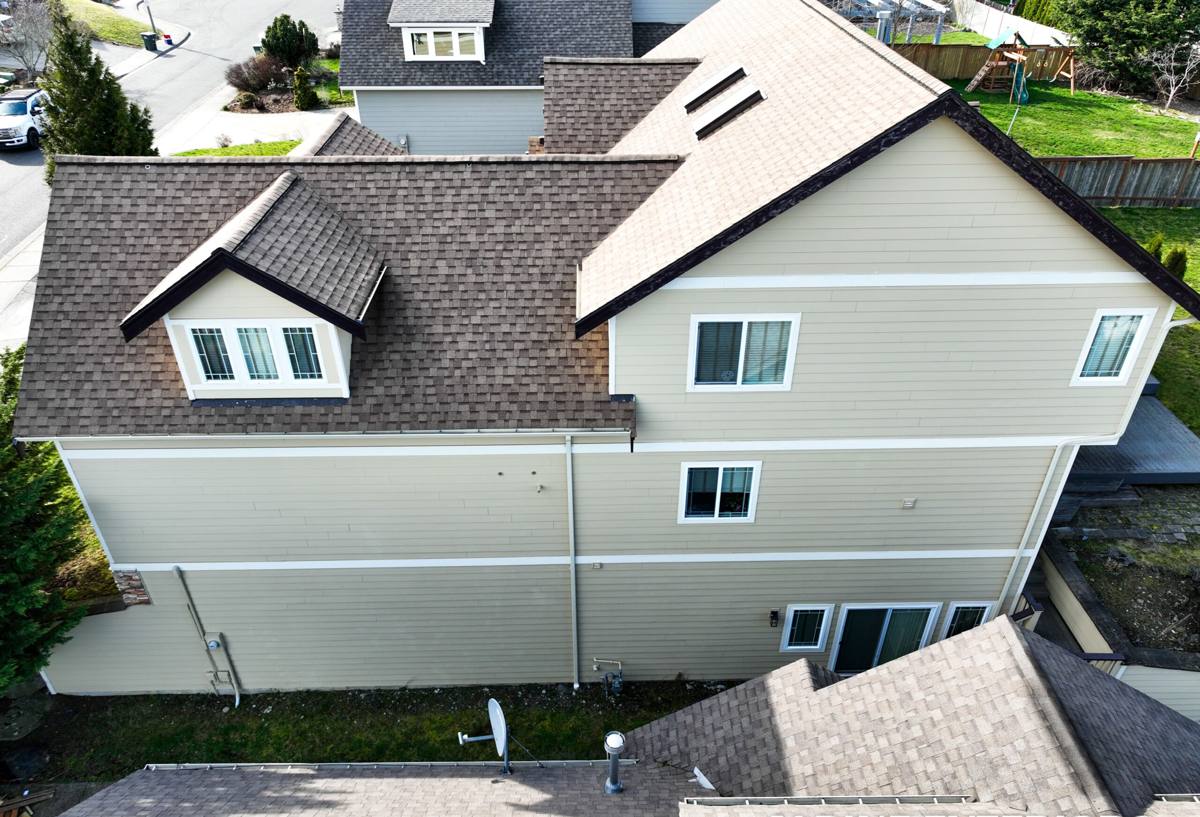
How Attic Ventilation Actually Works
Good attic ventilation is simple in concept: cool, dry air enters low (at the eaves or soffits) and warm, moist air exits high (at the ridge or through roof-mounted vents). This constant, passive airflow does three things:
- Carries moisture vapor out of the attic before it condenses on wood or insulation
- Keeps the roof deck temperature closer to outdoor air temperature, which reduces ice damming in cold snaps and slows shingle aging in summer sun
- Reduces the damp, stagnant air that moss spores, mold, and wood-decay fungi need to get established
The key word is balanced. Intake and exhaust need to work together and be roughly equal in size. A roof with plenty of ridge vent but blocked or missing soffit intake doesn't ventilate well — it just pulls conditioned air from the house through ceiling gaps instead of pulling fresh air from outside, which wastes energy and can actually pull moist household air into the attic.
The Two Halves of the System
Intake: Usually continuous soffit vents or individual round vents along the underside of the eaves. This is where outside air enters.
Exhaust: Ridge vents, box vents, or power/turbine vents near the peak of the roof. This is where the warm, moist air leaves.
Both halves have to be clear and correctly sized, or the system doesn't function as a system — it's just two disconnected openings.
Signs Your Attic Isn't Ventilating Properly
Because the attic is out of sight, most homeowners find out there's a problem only after it's been going on for a while. Some things worth checking or asking about:
| What You Notice | What It Often Means |
|---|---|
| Moss forming quickly on north or shaded roof slopes | Roof deck staying damp longer than it should — sometimes ventilation, sometimes just shade and tree cover |
| Musty smell in upstairs rooms or closets under the roofline | Trapped moisture and possible mold growth in the attic space |
| Visible frost or condensation on the underside of the roof deck in winter | Warm, moist household air reaching the attic and condensing on cold sheathing |
| Dark staining or streaking on rafters or sheathing | Long-term moisture exposure, often an early sign of mold or rot |
| Ice buildup at the eaves in cold weather | Uneven roof deck temperature, often tied to poor airflow or insulation gaps |
| Shingles curling or granule loss well before expected lifespan | Excess heat and moisture cycling under the shingles |
None of these are things we'd tell you to panic about from a single symptom — but a couple of them together is worth having a professional take a look at the attic from the inside, not just the roof from the ground.
What Good Ventilation Looks Like in Practice
Continuous Ridge and Soffit Venting
For most homes in our area, a continuous ridge vent paired with continuous soffit venting is the cleanest, lowest-maintenance setup. It has no moving parts, works in every wind direction, and distributes airflow evenly along the entire roofline rather than concentrating it at a few spots.
Box Vents and Static Vents
On roofs without a long enough ridge to support a ridge vent — hip roofs, additions, complex rooflines — static box vents spread across the upper roof plane can do the job, as long as there's enough total open area and matching intake below.
Power and Turbine Vents
These use electricity or wind to actively pull air out. We generally recommend against relying on them as a primary system on their own. They can create negative pressure that pulls conditioned air out of the living space through ceiling penetrations, they add a moving part that eventually needs replacement, and if the intake side isn't sized to match, they can pull air from the wrong places — including through gaps around can lights or attic hatches. Where we do use them, it's as a supplement on a roof shape that genuinely can't support enough passive venting on its own, not as a first choice.
Insulation and Air Sealing Are Part of the Same Problem
Ventilation and insulation get talked about separately, but they solve related problems. Insulation's job is to keep conditioned air and heat inside the living space. Ventilation's job is to manage whatever moisture and heat still make it into the attic anyway. If insulation is thin, missing in spots, or compressed against the roof deck (blocking the airflow path from soffit to ridge), no amount of ridge venting will fully fix the moisture problem, because warm moist air keeps pouring in faster than the vents can move it out.
This is also why baffles — the rigid channels installed between the rafters at the eaves — matter. They keep insulation from getting pushed into the soffit opening and choking off intake air, which is one of the most common ventilation problems we find in older Bellingham homes when we're up in the attic for something else.
Cost Factors for Ventilation Upgrades
Every roof is different, so we won't quote a number without seeing the attic and roof in person, but here's what generally drives cost on a ventilation project:
| Factor | Why It Affects Cost |
|---|---|
| Roof shape and ridge length | A long, simple ridge is efficient to vent; hip roofs and cut-up rooflines need more individual vents to get equivalent airflow |
| Existing soffit condition | If soffits are solid (no vent capacity) they need to be modified or replaced to add intake, which adds labor |
| Attic accessibility | Steep pitches, low clearance, and multiple attic sections all add time |
| Whether it's a standalone repair or part of a re-roof | Adding or correcting ventilation during a full roof replacement is far more cost-effective than as a separate project later |
| Insulation and baffle work needed alongside it | Fixing blocked intake often means adding baffles and sometimes topping up insulation at the same time |
Why We Don't Push Powered Attic Fans as a First Solution
Powered attic fans get marketed heavily, and homeowners sometimes ask us to install one thinking it's the fix for a stuffy or musty attic. Our standard is to look at passive balanced ventilation first, because it requires no power, has nothing to wear out, and doesn't risk depressurizing the attic relative to the house. If a powered fan is added to a house with poor air sealing between the living space and attic, it can pull heated, moist indoor air upward faster than before — the opposite of what you want. When a powered vent is genuinely the right call for a specific roof shape, we'll say so, but it's a decision made after evaluating the whole system, not a default add-on.
What to Check Before You Buy a House or Plan a Re-Roof
- Look for a continuous vent along the ridge and confirm the soffits underneath actually have open vent holes or slots, not just a vented-looking panel that's solid behind it
- Ask whether the attic has visible baffles at the eaves keeping insulation clear of the soffit vents
- Check for daylight or airflow through gable vents if the home uses that style instead of ridge/soffit
- Note any musty smell, staining, or moss patterns that seem heavier than the rest of the neighborhood
- If a re-roof is coming up, treat ventilation as part of that project rather than an afterthought — correcting intake and exhaust balance is far cheaper done alongside new shingles than as a standalone repair later
Our Approach on Bellingham and Whatcom County Homes
Because of the salt air, near-constant rain exposure, and long moss season we deal with here, we treat attic ventilation as a core part of any roof inspection or replacement, not an optional upgrade. We physically get into the attic rather than judging airflow from the roofline alone, check that intake and exhaust are actually balanced (not just present), and look for the moisture damage patterns that tell us whether a system has been working or just looks like it should. Whether your home is close to the water in Fairhaven, up in the county away from the coast, or anywhere in between, the same basic physics apply — the details of roof shape, tree cover, and existing construction are what change the plan.
If you're dealing with a musty attic, heavier-than-normal moss, or you're planning a re-roof and want ventilation done right the first time, we're happy to take a look and walk you through what we find — no pressure, no sales pitch, just a straight answer about what your attic needs. Reach out for a free estimate and we'll get you scheduled.