 Bellingham
 Every roof reaches a point where a homeowner has to make a call: patch it again, or replace it. In Bellingham, that decision gets complicated by our specific climate — salt-laden air rolling in off Bellingham Bay, long stretches of driving rain from fall through spring, and a moss season that can stretch nine months out of the year in shaded, north-facing Whatcom County neighborhoods. What's a simple decision in a dry climate becomes a more layered one here, because our weather accelerates certain kinds of roof damage while masking others.
This page walks through how we actually evaluate a roof — the same process we'd use standing on your roof with a flashlight and a moisture meter — so you can understand the reasoning before you ever get a quote.
Start With the Roof's Age, Not Just Its Appearance
A roof can look rough and still have years left, or look fine from the ground and be structurally tired underneath. Age is the single most useful data point because it tells you where the roof sits on its expected lifespan curve — and how much remaining value a repair actually protects.
| Roofing Material | Typical Lifespan (PNW Climate) | Notes for Whatcom County |
|---|---|---|
| 3-tab asphalt shingle | 15-20 years | Shorter end of range common here due to constant moisture exposure |
| Architectural (dimensional) asphalt shingle | 25-30 years | Better wind and moss resistance than 3-tab |
| Wood shake/shingle | 20-30 years with upkeep | High maintenance burden in a wet, mossy climate |
| Metal (standing seam) | 40-60 years | Sheds moss and moisture well; higher upfront cost |
| Torch-down / TPO (low-slope) | 15-25 years | Common on additions and porch roofs; seams are the weak point |
If a roof is inside its expected lifespan and the damage is isolated, repair is usually the responsible answer. If it's past the midpoint of that range and showing multiple issues at once, we start talking about replacement — not because one problem demands it, but because the roof as a system is running out of runway.
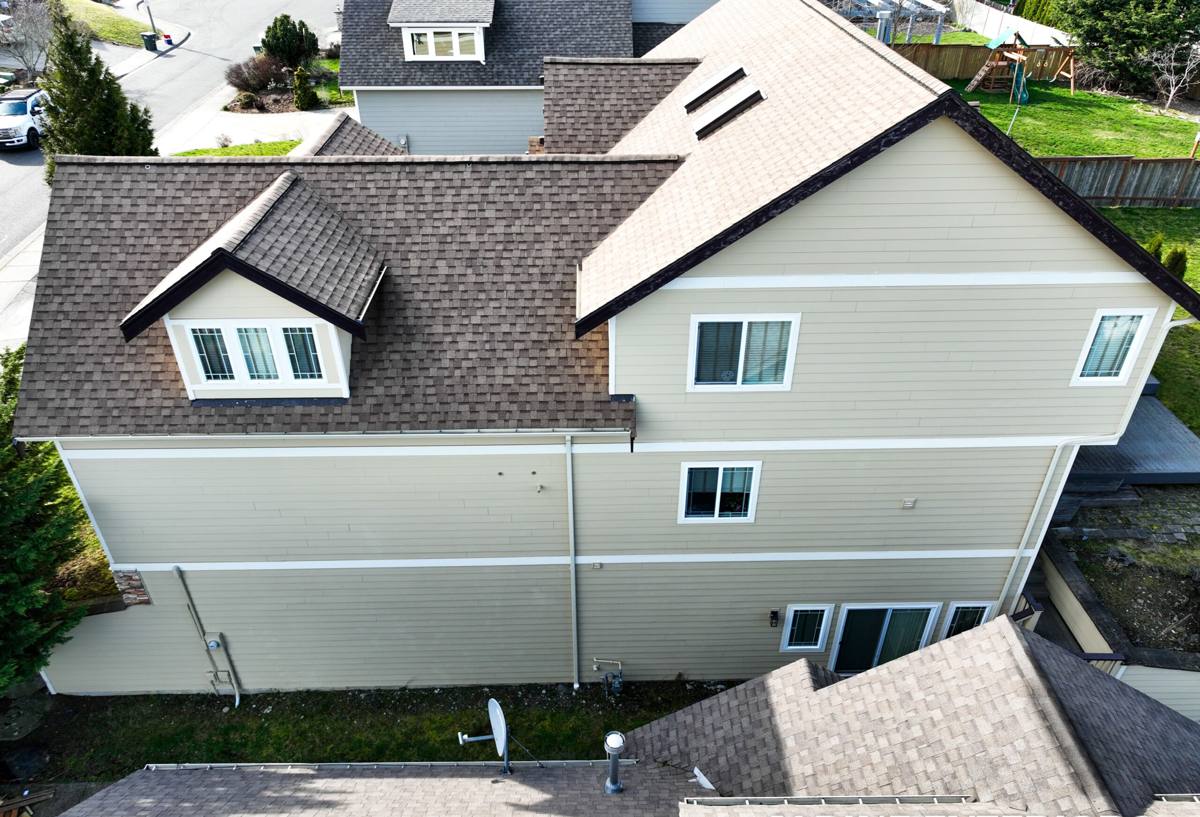
When a Repair Is the Right Call
We'd rather fix a section of roof correctly than sell a full replacement a homeowner doesn't need yet. Repair makes sense when the damage is contained and the rest of the roof is sound. Common repair-appropriate scenarios include:
- A localized leak from a failed pipe boot, cracked flashing, or a handful of damaged shingles after wind
- Moss buildup that hasn't yet lifted shingles or worked its way under the shingle edges
- Minor granule loss on a roof that's otherwise under 15 years old
- Damage confined to one slope or one section (a dormer, a valley, a chimney flashing)
- A roof with clean, dry decking underneath the affected area once we open it up
The key test we apply: can we fix this section without disturbing sound, well-adhered shingles elsewhere on the roof? If yes, a repair is honest work and a fair use of your money.
When Replacement Is the Smarter Long-Term Call
Some situations make repair a short-term patch that doesn't actually solve anything. We see this most often on roofs where moss has been established for years, or where a homeowner has had the same leak "fixed" two or three times without it fully resolving. Signs that point toward replacement:
- Multiple leaks in different areas, rather than one isolated spot
- Shingles that are curling, cupping, or losing granules broadly across the roof, not just in one section
- Soft or spongy decking discovered during inspection — a sign moisture has been getting in for a while
- Moss or algae that has lifted shingle tabs or worked underneath the shingle courses
- A roof already at or past the upper end of its material's expected lifespan
- Repeated repair costs that, added up over a couple of years, start closing in on replacement cost
None of these on their own is automatically a "replace it" verdict — but two or three together usually is, especially on a roof that's already 18-20+ years old.
Why Moss Matters More Here Than It Looks Like It Should
Moss is often treated as a cosmetic nuisance, but in a climate like ours it's a mechanical problem. Bellingham's tree cover, marine layer humidity, and long damp season give moss ideal conditions on north-facing slopes and shaded areas near mature trees — which describes a large share of Whatcom County roofs. Moss holds water against the shingle surface far longer than the shingle is designed to tolerate, and as it grows it physically lifts shingle edges, breaking the seal that keeps wind-driven rain out.
A roof with light surface moss that hasn't disturbed the shingles is a maintenance issue — clean it, treat it, keep an eye on it. A roof where moss has been growing unchecked for several years, with visible lift at the shingle tabs, has likely already let moisture into the underlayment in more places than are visible from the ground. That's a meaningful factor in the repair-versus-replace conversation, separate from the roof's age.
How Salt Air and Driving Rain Change the Math
Roofs closer to the water deal with airborne salt that accelerates corrosion on metal flashing, fasteners, and vents faster than an inland roof of the same age would show. Fastener and flashing failure is a common source of leaks that looks like "the roof is bad" but is actually a metal-components problem — sometimes repairable on its own, sometimes a sign that everything installed at the same time is reaching end of life together.
Driving rain — wind-driven rain that hits a roof at an angle instead of falling straight down — tests every seam, lap, and flashing detail a roof has. A roof that would hold up fine under vertical rainfall in a drier climate can leak here because water gets pushed sideways under shingle edges and around chimneys and skylights. This is part of why we pay close attention to flashing condition, not just shingle condition, when evaluating a roof in this region.
What Repair vs. Replacement Actually Costs to Weigh
We won't quote a number here because every roof, pitch, and access situation is different — but the factors that move the price are consistent, and worth understanding before you get bids.
| Factor | Pushes Toward Repair | Pushes Toward Replacement |
|---|---|---|
| Roof age | Under half its expected lifespan | Past two-thirds of expected lifespan |
| Leak pattern | Single, isolated source | Multiple sources, or recurring in the same area |
| Decking condition | Dry and solid where checked | Soft, stained, or spongy in more than one spot |
| Moss/algae extent | Surface growth, shingles undisturbed | Growth has lifted shingles or spread broadly |
| Prior repair history | First repair on this roof | Third or fourth repair attempt in a few years |
| Plans for the home | Selling soon, need it watertight now | Staying long-term, want to stop recurring costs |
A useful rule of thumb: if a repair's cost starts approaching a third of what full replacement would run, and the roof is already older, replacement is usually the better use of that money — because you're not paying again for the next issue that surfaces six months later.
What a Trustworthy Inspection Should Actually Include
The repair-or-replace call should never be made from the ground or from a single photo. A proper inspection includes:
- Walking the roof surface (weather and safety permitting), not just viewing it from a ladder
- Checking flashing at every penetration — chimneys, vents, skylights, walls
- Looking at the attic or underside of the decking for moisture staining, if accessible
- Noting moss and algae extent and whether it has disturbed the shingle mat
- Checking gutter and downspout condition, since backed-up water compounds every other issue
- An honest estimate of remaining service life, not just a list of visible damage
Be cautious of any inspection that reaches a "you need a full replacement" conclusion without ever getting on the roof or opening anything up. That's a sales conclusion, not an inspection finding.
A Homeowner's Pre-Decision Checklist
- Do you know the age of your current roof, even approximately?
- Has this roof been repaired more than once for the same or a nearby issue?
- Is the leak or damage confined to one area, or showing up in multiple spots?
- Has anyone actually checked the decking condition, not just the shingle surface?
- Is there visible moss or algae, and has it lifted any shingle edges?
- How long do you plan to stay in the home?
- Have you gotten more than one opinion if a full replacement is being recommended?
Answering these honestly before a contractor arrives puts you in a much stronger position to evaluate whatever recommendation you're given.
Making the Decision With Confidence
The right call almost always comes down to matching the scope of the fix to the actual scope of the problem. A well-maintained roof with an isolated issue deserves a repair. A roof carrying years of moss damage, multiple leak points, and compromised decking is past the point where another patch makes financial sense. Whatcom County's combination of salt air, driving rain, and extended moss season doesn't change that logic — it just means problems tend to show up sooner and in more places than they would in a milder, drier climate, so it pays to get an honest read rather than guess.
If you're weighing repair against replacement and want a straight answer based on what's actually happening on your roof, we're happy to take a look. There's a free, no-pressure estimate form below — use it to get a clear read on where your roof stands before you spend money either way.