 Bellingham
 What Barkley's Climate Actually Does to a Roof
Barkley sits close enough to Bellingham Bay that salt-laden air is a real factor on roofing materials, not just a coastal talking point. Combine that with Whatcom County's long wet season — months of driving rain off the Sound, punctuated by wind that drives moisture sideways under poorly lapped flashing — and you get a roof environment that's harder on materials than most manufacturers assume when they write their warranty fine print. Add a moss season that can run eight or nine months out of the year in shaded, tree-covered lots common to Barkley, and you have three separate stressors working on the same roof at once: corrosion, water intrusion, and organic growth that traps moisture against the roof surface.
None of that means a roof in Barkley needs to be exotic or overbuilt. It means the installation details that get skipped on an easier job — proper fastener selection, correct underlayment layering, real attic ventilation — are not optional here. A new roof installed without those details in mind will look fine for a year or two and then start showing problems that are expensive to trace back to the install.
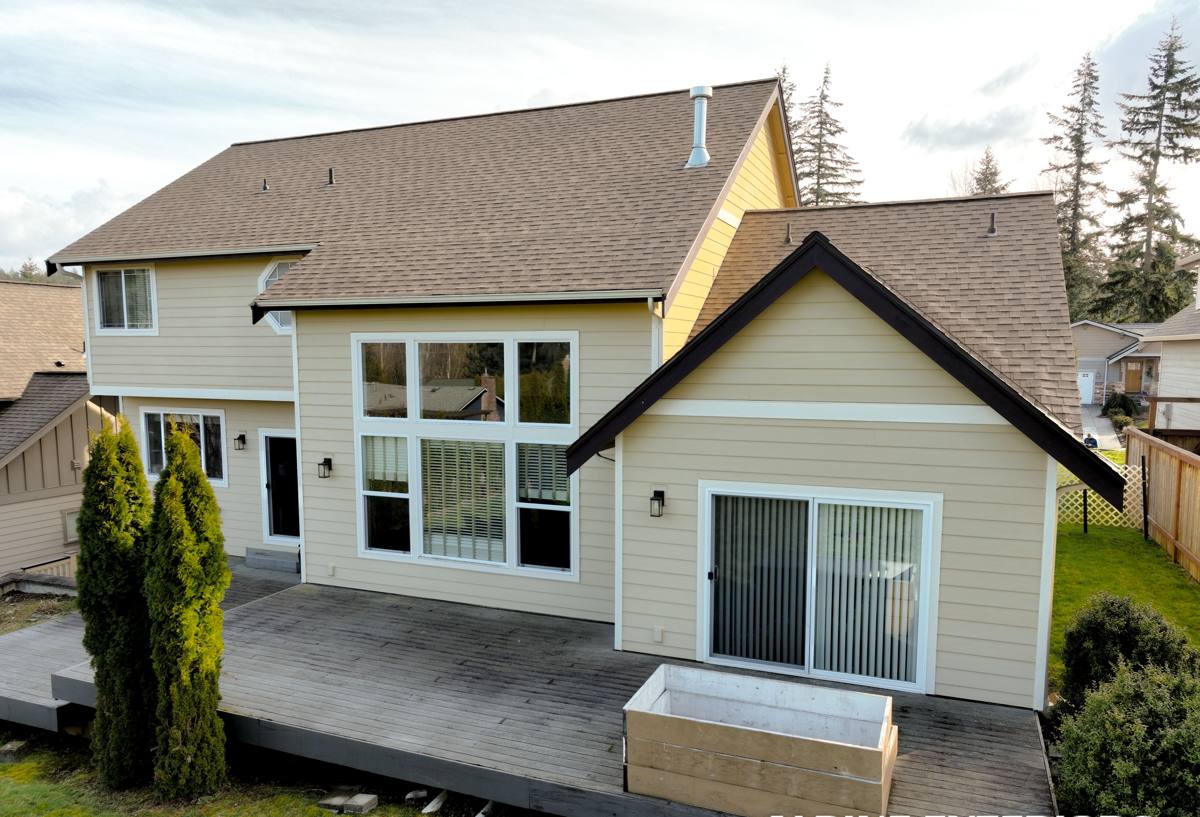
What a Correct New Roof Installation Involves
"New roof" covers a lot of ground, and the difference between a roof that lasts its full rated life and one that fails early almost always comes down to what happens underneath the shingles, not the shingles themselves.
Tear-Off and Deck Inspection
We remove the old roofing down to the deck rather than layering over it. That's the only way to actually see the plywood or plank sheathing underneath, which is where hidden rot from years of moss retention or slow leaks tends to hide. Any soft, delaminated, or water-stained decking gets replaced before anything new goes down — installing new roofing over a compromised deck just guarantees a repeat problem.
Ice and Water Protection at Vulnerable Points
Eaves, valleys, and roof-to-wall transitions get self-adhering waterproof membrane, not just felt. These are the spots where wind-driven rain and, in colder snaps, ice damming push water backward under the shingle line. It's cheap insurance against the highest-risk failure points on the roof.
Underlayment Across the Field
A synthetic or felt underlayment layer covers the rest of the deck as a secondary water barrier. If wind ever drives rain past a shingle tab — which happens in a real Pacific Northwest storm — this layer is what keeps that water out of the living space while it works its way back out.
Flashing at Every Penetration
Chimneys, vent pipes, skylights, and wall step-flashing are where the vast majority of "new roof" leaks actually originate — not from the field shingles. We use correctly sized, properly lapped metal flashing at every one of these, rather than relying on sealant or mastic to do a metal detail's job.
Fasteners and Attachment
Corrosion-resistant fasteners matter more here than in drier inland climates, given the salt content in coastal air. We match nail or screw coatings to the roofing material and the site conditions rather than defaulting to whatever's cheapest.
Material Choices for Barkley Homes
There's no single "best" roofing material — the right choice depends on the home's roof pitch, tree cover, budget, and how long the owner plans to stay in the house. Here's how the common options actually compare under Barkley's conditions.
| Material | Performance in Salt Air / Rain | Moss Resistance | Typical Lifespan |
|---|---|---|---|
| Asphalt composition shingle | Good with proper flashing; algae-resistant granules recommended near tree cover | Moderate — needs periodic cleaning | 20–30 years |
| Standing seam metal | Excellent when properly coated; sheds wind-driven rain well | High — sheds moss more easily than textured surfaces | 40–60 years |
| Cedar shake/shingle | Requires diligent maintenance in wet, shaded lots | Low without regular treatment and cleaning | 20–30 years with upkeep |
| Synthetic/composite shake | Good; consistent performance without natural wood's moisture sensitivity | Moderate to high depending on product | 30–50 years |
We don't push cedar on shaded Barkley lots as a default. It's a beautiful product, but on a heavily treed property with limited sun exposure, it demands a maintenance schedule most homeowners underestimate before they commit to it — regular cleaning, treatment, and closer inspection than asphalt or metal require. That's a maintenance-burden and moisture-behavior tradeoff we'll walk through honestly rather than just installing what looks best on day one.
Ventilation and Moss: The Piece Most Installs Skip
A new roof surface doesn't stop moss on its own — moss grows where moisture sits, and moisture sits where airflow is poor. Proper intake and exhaust ventilation keeps the underside of the roof deck dry and closer to outdoor temperature, which reduces the condensation that feeds both moss growth on the surface and rot underneath. On a lot of older Barkley homes, ventilation was an afterthought during the original build, and a new roof install is the natural point to correct it — adding ridge vent, soffit intake, or baffles as needed rather than just replacing what was there.
We'll also talk about zinc or copper strips at the ridge on shaded roofs, which release trace metal ions with rainfall that slow moss regrowth over time. It's not a substitute for good ventilation and periodic cleaning, but it's a low-cost addition worth considering on a heavily shaded roof.
Signs a Roof Needs Replacement, Not Another Repair
- Granule loss heavy enough to see bare shingle mat, especially on south- and west-facing slopes
- Shingles that are cupping, curling, or cracking across multiple areas of the roof, not just one spot
- Soft or spongy decking felt underfoot during an attic or roof inspection
- Recurring leaks at the same location despite prior repairs — a sign the underlying flashing or decking has failed
- Visible daylight through the roof deck from inside the attic
- A roof already past or near the end of its material's typical service life, combined with any of the above
A roof with isolated damage — one bad flashing detail, a section of storm damage — is usually a repair candidate. A roof with several of these signs at once, or a deck with widespread moisture damage, is past the point where repair makes financial sense.
Our Process, Start to Finish
- On-site inspection of the existing roof, attic ventilation, and any visible trouble spots, with photos and a plain-English explanation of what we find
- Written estimate covering material options, scope of work, and a realistic timeline — no pressure to decide on the spot
- Tear-off and deck inspection, with any damaged sheathing replaced before new material goes down
- Installation of ice-and-water membrane at eaves, valleys, and wall transitions, followed by underlayment across the full deck
- New flashing at every penetration and wall intersection, sized and lapped correctly rather than sealed over
- Installation of the chosen roofing material to manufacturer specification, including ventilation components
- Final walkthrough and cleanup, including magnetic sweep for stray fasteners around the property
What Drives the Cost
| Factor | Why It Matters |
|---|---|
| Roof size and pitch | Steeper roofs take longer and require more safety setup, affecting labor cost |
| Number of penetrations and valleys | Each flashing detail adds material and labor time |
| Deck condition | Rotted or delaminated sheathing found at tear-off adds repair cost not visible during an initial inspection |
| Material selection | Asphalt, metal, and composite products carry different material and installation costs |
| Ventilation upgrades | Adding intake/exhaust venting where none existed is a worthwhile add, not a base-cost item |
| Tree cover and access | Heavily wooded lots common in Barkley may need extra debris management and careful equipment staging |
Exact numbers depend on all of the above, which is why we walk every roof in person before quoting rather than pricing over the phone. What we can say broadly: a straightforward asphalt shingle replacement on an average-size home runs well below a standing seam metal roof of the same size, but the metal roof's longer lifespan and lower long-term maintenance can close that gap over time. We'll lay out the real tradeoffs for your specific roof rather than steering you toward the highest-margin option.
A Checklist Before You Hire Anyone
- Ask whether tear-off to bare decking is included, or if overlay is being proposed
- Confirm what underlayment and ice-and-water membrane will be used, and where
- Ask how flashing at chimneys, vents, and walls will be handled — new metal, not just sealant
- Check that attic ventilation is part of the scope, not just the roofing surface
- Get the manufacturer warranty terms and the contractor's own workmanship warranty in writing
- Confirm licensing and insurance, and ask for local references or examples of nearby work
Why It Matters That We Already Work in Barkley
A crew that's worked this specific pocket of Bellingham has already seen how the tree cover, terrain, and coastal exposure in Barkley behave over a full wet season and a full moss season — not in theory, but on roofs a few streets apart from each other. That local pattern recognition shows up in small decisions: where ventilation tends to be undersized on homes of a certain era, which slopes hold moisture longest under the tree canopy, where salt-air corrosion shows up first on fasteners and flashing. None of that replaces a proper on-site inspection, but it means fewer surprises and a more accurate estimate the first time around.
If you're weighing a new roof for your Barkley home, we're happy to take a look and give you a straight answer — including telling you if a repair still makes more sense than full replacement. Reach out for a free, no-pressure estimate using the form below.