 Bellingham
 Why Birchwood Siding Takes a Different Kind of Beating
Birchwood sits close enough to the water and the lowland weather patterns that move through Whatcom County to get the full package: salt-tinged air rolling in off Bellingham Bay, long stretches of driving rain through fall and winter, and a moss season that seems to start earlier and last longer every year. None of that is unique to one street or subdivision — it's the reality for most of Bellingham — but it adds up differently depending on how a home is oriented, how much tree cover shades the siding, and what the siding is actually made of.
Salt air accelerates corrosion on fasteners and metal trim. Driving rain, especially wind-driven rain that hits north- and west-facing walls at an angle, finds every gap in flashing and caulk and pushes moisture where it doesn't belong. And moss and algae don't just look bad — they hold moisture against the siding surface for weeks at a time, which is exactly the condition that rots wood-based products and stresses the seams on lower-grade fiber cement and vinyl alike. Repair work in this neighborhood has to account for all three, not just patch the visible damage and move on.
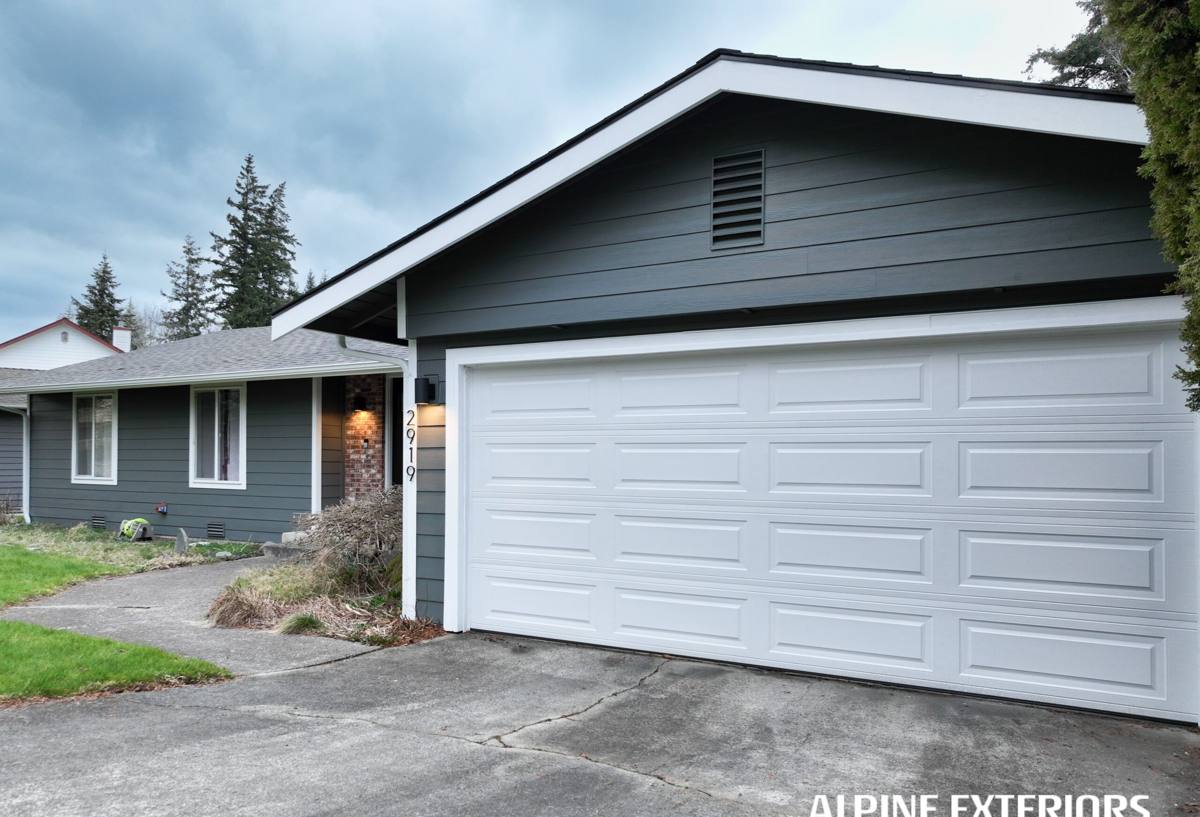
What Siding Damage Actually Looks Like Here
Most of the repair calls we get in this part of Bellingham fall into a handful of categories. Knowing which one you're dealing with matters, because the fix — and the cost — is different for each.
- Moisture staining or soft spots at the bottom edge of siding boards, usually near grade, deck ledgers, or under windows without proper flashing.
- Cracked or split boards from impact damage, freeze-thaw cycling, or old material that was never rated for this climate.
- Failed caulk joints and open seams around trim, corners, and penetrations (hose bibs, vents, light fixtures) that let water track behind the siding.
- Moss and algae buildup on north-facing and shaded walls, which traps moisture even when the siding itself is still sound.
- Warped or bowed panels, common on lower-grade composite and vinyl products that weren't built for sustained wet exposure.
- Rust streaking from corroding nails or trim screws, a slower but steady problem in salt-influenced air.
Some of these are cosmetic annoyances. Others are early warnings of framing damage that costs a lot more to fix if it's ignored for another wet season.
Repair or Replace? How We Make That Call
Not every damaged section needs a full re-side, and we don't push a bigger job than the house needs. But we also won't patch over a problem that's going to reopen in a year. The honest answer usually comes down to how much of the wall is affected and what's happening behind the surface.
| Situation | Usually a Repair | Usually a Replacement |
|---|---|---|
| Damage scope | One or two boards, a single wall section, an isolated impact spot | Damage spread across multiple walls or repeating in the same areas year after year |
| Sheathing condition | Dry, solid sheathing behind the damaged boards | Soft, delaminating, or stained sheathing found once siding is opened up |
| Siding age and material | Newer James Hardie siding with an isolated issue | Original wood, older vinyl, or composite siding nearing the end of its practical life |
| Color match | Factory-finish batch still reasonably matchable, or damage on a less visible elevation | Faded or discontinued color where a patch would visibly stand out |
| Root cause | A single failed flashing or caulk joint that can be corrected | A systemic problem — missing drainage plane, wrong product for the exposure, chronic moss/moisture |
We'll tell you plainly which category your house falls into, including when a repair is genuinely the right call and a full replacement would be overkill.
What a Correct Repair Actually Involves
It Starts Behind the Siding, Not on the Surface
A repair that only addresses what's visible from the sidewalk is a repair that comes back. Before we cut anything, we check what's causing the damage — a flashing gap above a window, a caulk joint that failed at a butt seam, grading that pushes water back toward the foundation wall. If we don't fix the cause, the new siding fails the same way the old siding did.
Matching the Existing Material
If your home already has James Hardie fiber cement siding, a proper repair means removing the damaged boards cleanly, checking the weather-resistive barrier and flashing underneath, and installing new Hardie boards with the correct nailing pattern, joint treatment, and caulking at seams and trim. ColorPlus finished boards are matched as closely as the current product line allows; on visible elevations we'll be upfront if an exact match isn't realistic and talk through the options rather than surprise you with a mismatched patch.
If Your Home Has a Different Product
We only install James Hardie siding. If your current siding is vinyl, LP SmartSide, cedar, or an older fiber cement product, we can still often repair a damaged section in the existing material to get you through, but we'll also tell you honestly when that's a stopgap rather than a fix — particularly on wood-based or vinyl siding where the underlying material is already past the point of holding up well in this climate. For sections we're replacing outright, we use Hardie boards and explain what that changes structurally and cosmetically compared to what's coming off.
Our Process for a Repair Job
- On-site inspection. We look at the damaged area and the surrounding wall, not just the spot you called about — moisture and moss problems rarely stay contained to one board.
- Diagnosis. We identify the actual cause — flashing, caulking, grading, ventilation, or simple age — and explain it in plain terms.
- Written scope and estimate. You get a clear description of what's being repaired, what material is going on, and what it costs, before any work starts.
- Removal and inspection behind the siding. We open the wall enough to confirm the sheathing and barrier are sound before closing it back up.
- Repair and finish. New Hardie material installed to manufacturer spec, properly flashed and caulked, finished to match as closely as possible.
- Walkthrough. We show you what was done and what to watch for going forward.
Why a Crew That Already Works in Birchwood Matters
Repair work rewards local knowledge in a way that new construction doesn't always. A crew that's already worked on homes in this part of Bellingham has a feel for how the microclimate here treats different elevations — which walls hold moss longest, which orientations take the worst of the driving rain, where drainage tends to be a problem given the terrain around Lake Whatcom and the surrounding hills. That's not something you get from a general contractor who only passes through once.
There's also the practical side: knowing the permitting expectations for Whatcom County and the City of Bellingham, understanding typical lot access and setback situations in established neighborhoods, and being able to source matching Hardie product without a long lead time because we're already a regular installer in the area. None of that is glamorous, but it's the difference between a repair that gets done efficiently and one that drags out over unexpected delays.
Why We Only Repair and Replace With James Hardie
We standardized on James Hardie fiber cement for a reason that matters even more on repair work than on new installs: consistency. Hardie's HZ5 product line is engineered for the kind of wet, marine-influenced climate Bellingham sits in, it's non-combustible, and the ColorPlus factory finish holds up to UV and moisture far better than field-applied paint on wood or composite siding. When we patch a Hardie home, we're working with a product system we know inside out — the fastening spec, the joint treatment, the warranty terms — instead of guessing at how a different manufacturer's board will behave once it's opened up.
We don't install vinyl, LP SmartSide, Cemplank, Allura, or primed wood siding, even for repair-only jobs, because we'd rather tell you honestly that a different product is a better long-term investment than sell you a patch job we don't believe in. If your existing siding isn't Hardie, we'll still repair it when that's the responsible short-term move, and we'll give you a straight answer on when replacement with Hardie makes more financial sense than continuing to chase repairs.
Maintenance That Extends the Life of a Repair
A good repair holds up longer with a little routine attention, especially given how long the wet season runs here.
- Rinse moss and algae off shaded, north-facing walls before it builds up thick enough to trap moisture.
- Keep gutters clear so overflow doesn't run down the siding face repeatedly.
- Trim back vegetation and tree limbs that keep a wall damp and shaded for days after it rains.
- Re-caulk trim and penetration points every few years — caulk is a maintenance item, not a permanent fix.
- Walk the exterior once a year, especially after a hard windstorm, and catch small issues before winter rain gets behind them.
If you're noticing staining, soft spots, cracked boards, or heavy moss on your Birchwood home's siding, we're happy to take a look and give you a straight assessment — repair, partial replacement, or full re-side — with no pressure either way. Reach out for a free estimate using the form below.