 Bellingham
 Why Birch Bay Roofs Age Differently Than Roofs Farther Inland
Birch Bay sits right on the water, and that changes what a roof deals with year to year compared to a home a few miles inland around Bellingham. Salt-laden air moves off the bay and settles on every exposed surface, including your roof. Over time it accelerates corrosion on exposed metal fasteners, flashing, and vent caps, and it also changes how quickly algae and moss take hold on shaded, north-facing slopes. Add in driving rain that comes sideways during winter storms off the Strait, and you've got a roof that is fighting wind-driven water intrusion at every lap and seam, not just water falling straight down.
None of this means Birch Bay roofs are doomed to fail early. It means the details matter more here than they do in a drier, more sheltered part of Whatcom County. A repair that would hold up fine on an inland roof can fail within a season or two on a bay-front home if it doesn't account for wind-driven rain and salt exposure. That's the whole reason a roof repair page specific to this neighborhood exists — the fix has to match the conditions.
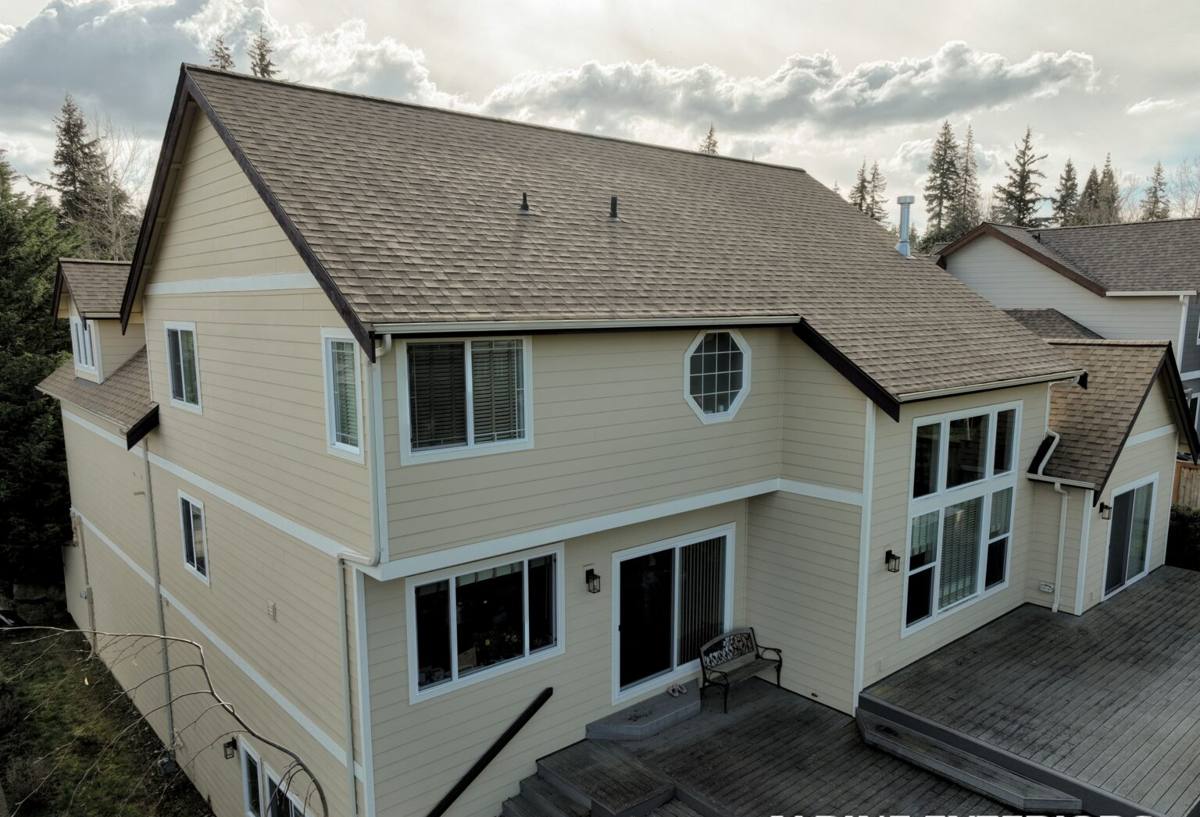
The Three Climate Factors That Drive Repair Needs Here
Salt Air and Corrosion
Salt air doesn't just sit on the surface — it works its way into any unprotected metal, including nail heads, flashing edges, and the fasteners holding down ridge caps and vents. Once corrosion starts on a fastener, it loosens its grip on the shingle or panel below, and that's often the actual point of failure, even though the shingle itself looks fine.
Driving, Wind-Driven Rain
A roof built for straight-down rain and a roof built for horizontal, wind-pushed rain aren't the same roof. Laps, step flashing, and valley details all need extra margin in a spot like Birch Bay, because water gets pushed uphill under shingles during a real coastal storm in a way it never would on a calm day.
A Long Moss Season
Whatcom County's moss season is long to begin with, and Birch Bay's shaded, moisture-holding microclimate near the water can stretch it further on north-facing and tree-covered slopes. Moss isn't just cosmetic — it holds moisture against the shingle surface, lifts shingle edges as it grows, and channels water sideways into laps that were never designed to handle standing moisture.
Signs a Birch Bay Roof Needs Repair Now
Most roof problems here show up gradually, and homeowners often notice a symptom inside the house before they ever look at the roof itself. Here's what tends to show up first in this area specifically:
- Water staining on interior ceilings near exterior walls, which often points to wind-driven rain getting past flashing rather than a simple leak straight through the roof deck
- Streaking or dark patches on north-facing or shaded slopes, usually algae or early moss growth rather than structural damage
- Rust bleed streaks below metal vents, flashing, or fasteners — a sign salt air is starting to corrode exposed metal
- Lifted or curling shingle edges along moss-affected areas, where trapped moisture has started to work the shingle loose
- Granule buildup in gutters after a storm, which speeds up with age and with the abrasive effect of wind-driven rain
- Soft spots or gentle give underfoot near valleys or chimney flashing, which usually means moisture has already reached the deck
What a Correct Repair Actually Involves
A roof repair that's built for this environment isn't just swapping out a few shingles. It's a short list of decisions that determine whether the fix lasts one season or ten years.
Finding the Real Source
Water almost never shows up directly below where it entered the roof. It travels along the underlayment or deck before it drips through, so tracing a leak back to its actual entry point — often a flashing detail, not the shingle field — is the first and most important step. Repairing the visible symptom without finding the source just delays the same call for next winter.
Matching Materials and Fastener Grade
In a salt-air environment, the fasteners and flashing metal used in a repair matter as much as the shingles. Mismatched or lower-grade metal will corrode faster here than it would inland, undermining an otherwise solid repair within a few years.
Rebuilding Flashing and Laps for Wind-Driven Rain
Step flashing, valley metal, and shingle laps need to be reset with enough overlap and sealant detail to resist water being pushed sideways and slightly uphill during a coastal storm — not just water running straight down under gravity.
Clearing and Treating Moss Properly
Moss needs to be removed without tearing up the shingle surface underneath, and the affected area checked for moisture that's already worked its way into the mat. Scraping moss off without addressing what's underneath just hides a problem that will resurface, often worse, the following wet season.
Repair vs. Replacement: How We Help You Decide
Not every roof problem in Birch Bay needs a full replacement, and not every roof problem is a quick, cheap fix either. The honest answer depends on a handful of factors we walk through with you during the estimate.
| Factor | What It Tells Us | Typical Direction |
|---|---|---|
| Age of the roof | Roofs already near the end of their expected lifespan often aren't worth repeated repairs | Leans toward replacement |
| Extent of moisture in the deck | Isolated, localized moisture vs. widespread saturation changes the scope dramatically | Localized: repair. Widespread: replacement |
| Corrosion on fasteners and flashing | Scattered surface corrosion is manageable; extensive corrosion signals broader material fatigue | Depends on extent |
| Moss coverage across the roof | A patch or two is routine maintenance; roof-wide coverage often means moisture has been trapped for years | Depends on extent |
| History of repeat leaks in the same area | Recurring leaks in one spot usually mean an underlying detail was never fixed correctly | Leans toward a more thorough repair or partial re-roof |
| Overall shingle granule loss | Heavy, roof-wide granule loss means the shingles are aging out, not just weathering locally | Leans toward replacement |
We'll always tell you honestly which side of that line your roof falls on. A repair recommendation when replacement is really the better long-term value doesn't save you money — it just delays an expense and adds the cost of the repair on top.
How Our Repair Process Works
- Inspection first. We walk the roof (or use a lift or drone where needed) and trace visible symptoms back to their actual source before recommending anything.
- A clear, written scope. You'll know exactly what's being repaired, why, and what materials are being used — no vague line items.
- Repair work matched to coastal conditions. Flashing, fasteners, and lap details are handled with the salt air and wind-driven rain in mind, not just a standard inland approach.
- Cleanup and a final check. We clear debris and confirm the repair is watertight before we consider the job done.
- Follow-up if something doesn't hold. A repair that doesn't perform in the next storm gets a callback, not a runaround.
What Affects Repair Cost
Repair costs vary a fair amount depending on scope, but as a broad guide, small, localized flashing or shingle repairs on an accessible roof often run in the low hundreds of dollars, while more involved repairs — larger moss remediation, multiple leak sources, or deck repair under a valley — can run into the low thousands. Roof pitch, access, and how much of the deck has been affected by trapped moisture are the biggest swing factors. We'll give you a firm number after inspection, not a phone-quote guess.
Why Local Experience in Birch Bay Matters
A roofing crew that mainly works drier, inland neighborhoods around Whatcom County can still do fine work — but they may not default to the extra margin on flashing laps or the fastener grade that a bay-front roof actually needs. Crews who regularly work Birch Bay and similar shoreline areas around Bellingham get a feel for which slopes hold moss longest, which flashing details tend to fail first in wind-driven storms, and which fastener and metal choices actually hold up against salt air over years, not just through one dry summer.
That local pattern recognition is the difference between a repair that's technically correct on paper and one that's actually built for what this specific stretch of coastline throws at a roof every winter.
Simple Maintenance Steps Between Repairs
A few habits go a long way toward stretching the life of a repair in this climate:
- Have moss treated or removed before it spreads across a full slope, not after
- Keep gutters clear so wind-driven rain has somewhere to go besides under the shingle edge
- Trim back overhanging branches on shaded sides to cut down on the moisture that feeds moss growth
- Have flashing and exposed fasteners checked every couple of years for early corrosion, before it compromises the seal
- Address small leaks as soon as they're noticed — a small, localized repair now is almost always cheaper than deck repair later
If you're noticing staining, moss buildup, or a soft spot on your Birch Bay roof, we're happy to come take an honest look. There's no cost and no pressure for an estimate — just a clear read on what's actually going on and what it would take to fix it right.