 Bellingham
 Why Siding in Puget Takes a Different Kind of Beating
Homes in the Puget area of Bellingham deal with a specific combination of stress that inland Whatcom County properties don't see nearly as often. Proximity to open water means salt-laden air settles on exterior walls year-round, not just during storms. Add Bellingham's long, wet winters and the driving rain that comes sideways off the water during a southwesterly blow, and siding here is under near-constant moisture pressure for months at a stretch. Then there's moss — shaded north and east walls, tree-lined lots, and the extended damp season give it plenty of time to establish itself in seams, behind trim, and along the bottom courses of siding where splash-back keeps things wet longer than the rest of the wall.
None of that means siding is doomed here. It means siding has to be installed and repaired with those specific conditions in mind, not treated the same way you'd treat a wall in a dry inland climate. A repair that looks fine on the surface but doesn't account for salt exposure, wind-driven rain, or moss growth patterns will fail again — usually within a season or two.
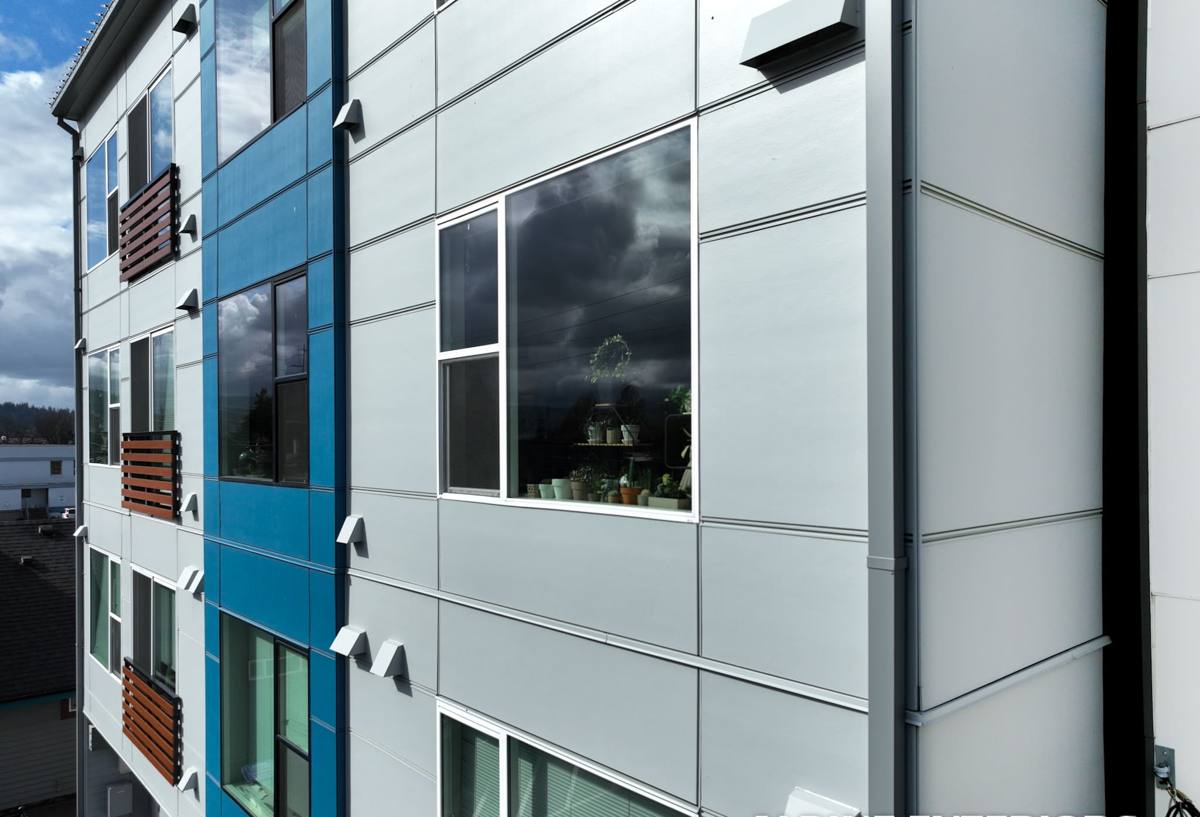
Signs Your Puget Home May Need Siding Repair
Some damage is obvious. Some isn't, and that's the kind that costs homeowners the most because it keeps working behind the wall long after it should have been caught. Here's what we look for and what you can check yourself between inspections:
- Soft or spongy spots when you press on a panel, especially near the bottom courses or around windows and doors
- Paint or ColorPlus finish that's bubbling, peeling, or chalking unevenly in patches rather than across the whole wall
- Visible gaps at seams, corners, or trim where caulking has shrunk, cracked, or pulled away
- Moss or algae staining concentrated on shaded walls or low sections that stay damp longer
- Streaking or discoloration below a window, gutter, or roofline that suggests water is being funneled onto the siding repeatedly
- Warping, buckling, or panels that no longer sit flush against the wall
- A musty smell near an exterior wall inside the house, which often means moisture has already worked past the siding
Any one of these on its own might be minor. Several together, or any sign near a corner or ground-level junction, usually means water has been getting behind the cladding for a while.
What a Correct Repair Actually Involves
A siding repair that's done right is not just pulling a damaged piece off and nailing up a new one. On a Puget-area home, we treat every repair as a chance to check the parts of the wall assembly you can't see once the siding goes back on.
Checking What's Behind the Siding, Not Just the Siding Itself
Once a damaged section is removed, we check the water-resistive barrier and flashing underneath before anything new goes up. Damaged siding is often a symptom, not the root problem — a failed flashing detail, a gap in the house wrap, or trim that was never properly sealed is usually what let water in to begin with. Replacing the visible panel without fixing what's underneath just delays the same failure.
Matching Material and Finish
If the existing siding is James Hardie fiber cement, we match the exact profile and, where possible, the ColorPlus finish so the repair doesn't stand out as an obvious patch. If the home has non-Hardie siding — vinyl, LP SmartSide, cedar, or primed wood — we'll be honest with you about what a like-for-like patch can and can't achieve, and where it makes more sense to upgrade the repaired section (or the whole wall) to fiber cement instead of chasing a matching product that may not perform the same way going forward.
Sealing and Flashing Details Built for This Climate
Every seam, corner, and penetration gets sealed with attention to how wind-driven rain actually hits a Puget-facing wall — not just a bead of caulk run along the surface. Flashing above windows, doors, and any horizontal trim gets checked and corrected if it's not shedding water the way it should.
Common Failure Points We See on Puget-Area Homes
Certain parts of a home take more punishment here than others, and repairs concentrate around a handful of predictable spots:
- Water-facing walls exposed directly to wind-driven rain, where caulking and finish wear fastest
- Bottom courses near grade, where splash-back and standing moisture cause the most persistent rot and moss growth
- Shaded, tree-covered sides where moss and algae get a long head start each year and hold moisture against the wall
- Corners and trim joints, which move slightly with temperature and humidity swings and are the first place sealant fails
- Areas below poorly draining gutters, where repeated overflow soaks the same section of wall over and over
Knowing which of these applies to your home changes how we approach the repair — a bottom-course repair on a shaded wall needs different moisture and moss handling than a mid-wall repair on a water-facing side.
Repair vs. Replacement: What Tips the Scale
Not every damaged section needs a full re-side, and not every repair is worth doing on its own. Here's how we generally think about it:
| Situation | Repair Usually Makes Sense | Replacement Usually Makes Sense |
|---|---|---|
| Damage scope | Isolated to one or two sections or walls | Spread across multiple walls or the whole exterior |
| Underlying moisture barrier | Intact once damaged panels are removed | Compromised across a large area, requiring a full rewrap |
| Siding age and material | Newer, still-serviceable material with isolated defects | Original material is past its practical service life |
| Root cause | A specific, fixable detail (one flashing issue, one impact site) | A systemic issue affecting most of the exterior (widespread rot, chronic moisture intrusion) |
| Cosmetic match | Existing product and finish can still be matched reasonably well | Product is discontinued, faded beyond match, or homeowner wants a different material entirely |
We'll always tell you plainly which category your home falls into rather than defaulting to the more expensive option. A well-executed repair on a sound wall can add years of service life for a fraction of the cost of a full re-side.
How Our Repair Process Works
1. Inspection and Moisture Check
We start by inspecting the damaged area and the surrounding wall, and where warranted, check moisture readings behind the siding to see how far a problem has actually spread before we quote anything.
2. Honest Scope and Straightforward Pricing
You get a clear explanation of what's damaged, what caused it, and what the repair will involve — no inflating a simple patch into a bigger job, and no downplaying a problem that's actually more serious than it looks from the outside.
3. Removal and Underlying Repair
Damaged siding comes off carefully to avoid unnecessary damage to adjacent panels. Any compromised flashing, house wrap, or framing is addressed before new material goes up.
4. Matching Installation
New material is installed to match the existing wall as closely as possible, with fastening, sealing, and flashing done to hold up against Puget's wind-driven rain and salt exposure — not just to look right on installation day.
5. Cleanup and Walkthrough
We walk the finished repair with you, point out what we found and fixed, and let you know if there's anything worth keeping an eye on elsewhere on the house.
Why We Only Repair and Replace With James Hardie
When a repair calls for new material — whether it's a small patch or a section that's better off replaced than matched — we use James Hardie fiber cement, and only James Hardie. It's the one product we've standardized on across every job, and there's a reason for that in a climate like this one.
Fiber cement doesn't rot, and it's non-combustible, which matters for long-term durability on a wall that's going to keep taking on moisture year after year. Hardie's HZ product lines are engineered for specific climate zones, so the material going onto a Puget-area repair is built for the moisture and humidity conditions it will actually face, not a generic all-climate product. The factory-applied ColorPlus finish holds color and resists the fading and chalking that painted wood or vinyl tends to show first, which also makes future repairs easier to match. And because it's backed by a strong transferable warranty, a repair done today doesn't become a liability if you sell the house down the road.
We don't install LP SmartSide, vinyl, Cemplank, Allura, primed spruce, or cedar, and we won't talk you into any of them for a patch just because it's what's already on the wall. If your home has one of those products, we'll be straightforward about what a matching repair can realistically achieve versus where it makes more sense to convert that section — or eventually the whole exterior — to fiber cement instead.
Why a Crew That Already Works Puget Makes a Difference
Siding repair isn't a one-size-fits-all trade. A crew that regularly works Puget and the surrounding Bellingham waterfront-adjacent areas has already seen how salt air, wind direction, and moss patterns play out on homes like yours — which walls fail first, which details tend to get skipped in a lower-quality original install, and which repairs hold up versus which ones need to be revisited a year later. That local pattern recognition is the difference between a repair that solves the actual problem and one that just covers it up until the next wet season.
It also means faster response. Storm damage, a sudden leak, or a section that's been getting worse all winter doesn't wait for a convenient time, and a crew based in the area can get eyes on the problem and start the repair without the delays of scheduling around a long drive.
Keeping a Repair Working Long-Term
A good repair is only half the equation — a little maintenance keeps it (and the rest of your siding) performing the way it should:
- Rinse off accumulated salt spray and grime on water-facing walls periodically, especially after storm season
- Keep gutters clear so overflow doesn't repeatedly soak the same section of wall
- Trim back vegetation that shades siding and keeps it damp longer than it needs to be
- Address small caulking cracks or gaps early, before water gets a chance to work behind the panel
- Have the exterior looked at after major windstorms, since impact damage isn't always obvious from the ground
If you're seeing any of the warning signs above, or just want an honest read on a section of siding that's been bothering you, we're happy to take a look. The estimate is free, there's no pressure to do more than what actually needs doing, and you'll get a straight answer about whether it's a repair or something bigger.