 Bellingham
 Siding Installation in Happy Valley: What This Neighborhood Asks of a Wall
Happy Valley sits close enough to Bellingham Bay that its homes deal with the same coastal pressures as the rest of western Whatcom County, but the neighborhood's mix of mature tree cover, established lots, and a housing stock that spans several decades of construction adds its own wrinkle. Older siding here isn't just aging on schedule — it's aging under salt-tinged marine air, rain that arrives sideways more often than straight down, and a moss season that can run most of the year on shaded walls. When a siding job in this neighborhood gets done right, it holds up against all of that for decades. When it doesn't, the climate finds the shortcut fast, usually within the first two or three wet seasons.
This page is specifically about siding installation for Happy Valley homes — new construction, full re-siding, and additions — not what siding material to pick in the abstract. We install James Hardie fiber cement exclusively, and everything below assumes that system, since it's the only one we install to spec on homes in this part of Bellingham.
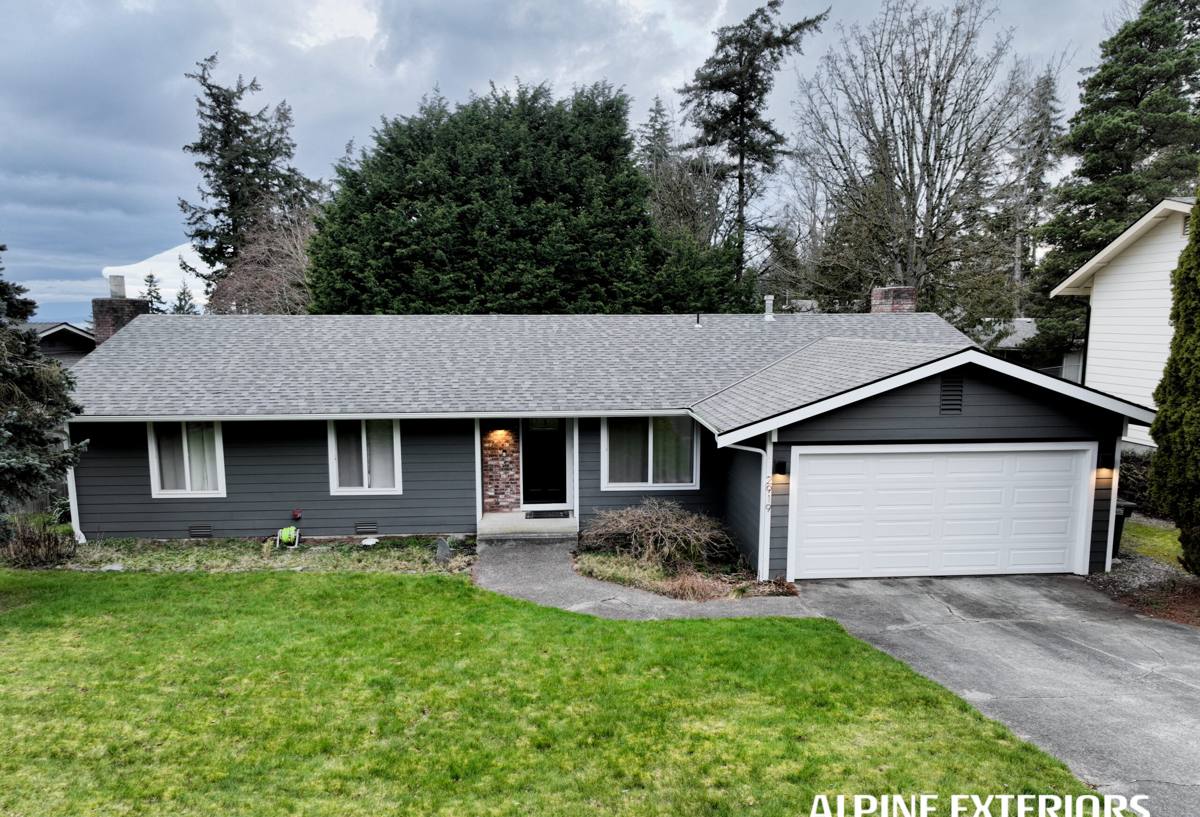
What Bellingham's Climate Demands From an Installation
Salt Air and Fastener Corrosion
Homes in Happy Valley aren't right on the water, but they're close enough to Bellingham Bay that salt-laden air is a background condition most of the year, not an occasional event. That kind of exposure works slowly on exposed metal — fasteners, flashing, trim hardware — and it does it whether a house sits in full sun or under tree cover. An installation that uses standard-grade fasteners because they're cheaper or easier to source shows up years later as rust streaking at nail heads and loosened trim, well before it should.
Wind-Driven Rain at Every Seam
Rain in this part of Whatcom County rarely falls straight down. Wind off the water pushes it sideways, forcing it into lap joints, trim seams, and window flashing from angles a siding system built for a calmer climate was never tested against. The water-resistive barrier underneath the siding — and how carefully it's lapped, taped, and integrated with flashing at every penetration — matters as much as the siding material itself. A correctly detailed barrier sheds wind-driven water before it reaches the sheathing; a rushed one gives it a path straight in.
A Moss Season That Rewards Airflow
Happy Valley's tree cover and hillside terrain mean plenty of walls sit in partial shade for large parts of the day, and shaded, damp surfaces are exactly what moss and mildew need to take hold. Installation detail affects this more than most homeowners expect: proper clearance at grade, a working drainage plane behind the siding, and panels that aren't installed tight against trim all give a wall the chance to dry out between wet spells instead of staying damp continuously.
Why Happy Valley's Housing Stock Adds Its Own Considerations
Because it's an established, tree-lined residential neighborhood rather than a newer subdivision, Happy Valley has a wider range of home ages and original construction quality than you'd find in a single-era development. That matters for a siding installation in a few concrete ways: older homes are more likely to have wall assemblies that predate modern water-resistive barrier and rainscreen practices, mature landscaping means more walls sitting in partial shade with reduced airflow, and additions or remodels over the years sometimes mean a single house has more than one type of wall construction hiding behind its existing siding. None of that is a problem on its own — it's just information a crew needs before the first piece of old siding comes off, not something discovered mid-project.
What a Correct James Hardie Installation Actually Involves
Tear-Off and Wall Assessment
Before any new siding goes up, the old material comes off and the sheathing underneath gets a real look, not a glance. This is where hidden rot, past water intrusion, or an outdated wall assembly gets found and addressed — problems that are far cheaper to fix now than to bury under a new wall and discover again in ten years.
Water-Resistive Barrier and Flashing
A new barrier gets installed and integrated with flashing at every window, door, and penetration, lapped correctly from the bottom up so water is always directed outward and down. This step doesn't show in the finished look of the house, but it's the single biggest factor in whether the wall stays dry behind the siding for the next thirty years.
Fastening and Spacing to Manufacturer Spec
James Hardie publishes exact fastener type, spacing, and placement requirements, and they vary by product line and exposure. Following that spec — not an approximate version of it — is what keeps panels secure through coastal wind and what keeps the manufacturer's warranty valid if an issue ever comes up down the line.
Clearances at Grade, Roof Lines, and Trim
Siding installed tight to a deck, patio, or grade line traps moisture against the bottom edge of the wall, and that's one of the most common causes of premature failure we see when we're called out to look at problems on an existing home. Correct clearance, and a gap that's actually maintained rather than closed up over time, keeps that bottom edge dry.
Caulking and Cut-Edge Sealing
Every cut edge of a fiber cement board needs to be primed and sealed before it goes on the wall, since the factory finish only covers the original surface. Skipping this step is invisible on install day and shows up later as moisture staining right at the cut lines — usually around windows, corners, and trim.
- Old siding and building paper fully removed, not covered over
- Sheathing inspected and any damaged sections replaced before new barrier goes on
- Water-resistive barrier lapped shingle-style and taped at seams and penetrations
- Flashing integrated at every window, door, and roof-to-wall transition
- Corrosion-resistant fasteners placed to Hardie's published spacing spec
- Minimum clearance maintained at grade, decks, patios, and roof lines
- All field-cut edges primed and sealed before installation
- Final walkthrough covering caulking, touch-up, and site cleanup
Why Product Choice Still Matters at the Installation Stage
A siding installation can only perform as well as the material allows, no matter how carefully the crew details the wall behind it. That's part of why we don't install LP SmartSide, vinyl, Cemplank, Allura, primed spruce, or cedar. Those are legitimate products, and other contractors install them competently — but in a climate that combines salt air, sustained wind-driven rain, and a moss season that runs most of the year, we standardized on one system we trust completely rather than offering several with different long-term risk profiles.
| Material | Behavior in Marine, Wet Climate | Ongoing Maintenance | Realistic Lifespan |
|---|---|---|---|
| James Hardie fiber cement | Dimensionally stable; doesn't swell, warp, or rot with sustained moisture | Low; factory finish resists moss and fading | 30+ years with proper installation |
| LP SmartSide (engineered wood) | More sensitive to moisture at cut edges and fastener penetrations | Moderate; edge sealing needs regular upkeep | 15-25 years, climate-dependent |
| Vinyl | Can warp in sun and cold; seams don't always shed wind-driven rain well | Low, but hidden moisture problems are hard to spot | 20-30 years, variable |
| Cedar | Absorbs moisture readily without regular sealing or repainting | High; recurring maintenance cycle required | 15-25 years with consistent upkeep |
James Hardie's fiber cement core doesn't expand and contract with moisture the way wood-based products do, and the factory-applied ColorPlus finish means the cut edges we seal on site are the exception, not something the entire wall depends on. That combination is what holds up best against the specific conditions Happy Valley homes deal with year-round.
How Our Installation Process Works
Estimate and Wall Walkthrough
We start with an on-site look at the whole house, not just a square-footage number over the phone. Orientation, tree cover, existing siding condition, and any visible moisture issues all factor into the plan before we quote anything.
Detailed Scope Before Work Starts
You get a written scope covering tear-off, any sheathing repair contingencies, barrier and flashing details, and the specific Hardie product and finish going on the wall — so there's no ambiguity about what "installation" includes on your project.
Tear-Off, Repair, and Install
Old siding comes off, the wall gets assessed and repaired where needed, and the new system goes on in the sequence outlined above — barrier, flashing, siding, trim, caulking.
Final Walkthrough
We walk the finished job with you before calling it done, covering anything that needs touch-up and making sure the site is cleaned up to the same standard we'd want at our own house.
What Drives Cost on a Happy Valley Siding Project
| Factor | Why It Matters |
|---|---|
| Existing wall condition | Rot or water damage found at tear-off needs repair before new siding goes on |
| Home size and wall complexity | More corners, dormers, and transitions mean more cuts and flashing details |
| Product line and finish | Hardie's HZ10 and HZ5 lines, and different ColorPlus finishes, price differently |
| Access and site conditions | Tree-covered lots, hillside grades, and tight access can add labor time |
| Trim and window detailing | More openings mean more flashing and finish work around each one |
Two houses with the same square footage in Happy Valley can price out very differently once wall condition and access are factored in. We'll walk your specific property and give you real numbers rather than a rough estimate off square footage alone.
Why Hiring a Crew That Already Works This Neighborhood Matters
A siding installation is only as good as the crew's judgment on the parts nobody sees once the wall is closed up — how a barrier gets lapped, how a flashing detail gets built around an odd window, how much clearance actually gets left at grade. Crews who've worked repeatedly in Bellingham and throughout Whatcom County have already made the mistakes that a climate like this one exposes, and they've adjusted their process because of it. That experience is worth more on a wet, wind-exposed site like Happy Valley than it would be somewhere drier and more forgiving, where a shortcut might simply never get tested.
If you're planning a siding installation for a home in Happy Valley, we're happy to walk the property, talk through what your specific walls need given their orientation and tree cover, and give you a straightforward, no-pressure estimate. There's a form below — reach out and we'll set up a time to take a look.