 Bellingham
 Why Ferndale's Climate Is Hard on Ordinary Siding
Ferndale sits close enough to Bellingham Bay and the Strait of Georgia that salt-laden air is a daily fact of life for exterior building materials, not an occasional nuisance. Add Whatcom County's long, wet fall-through-spring stretch — months of low-intensity rain punctuated by wind-driven storms off the water — and you have a climate that tests siding in three ways at once: corrosion resistance, moisture management, and biological growth. Moss and algae don't just grow here, they thrive, especially on the shaded, north-facing walls common on wooded Ferndale lots.
Most siding failures we get called out to inspect in this area aren't dramatic. They're slow: a paint film that chalks and peels early because it wasn't built for constant damp cycling, a seam that never quite dried out between rains and started to swell, or a north wall that stays green no matter how often it's power-washed. None of that is really a materials mystery — it's what happens when a product designed for a drier, milder climate gets installed on a house two miles from saltwater.
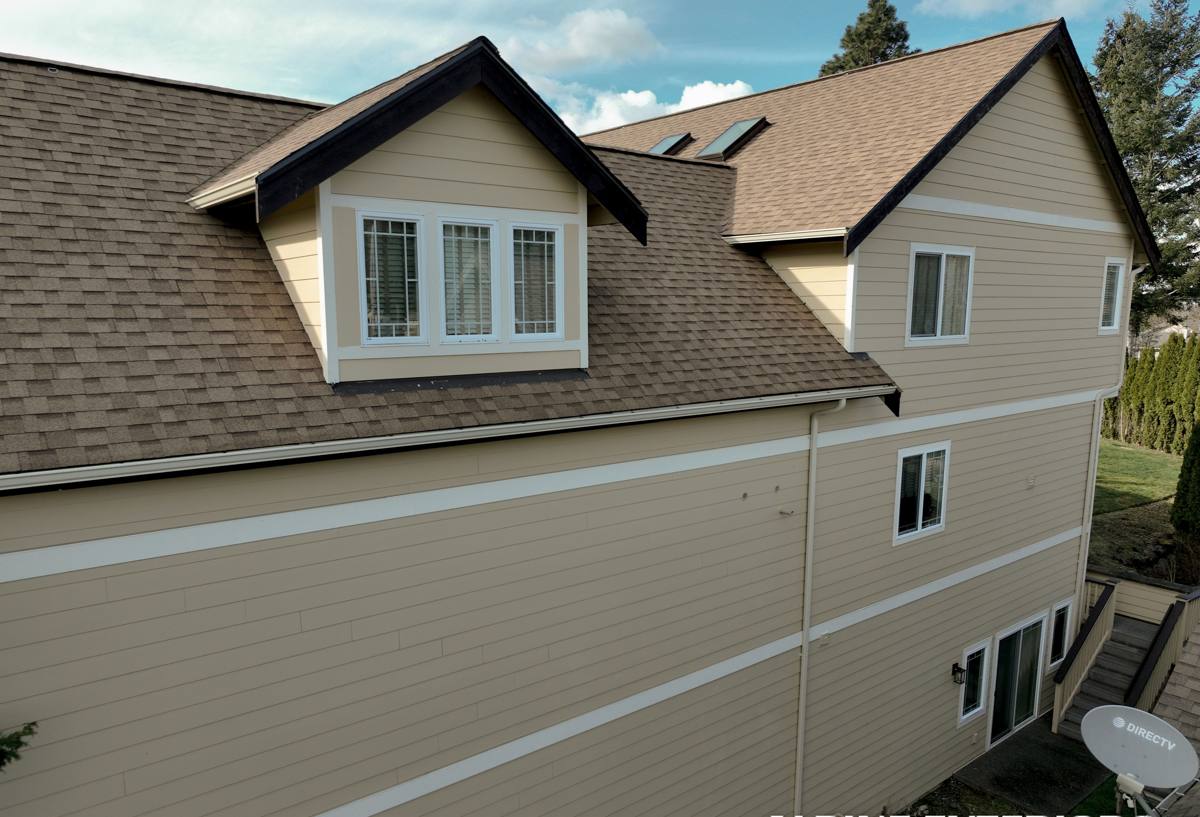
Why We Standardized on James Hardie Fiber Cement
We install James Hardie fiber cement siding exclusively. We don't install vinyl, LP SmartSide, Cemplank, Allura, or wood products like primed spruce or cedar, and that's a deliberate professional standard, not a sales preference. Fiber cement is a blend of cement, sand, and cellulose fiber, which makes it non-combustible and dimensionally stable in ways wood-based and engineered-wood products simply aren't. It doesn't absorb water the way an untreated or edge-exposed wood product can, and it doesn't soften or deform in prolonged damp the way some engineered wood substrates do when a seal is compromised.
That matters more in a marine climate than almost anywhere else in the state. A product that's marginal in Eastern Washington's dry heat can be a genuine liability on a Ferndale lot that sees fog, drizzle, and driving rain for half the year. We'd rather install one product line correctly, everywhere we work, than offer five options and let a homeowner unknowingly pick the one least suited to this specific stretch of coastline.
The HZ5 Engineering Difference
James Hardie doesn't make one universal siding — it engineers products by climate zone. Homes in our region get the HZ5 product line, formulated specifically for wetter, cooler climates like the Pacific Northwest, versus the HZ10 line built for hot, humid Southern climates. The practical difference shows up in moisture resistance and freeze-thaw performance, which is exactly what a Whatcom County winter demands. Installing the wrong regional formulation is a mistake some less specialized crews make without realizing it — we only stock and install HZ5 for this reason.
ColorPlus Finish vs. Field-Applied Paint
Every board we install carries Hardie's ColorPlus factory finish — a baked-on, multi-coat finish applied in a controlled environment, not a paint job done on a ladder in variable Ferndale weather. Field-applied paint on any siding material is only as good as the temperature, humidity, and dry time it gets during application, and those conditions are unreliable here for long stretches of the year. A factory finish cures fully before the boards ever reach the truck, which matters when the alternative is trying to get good paint adhesion on a drizzly October afternoon.
What a Correct Installation Actually Involves
Fiber cement siding is only as good as its installation. Most of the siding problems we're called to diagnose on existing homes trace back to installation shortcuts, not the material itself. A correct install on a Ferndale home includes:
- Weather-resistant barrier installed and lapped correctly behind the siding, not just stapled up as an afterthought
- Proper flashing at every window, door, and roof-to-wall intersection, since these are the leak points a marine climate finds first
- Minimum clearance maintained between the bottom of the siding and grade, decks, patios, and roof lines, so splash-back and standing moisture can't wick into the board
- Correct fastener type, spacing, and placement per Hardie's published installation instructions — not shortcuts that void the warranty
- Factory-cut and factory-primed edges kept intact wherever possible, with field cuts sealed per manufacturer spec
- Caulking limited to where Hardie's instructions actually call for it — over-caulking traps moisture just as reliably as skipping it
Every one of those steps is spelled out in Hardie's installation manual, and the warranty is explicitly tied to following it. A crew that treats the instructions as optional isn't just risking a callback — they're voiding the manufacturer warranty the homeowner is paying for.
Grade, Deck, and Roofline Clearances Matter More Here
Whatcom County's rain isn't usually a downpour — it's persistent, and it finds its way into gaps that would dry out fine in a drier climate. Clearance requirements above decks, patios, and grade exist precisely so that splash and standing water never sit against the bottom edge of the siding. On the wooded, sloped lots common around Ferndale, we also pay close attention to where roof valleys and lower rooflines dump concentrated water directly onto a wall — those spots need flashing and clearance handled with extra care, not standard treatment.
Our Process, Start to Finish
We keep the process straightforward because siding replacement is disruptive enough without added surprises:
- On-site assessment — we walk the exterior, check for hidden moisture or sheathing damage behind existing siding, and note problem areas like north-facing walls, deck clearances, and flashing conditions.
- Written estimate — scope, product line, color, and price laid out clearly, with no vague allowances.
- Prep and removal — old siding comes off, sheathing is inspected and repaired if needed, and the weather-resistant barrier goes on correctly the first time.
- Installation to manufacturer spec — flashing, clearances, fastening, and caulking done per Hardie's instructions, not shortcuts.
- Final walkthrough — we review the finished job with the homeowner before calling it done.
Problems We Commonly Find on Existing Ferndale Homes
When we're called out to inspect siding that's failing early, a handful of patterns show up again and again in this area:
| What We Find | Usual Cause | Why It Matters Here |
|---|---|---|
| Persistent green/black staining on north walls | Poor sun exposure combined with a finish that holds moisture | Moss and algae growth accelerates in shaded, damp conditions typical of wooded Ferndale lots |
| Peeling or chalking paint within a few years | Field-applied paint that never fully cured | Our rain pattern rarely gives paint the dry window it needs |
| Swollen or soft board edges | Missing clearance or unsealed field cuts | Constant damp cycling finds any gap in moisture protection |
| Cracking near fasteners | Incorrect fastener spacing or over-driving | Coastal wind loads stress improperly fastened boards over time |
| Corrosion streaking near trim and fasteners | Non-corrosion-resistant fasteners or trim hardware | Salt air accelerates corrosion on anything not rated for it |
Living With Siding in a Marine Climate: Realistic Maintenance
Correctly installed fiber cement siding is low-maintenance, not no-maintenance. In a climate like ours, a little seasonal attention goes a long way:
- Rinse moss and algae off shaded walls before it builds up a heavy film — a garden hose and soft brush is usually enough; avoid high-pressure washing directly at seams
- Keep gutters clean so overflow doesn't run down the wall face during heavy rain events
- Trim back vegetation and tree cover that keeps a wall section shaded and damp longer than the rest of the house
- Walk the exterior once a year and look at caulk lines around windows and trim for cracking or gaps
- Address any impact damage promptly rather than letting an exposed edge sit through a wet season
None of this is unusual maintenance for a house on the water side of Washington — it's just what keeps any exterior looking good here, and fiber cement handles it better than most alternatives because it isn't absorbing moisture through the field of the board the way wood-based products can.
What Drives Cost on a Ferndale Siding Job
| Factor | Why It Affects Price |
|---|---|
| Home size and wall complexity | More corners, gables, and dormers mean more cutting, flashing, and labor time |
| Condition of existing sheathing | Hidden moisture damage found during tear-off adds repair scope |
| Product line and profile | Lap siding, shingle-style panels, and board-and-batten carry different material and labor costs |
| Trim and accessory scope | Corner boards, window trim, and soffit work add to the total beyond the field siding |
| Access and site conditions | Sloped or wooded lots common around Ferndale can affect staging and scaffolding needs |
We don't publish a flat per-square-foot number because these variables genuinely move the price from one house to the next — it's why we walk every job in person before quoting.
Why Hiring a Crew That Already Works This Area Matters
Whatcom County building conditions aren't uniform, and Ferndale's mix of coastal exposure, tree cover, and older housing stock rewards a crew that's already seen how siding behaves here over time. That means knowing which walls in this area tend to hold moss, which clearance details actually get skipped on older homes, and how to sequence a tear-off around our rain pattern instead of getting caught mid-project by a wet week. A crew that only occasionally works this far north can install a technically correct system on paper and still miss the local details that make it hold up for decades instead of years.
Ready for a Straightforward Look at Your Siding?
If your siding is showing moss staining, peeling paint, soft spots, or you're just planning ahead for a home in a demanding coastal climate, we're happy to take a look. We'll walk the exterior, tell you honestly what we see, and put together a clear, no-pressure estimate for James Hardie fiber cement siding built for Ferndale's weather — no obligation, just a straight answer. Use the form below to get started.