 Bellingham
 Why Birchwood Siding Has to Work Harder
Birchwood sits close enough to Bellingham Bay and the surrounding waterways that homes here take on a specific combination of punishment: salt-laden air moving in off the water, driving rain that hits siding at an angle instead of falling straight down, and a moss season that can stretch from October well into spring. Individually, none of these is unusual for a Whatcom County home. Together, over ten or fifteen years, they expose the difference between siding that was installed correctly and siding that was just installed.
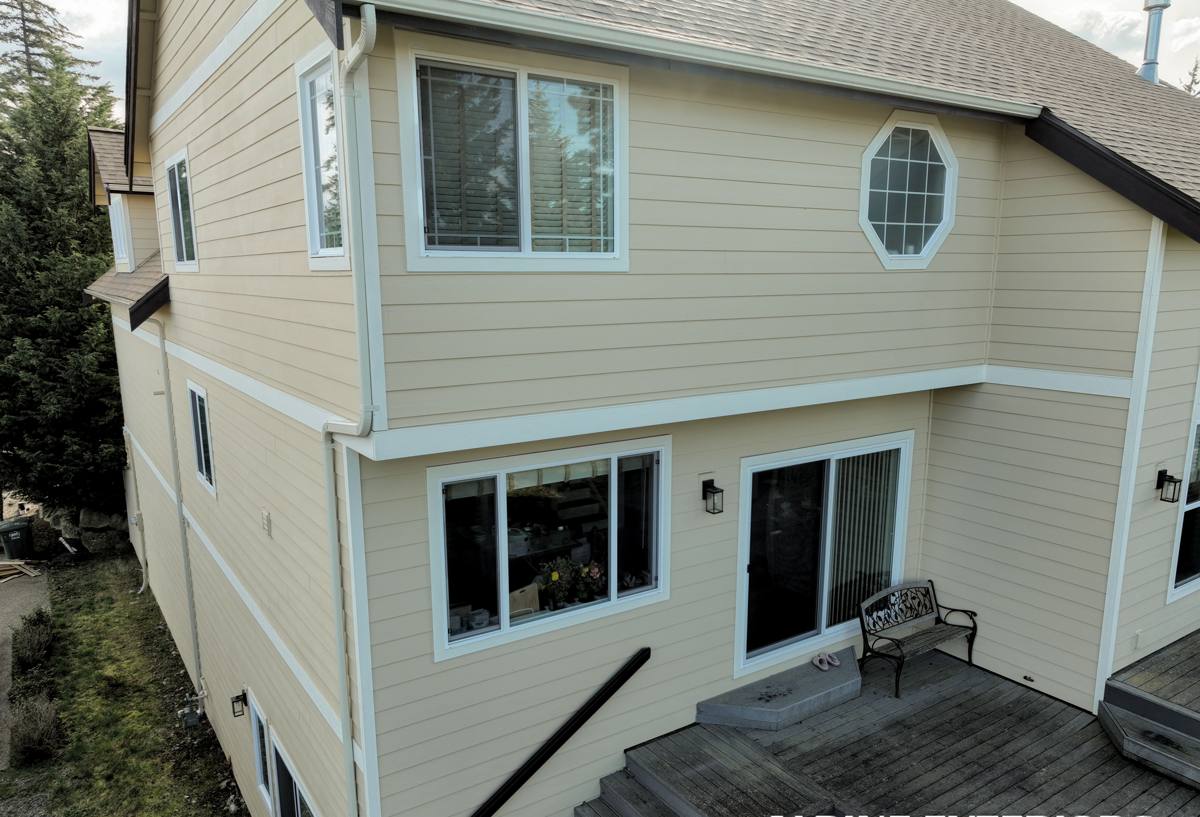
We install fiber cement siding on Birchwood homes because it's the one exterior cladding material we're comfortable putting our name behind in this climate. This page covers what that actually means in practice — not marketing language, but what correct fiber cement siding looks like on a house in this specific part of Bellingham.
What Salt Air, Rain, and Moss Actually Do to a House
Salt Air
Salt air doesn't just affect metal — it accelerates the breakdown of paint films and finishes on wood and composite products, and it can work into fastener heads and trim joints over time. Siding with a factory-applied, baked-on finish holds up to this kind of exposure far better than a product that relies on field-applied paint, because the finish isn't fighting UV, salt, and moisture from day one the way a repaint job is.
Driving Rain
Rain that comes in at an angle finds every gap, every under-caulked seam, and every spot where siding was nailed too tight or lapped too short. Bellingham's weather pattern means siding on this house isn't just shedding water off a vertical surface — it's dealing with wind-driven moisture that gets pushed up under laps and around penetrations. This is a water-management problem as much as a material problem, and it's why installation detail matters as much as the product itself.
Moss Season
Whatcom County's moss season is long, and Birchwood's tree cover and moisture levels give moss plenty of opportunity to establish itself on north-facing walls, under eaves, and anywhere airflow is limited. Moss holds moisture against the siding surface for extended periods. A material that absorbs and swells with that moisture will degrade faster than one that doesn't.
Why We Standardized on James Hardie Fiber Cement
We install James Hardie fiber cement siding exclusively. We don't install vinyl, LP SmartSide, Cemplank, Allura, primed spruce, or cedar. That's not because those products have no merit — it's because after years of doing exterior work in this climate, we settled on the one material system that consistently holds up to what Bellingham weather does to a house, and we'd rather install one product well than spread ourselves across several and get inconsistent results.
Fiber cement is non-combustible, which matters for wildfire-adjacent insurance considerations even in a coastal climate. It's engineered specifically for moisture performance — it doesn't absorb water and swell the way wood-based and some composite products can. And James Hardie's ColorPlus factory finish is baked on and warrantied against fading and peeling, which removes the repaint cycle that salt air and UV would otherwise force on a field-painted product.
Climate-Engineered Product Lines
James Hardie makes region-specific formulations — HZ5 for the general climate zone that includes the Pacific Northwest, and HZ10 for harsher moisture and freeze-thaw regions. The point of climate engineering is that the product's moisture resistance and durability are matched to what a region actually throws at it, rather than using one generic formulation everywhere. For a Birchwood home dealing with salt air and sustained wet seasons, that distinction is part of why we don't treat fiber cement as a one-size-fits-all product.
What a Correct Fiber Cement Installation Involves
The material is only half of the equation. A large share of the siding failures we get called out to inspect in this region trace back to installation shortcuts, not the product itself. Correct installation on a Birchwood home means:
- A properly lapped, continuous weather-resistant barrier behind the siding — this is the drainage plane doing the real work of keeping bulk water out of the wall assembly
- Rainscreen or furring strategy where conditions call for it, so water that does get behind the siding has somewhere to drain and dry rather than sitting against the sheathing
- Correct fastener type, spacing, and penetration depth — Hardie is specific about this, and over- or under-driven nails are one of the most common causes of premature cracking
- Proper flashing at every window, door, and penetration, integrated with the weather barrier rather than just caulked over it
- Correct minimum clearances from grade, roof lines, decks, and other siding terminations, so the bottom edge of the siding isn't sitting in standing water or splash-back
- Factory-cut and factory-primed edges kept intact wherever possible, with field cuts properly sealed per manufacturer specification
- Caulking and sealant only at the joints Hardie's installation guide actually calls for — over-caulking can trap moisture instead of shedding it
Every one of these steps addresses a specific way water gets into a wall assembly. Skip one and the siding can still look fine for a few years while a problem develops behind it.
How We Approach a Birchwood Siding Job
We start with an on-site assessment of the existing siding and the wall assembly underneath it, not just a measurement for a quote. That includes checking for existing moisture damage, evaluating what's driving any moss or algae growth on the current siding, and looking at drainage around the foundation and grading near the house.
From there, we plan the tear-off and prep so the weather barrier and flashing details go in correctly the first time — this is the stage that determines how the siding performs in year eight, not just how it looks in week one. Installation follows James Hardie's published specifications for fastening, clearances, and joint treatment. We finish with a walk-through so you understand what was done, why, and what basic upkeep looks like going forward.
Because we work in Bellingham and the surrounding neighborhoods regularly, we're familiar with how local conditions — tree cover, prevailing wind and rain direction, and proximity to the water — vary block to block, and that shapes decisions like where extra flashing attention or airflow consideration is worth it.
Comparing Siding Options for This Climate
| Material | Moisture Behavior | Moss/Algae Resistance | Finish Durability in Salt Air | Long-Term Maintenance |
|---|---|---|---|---|
| James Hardie Fiber Cement | Does not absorb and swell; engineered drainage detailing | Dense surface resists moss anchoring better than porous materials | Factory ColorPlus finish holds color, resists peeling | Occasional wash; no repainting cycle with ColorPlus |
| Vinyl | Can warp or buckle with heat and impact; seams are moisture-prone points | Can trap moisture behind panels where moss and mildew take hold | Can fade and become brittle with prolonged UV and salt exposure | Low upkeep but limited repair options if damaged |
| LP SmartSide / Engineered Wood | Wood-based core is more moisture-sensitive if edges or cuts aren't sealed properly | Susceptible if moisture gets in and sits | Field or factory finish still needs monitoring over time | Requires consistent edge and seam maintenance |
| Cedar | Natural material, absorbs and releases moisture with seasons | Prone to moss and mildew without regular treatment | Needs refinishing on a recurring cycle | Highest ongoing maintenance of the group |
Living With Fiber Cement Siding in a Moss-Prone Climate
No siding material makes moss impossible — moss grows on roofs, decks, and pavement too, wherever moisture and shade cooperate. What fiber cement does is reduce how much moss can actually attach to and degrade the material itself, and it holds up to the occasional soft wash that keeps growth in check without the surface degrading the way some materials do under repeated cleaning. Keeping gutters clear, trimming back vegetation that shades the wall, and rinsing north-facing sections periodically go a long way regardless of material — fiber cement just gives you more margin for error while you keep up with that basic upkeep.
Why Local Installation Experience Matters
Fiber cement siding is a forgiving material when installed to spec and an unforgiving one when it isn't — cracking, moisture intrusion, and premature finish failure almost always trace back to installation details rather than the product itself. A crew that's installed Hardie siding on homes throughout Bellingham and Whatcom County already knows how local wind-driven rain patterns, moss exposure, and salt air factor into flashing and drainage decisions, instead of learning that on your house. That experience is part of what you're paying for as much as the material itself.
If you're weighing a siding replacement for a Birchwood home, we're happy to take a look, walk you through what we're seeing, and put together a straightforward, no-pressure estimate — no obligation, just an honest read on your home's exterior.