 Bellingham
 Siding Installation Built for Sudden Valley's Climate
Sudden Valley sits on the south shore of Lake Whatcom, tucked into heavy second-growth forest with its own private road network. That setting is beautiful, but it's a demanding one for exterior siding. Between the humidity coming off the lake, driving rain that gets funneled by the surrounding hills, salt-tinged air that reaches inland from the Whatcom County coast, and tree canopy that keeps entire wall faces shaded and damp for days after a storm, siding here works harder than siding on a typical open lot. We install siding throughout Sudden Valley and the wider Bellingham area, and this page covers what a correct siding installation actually involves in this specific setting — not a generic rundown of siding in general.
We install James Hardie fiber cement siding exclusively. That's a professional standard we hold to because of what we've seen, repeatedly, on tear-offs and service calls in exactly this kind of moisture-heavy, shaded environment.
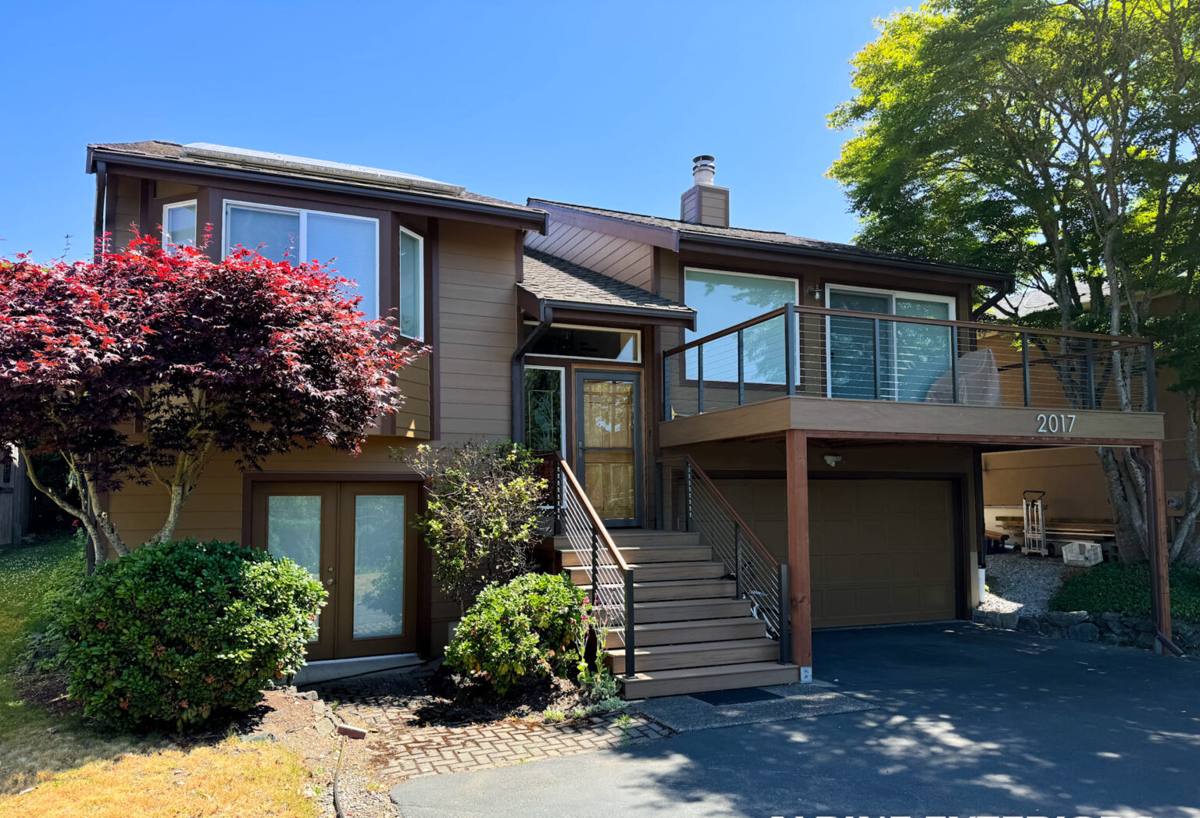
What Sudden Valley's Climate Demands From Siding
Moisture That Doesn't Dry Out Quickly
Many Sudden Valley lots have at least one elevation that gets very little direct sun because of surrounding trees. Siding on those walls stays wet longer after every rain than siding on a sunnier, more open property. Materials that rely on regular sun exposure to dry out between storms don't get that chance here, and over years that difference shows up as swelling, delamination, or finish failure on materials that aren't built to handle sustained dampness.
Driving Rain and Wind Off the Lake
Lake Whatcom's terrain funnels wind and rain unevenly across a property — a wall that stays relatively dry in most storms can take a direct hit in others, depending on orientation and elevation relative to the lake and the ridgelines around it. That variability means water management details — flashing, drainage planes, weep paths — have to be engineered per elevation rather than applied uniformly across the house.
Salt Air and a Long Moss Season
Whatcom County's proximity to Puget Sound means siding and trim across the region deal with some level of salt-laden air, which accelerates corrosion on fasteners and hardware that isn't rated for it. Combine that with Sudden Valley's shade and humidity, and you get a moss and mildew season that runs long — often most of the year on the shadiest walls. Porous or moisture-retentive siding materials pick up organic growth faster in these conditions, and that growth traps even more moisture against the wall behind it.
Why We Install Only James Hardie Fiber Cement
We used to offer a broader range of siding products. We narrowed that down to one system after seeing which materials actually held up on shaded, moisture-heavy properties like the ones throughout Sudden Valley, and which ones didn't.
- Non-combustible core — fiber cement doesn't feed a fire the way wood-based products can, which matters given Washington's wildfire seasons and the wooded setting of Sudden Valley itself.
- Moisture stability — Hardie's fiber cement doesn't swell, rot, or delaminate the way engineered wood or primed wood products can when they stay damp for extended periods.
- Factory-applied ColorPlus finish — baked on under controlled conditions rather than field-painted, so it resists fading, peeling, and moisture intrusion at the finish layer far better than a job-site paint job.
- Climate-engineered HZ formulations — Hardie makes region-specific product lines built for different climate stresses; the Pacific Northwest formulation is engineered for sustained moisture and freeze-thaw cycling rather than heat and dryness.
- A warranty we can actually stand behind — Hardie's transferable product warranty gives homeowners real recourse, and installing one product system means we take full responsibility for the outcome instead of splitting blame across multiple manufacturers.
We're not going to claim other siding materials are worthless — vinyl, LP SmartSide, and cedar all have legitimate uses in the right conditions. But on a shaded, damp, lakeside property like the ones throughout Sudden Valley, we've found the maintenance burden and moisture risk of those alternatives outweighs their lower upfront cost, and we'd rather install one product correctly than offer several and let the climate sort out which ones fail first.
What a Correct Siding Installation Actually Involves
Tear-Off and Substrate Inspection
Every installation starts with removing the existing siding down to the sheathing and inspecting what's underneath. In a wet, shaded community like Sudden Valley, it's common to find some degree of hidden moisture damage — soft sheathing, compromised framing, or trapped moisture behind old siding that never had a chance to dry. That has to be addressed before anything new goes on the wall, or the new siding is just covering up a problem that will keep getting worse.
Weather-Resistive Barrier and Drainage Plane
A correctly installed weather-resistive barrier, lapped properly from bottom to top and sealed at every penetration, is what actually keeps water out of the wall assembly — the siding itself is the first line of defense, not the last. On a property with uneven wind-driven rain exposure like a Sudden Valley lot, we pay particular attention to the walls that take the most direct hit, making sure the drainage plane behind the siding gives any moisture that gets past the surface a clear path back out.
Flashing at Every Penetration
Windows, doors, vents, hose bibs, light fixtures, deck ledgers — every point where something interrupts the siding is a place water can get behind it if the flashing isn't done correctly. This is the detail that separates a siding job that lasts a couple of decades from one that starts showing rot around openings within a few years, and it's exactly the kind of detail that gets rushed on a fast, low-bid installation.
Fastening Specific to Hardie's Requirements
James Hardie siding has specific fastening requirements — fastener type, spacing, and placement all affect how the material performs and whether the manufacturer's warranty stays valid. In a humid, shaded environment, corrosion-resistant fasteners matter even more than they would on a drier property, since the hardware stays exposed to moisture for longer stretches of the year.
Caulking and Sealant Details
Joints, trim intersections, and butt seams need the right sealant applied correctly — not as a cosmetic finishing step, but as part of the water management system. On a property that gets driving rain from variable directions, sealant failure at a single joint can let water track a long way behind the siding before it ever shows up as a visible problem.
Siding Options: What We Install vs. What We Don't
| Material | How It Performs in Sudden Valley's Climate | Do We Install It |
|---|---|---|
| James Hardie fiber cement | Engineered for sustained moisture and freeze-thaw; non-combustible; factory-finished for long-term color and moisture resistance | Yes — our only siding product |
| Vinyl siding | Won't rot, but can warp under heat and doesn't manage moisture behind the wall the way a rigid, factory-finished product does | No |
| LP SmartSide (engineered wood) | Wood-based core is more moisture-sensitive than fiber cement, a real concern on shaded, damp walls that don't dry out quickly | No |
| Cedar siding | Attractive natural material, but needs regular refinishing and is more prone to moisture and moss issues in prolonged shade | No |
| Primed spruce / other primed wood | Field-applied primer is less durable than a factory finish and more vulnerable to moisture intrusion at cut edges and joints | No |
Cost Factors for a Sudden Valley Siding Installation
Every home is different, but a few things consistently move the price on Sudden Valley projects specifically:
- Substrate condition — hidden moisture damage found during tear-off adds repair scope that's hard to price sight-unseen.
- Wall complexity — homes with a lot of dormers, angles, or multiple elevations take longer to flash and fit correctly than a simple rectangular footprint.
- Access — Sudden Valley's terrain and private road network can affect staging, material delivery, and scaffolding setup compared to a flat, easily accessed in-town lot.
- Siding profile and trim package — lap width, trim detailing, and accent choices all affect material and labor cost.
- Shaded-wall detailing — walls that stay damp longer sometimes warrant extra drainage detailing, which adds a modest amount of labor for a meaningful gain in long-term performance.
We give a written, itemized estimate after walking the property, so homeowners know exactly what's driving the number rather than getting a vague lump-sum figure.
Our Installation Process
We start with an on-site assessment that looks specifically at how shade, tree cover, and prevailing wind direction have affected the existing siding on each elevation — that variation matters more in Sudden Valley than it does on a typical open lot. From there we put together a clear written scope covering tear-off, substrate repair if needed, the weather-resistive barrier, flashing details, the Hardie product and color selected, and a realistic timeline. We treat correct flashing and drainage detailing as standard on every job, not as an upgrade — on a property in this climate, that detail work is what determines whether the siding holds up.
Because Sudden Valley is a private community with its own HOA and road network, we also coordinate access and scheduling with that in mind before work begins, so the project doesn't run into avoidable delays once it's underway.
Before You Hire — A Quick Checklist
- Ask what siding material they install and why, and get the warranty terms in writing
- Confirm current Washington contractor licensing and active liability insurance
- Ask how they handle tear-off and what happens if hidden moisture damage is found underneath the old siding
- Ask specifically how they detail flashing and drainage on shaded, moisture-exposed walls
- Get a written, itemized scope of work before signing anything — not a verbal estimate
Why Local Experience in Sudden Valley Matters
A siding crew that's worked this specific community already understands things that don't come up on a generic estimate: which elevations typically need extra drainage attention because of tree cover, how the terrain changes wind-driven rain exposure from one part of a lot to another, and how to work around HOA and private-road logistics without losing time. That familiarity shows up in the finished product — correct flashing on the walls that actually need it, fastener choices suited to a damp, wooded microclimate, and a realistic sense of what the substrate is likely to look like once the old siding comes off.
If you're weighing siding options for a Sudden Valley home, we're happy to walk the property with you and give an honest, specific read on what it needs. Reach out below for a free, no-pressure estimate.