 Bellingham
 Lynden's Climate Is Harder on Siding Than Most Homeowners Realize
Lynden sits inland from Bellingham Bay in the Nooksack River valley, but "inland" in Whatcom County still means wet. The same marine-influenced weather system that soaks the rest of the county settles over Lynden for months at a time: low gray skies, fine driving rain that blows sideways more often than it falls straight down, and long stretches where siding simply doesn't get a chance to dry out between storms. Add the moisture that collects along tree lines and low-lying farmland near the river, and you get a textbook environment for moss, algae, and slow water intrusion behind poorly installed siding.
None of this is unique to Lynden, but it's worth saying plainly: siding here isn't just cosmetic. It's the primary barrier standing between your home's framing and a climate that stays damp from October through May. A siding system that looks fine from the curb can still be failing behind the surface if it wasn't installed with this climate in mind.
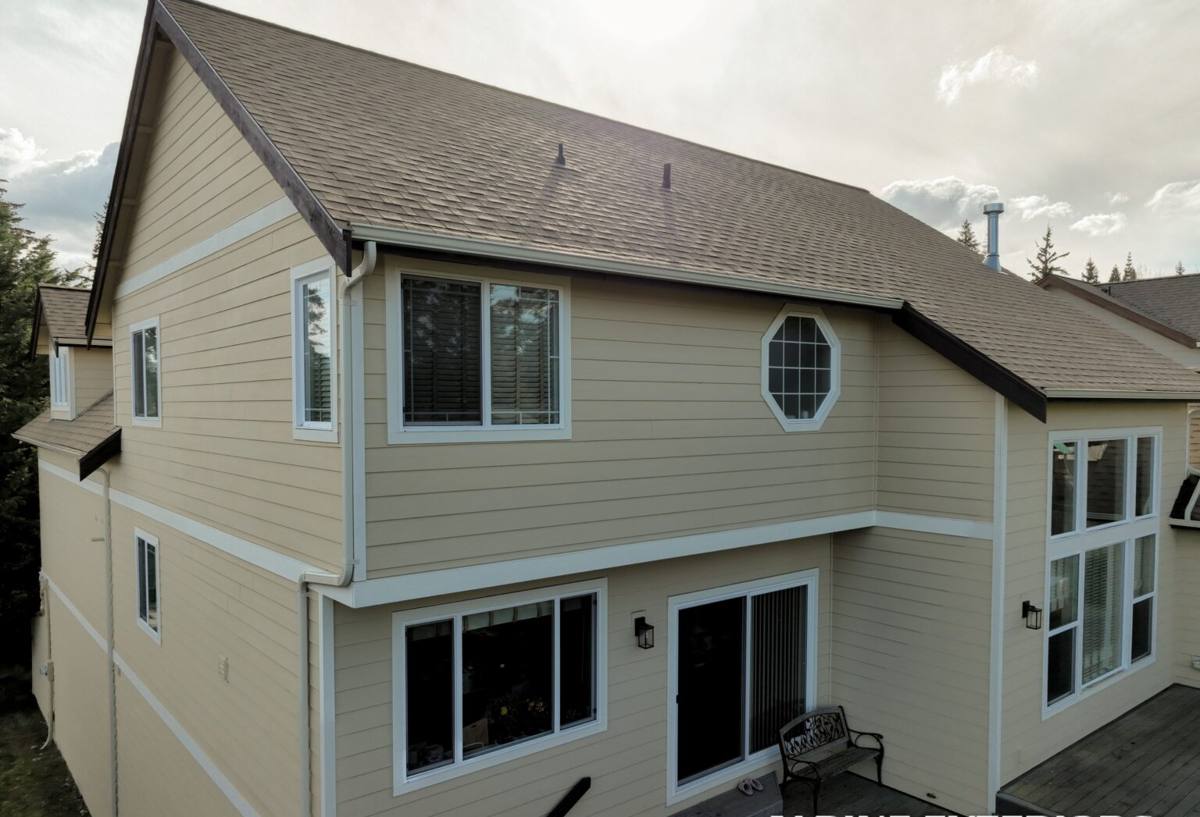
Signs a Lynden Home's Siding Needs Replacing, Not Patching
Homeowners often ask whether a repair will do. Sometimes it will. But there are signs that point to a full replacement rather than a patch job:
- Soft or spongy spots when you press on the siding, especially near the bottom courses and around window trim
- Persistent moss or algae staining that comes back within a season or two of cleaning
- Visible cupping, warping, or delamination, common on older wood-based or engineered wood siding
- Paint that won't hold — bubbling, peeling, or needing a fresh coat every two to three years
- Gaps opening up at seams, corners, or trim where caulking has failed repeatedly
- A musty smell in an interior wall, which often means moisture has already gotten past the siding
If you're seeing one or two of these in isolated spots, a repair might buy time. If they're showing up in multiple places, the siding system as a whole is likely past the point where patching makes financial sense.
What a Correct Siding Replacement Actually Involves
Siding replacement is not just pulling off old material and nailing up new panels. Done correctly, it's a water-management project first and a cosmetic upgrade second. On a Lynden home, that means:
Tearing Off to Bare Sheathing
We remove the old siding down to the wall sheathing so we can actually see what's underneath — rot, mold, damaged framing, or old flashing that was never installed correctly in the first place. This is where problems that have been hidden for years usually surface.
Repairing What's Underneath
Any soft sheathing, compromised framing, or old insulation that's absorbed moisture gets addressed before anything new goes up. Covering damaged sheathing with new siding just hides the problem for another decade.
Installing a Proper Water-Resistive Barrier
A weather-resistant barrier goes over the sheathing, correctly lapped so water sheds downward and outward rather than working its way behind the wall. In a climate that gets sustained wind-driven rain, this layer matters as much as the siding itself.
Flashing Every Penetration
Windows, doors, hose bibs, vents, and any other wall penetration get flashed so water is directed out and away from the framing. This is the single most common place we find corners cut on older installations, and it's usually the reason a home develops rot around windows years before the siding itself fails.
Installing Siding to Manufacturer Spec
Correct fastener spacing, correct clearance from grade and roof lines, correct gapping at butt joints, and correct caulking at trim — all of it matters. James Hardie siding is engineered to perform when it's installed to the manufacturer's published specifications, not "close enough."
Why We Only Install James Hardie Fiber Cement
We get asked regularly why we don't offer vinyl, LP SmartSide, or cedar as options. The honest answer is that we made a standard for our own crews and stuck with it, because the trade-offs of the alternatives are real and they show up over time, especially in a climate like Whatcom County's.
Vinyl siding is inexpensive and low-maintenance in the sense that it doesn't need painting, but it's a thin plastic product that can crack in freeze events, warp under sustained heat reflection, and it doesn't offer the fire resistance or impact resistance of fiber cement. It also can't be painted a custom color without voiding warranty terms on most product lines.
LP SmartSide and other engineered wood products perform well when installation and maintenance stay perfect, but they're wood-based, which means they're more sensitive to sustained moisture exposure than fiber cement. In a climate where siding can stay damp for days at a stretch, that sensitivity is a real long-term maintenance burden, not a theoretical one.
Cedar is a beautiful, legitimate product with a long history in the Pacific Northwest, but it requires disciplined, ongoing maintenance — staining or sealing on a schedule — to keep moisture from working into the wood. Skip a maintenance cycle or two in a wet stretch and you're playing catch-up.
James Hardie fiber cement is non-combustible, engineered specifically for climate zones like ours through its HZ product lines, holds a factory-applied ColorPlus finish that resists fading and chipping far longer than field-applied paint, and carries a strong transferable warranty backed by decades of real-world performance data. It costs more up front than vinyl. It earns that back in reduced maintenance, better moisture performance, and a longer service life when installed correctly — which is the part we control.
Comparing Siding Options for a Lynden Home
| Factor | James Hardie Fiber Cement | Vinyl | LP SmartSide | Cedar |
|---|---|---|---|---|
| Moisture resistance | Excellent — non-wood, engineered composition | Good, but seams can allow water behind panels | Fair — wood-based, sensitive to sustained damp | Fair — requires maintenance to hold up |
| Maintenance burden | Low — factory finish, occasional wash | Low, but limited repair/color options | Moderate — paint upkeep needed | High — staining/sealing on a schedule |
| Fire resistance | Non-combustible | Combustible, can melt/warp | Combustible | Combustible |
| Typical lifespan (installed to spec) | 30+ years | 20-30 years | 20-30 years | 20-30 years with upkeep |
| Upfront cost | Higher | Lowest | Moderate | Moderate to high |
Our Siding Replacement Process
Every job follows the same general path, adjusted for the specific home:
- On-site assessment — we walk the exterior, check for hidden moisture and framing issues, and talk through what we're seeing before quoting anything
- Written estimate with a clear scope — what's being torn off, what's being repaired, what's going on, and what's excluded
- Tear-off to bare sheathing and inspection of what's underneath
- Sheathing and framing repairs where needed, documented and discussed with the homeowner before covering it back up
- Water-resistive barrier and flashing installed at every penetration
- James Hardie siding installed to manufacturer specification, including fastener pattern, clearances, and trim detailing
- Final walkthrough with the homeowner before we consider the job done
We don't cover up problems to keep a job moving faster. If we find rot or framing damage during tear-off, we stop and talk to the homeowner before proceeding, because that's the point in the project where it's actually fixable.
Why It Matters That This Is a Bellingham Crew That Works Lynden Regularly
Siding installation isn't exotic work, but doing it correctly in a climate that stays wet for most of the year takes attention to detail that a crew unfamiliar with the region can miss. A contractor who mostly works drier inland climates may not flash a window the same way, may not think twice about a gap that will trap moisture through a long Whatcom County winter, or may not budget enough time for proper drying and sequencing around our weather windows.
A local crew that works Lynden and the surrounding Whatcom County area regularly builds a working knowledge of how these homes age, where moisture problems tend to originate, and what correct installation actually looks like once it's been tested by a few wet seasons. That's not something you can shortcut with a generic install checklist.
What to Ask Before Hiring a Siding Contractor
Whoever you hire for a siding replacement in Lynden, a few questions will tell you a lot about whether they'll do the job right:
- Do you tear off to bare sheathing, or do you install over existing siding?
- How do you flash windows, doors, and other wall penetrations?
- What water-resistive barrier do you use, and how is it lapped?
- Are you a licensed, bonded, and insured contractor in Washington State?
- Will you show me any rot or damage you find before you cover it back up?
- What warranty covers the material, and what warranty covers your labor?
- Can you walk me through why you recommend a specific siding product for my home?
A contractor who can answer these clearly and without hesitation is generally one who does this work carefully and often.
Get a Straight Answer for Your Home
If your Lynden home's siding is showing its age — moss that keeps coming back, soft spots, paint that won't hold, or gaps that keep opening up — it's worth having someone look at it before those problems reach the framing. We'll walk the exterior, tell you honestly what we see, and give you a straightforward estimate with no pressure to commit on the spot. Reach out using the form below to schedule a free assessment.