 Bellingham
 Siding Built for Lynden's Weather, Not Just Its Look
Lynden sits far enough inland from Bellingham Bay that people sometimes assume their homes get a break from the coastal weather that batters houses closer to the water. In practice, the difference is smaller than most homeowners expect. Whatcom County's marine air still carries salt and moisture well past the shoreline, the region's driving rain still hits siding at an angle during winter storms, and the long gray stretch from fall through spring still gives moss and algae months of damp shade to take hold. A siding job in Lynden has to hold up to the same combination of moisture cycling, wind-driven rain, and slow biological growth that the rest of Whatcom County deals with — it just shows up a little differently on a farmhouse or a newer subdivision build than it does on a bluff-top home in Bellingham.
That's the lens we use on every Lynden siding project: not "what looks good going up," but "what's still going to look good and perform in fifteen years after a decade and a half of wet Pacific Northwest winters." That's also the reason this company installs only James Hardie fiber cement siding — no vinyl, no LP SmartSide, no cedar, no primed spruce. We'll get into why below, but the short version is that fiber cement is the only siding material we're willing to put our name behind in this climate.
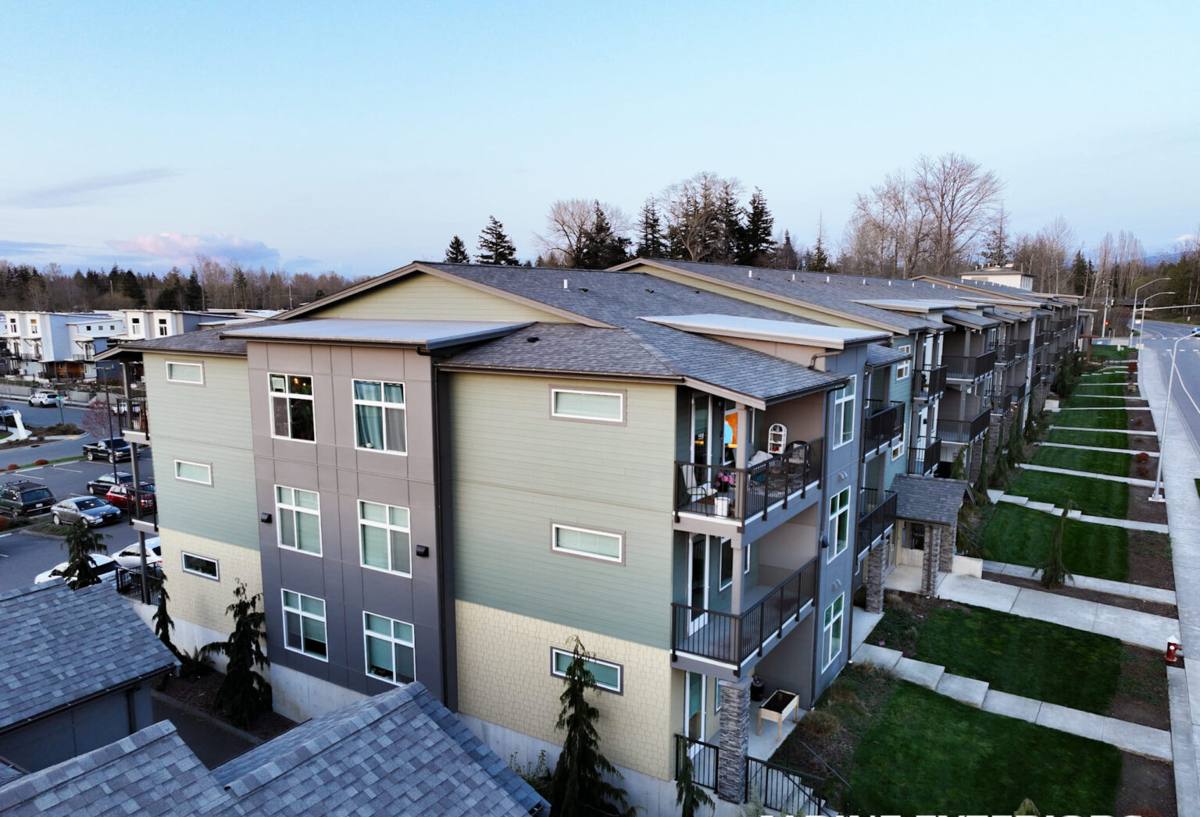
What Lynden Homes Actually Need From Their Siding
Moisture Management Over Looks
The single biggest driver of siding failure in this region isn't UV damage or impact — it's moisture that gets behind the cladding and has nowhere to go. Whatcom County's rain doesn't just fall straight down; wind off the Strait and the Fraser Valley pushes it sideways into wall assemblies, especially on exposed gable ends and second-story walls with no roof overhang to shield them. Good siding installation is as much about the water-resistive barrier, flashing, and drainage plane behind the siding as it is about the panels themselves.
Standing Up to Moss and Algae Season
Lynden's tree cover, agricultural humidity, and long damp season create ideal conditions for moss and algae to colonize siding — particularly on north-facing walls and anywhere shaded by mature trees or neighboring structures. Some materials absorb moisture into their surface and give moss a foothold; others shed water and stay inhospitable to growth. This matters more here than in drier parts of the state, because Lynden's moss season isn't a few weeks — it's most of the year.
Salt Air, Even Inland
Salt-laden air moves with weather systems, not just proximity to open water. Metal fasteners, trim, and unprotected wood fibers can corrode or degrade faster than homeowners expect this far from the coast. Siding and fastening systems rated for coastal exposure are cheap insurance, even on a Lynden lot that feels landlocked.
Why We Only Install James Hardie Fiber Cement
We get asked regularly why we don't offer vinyl or engineered wood siding as a lower-cost option. It's a fair question, and the honest answer is that we've made a deliberate choice to stand behind one material system rather than sell whatever a homeowner's budget points them toward.
| Material | Where it's genuinely fine | Why we don't install it here |
|---|---|---|
| Vinyl siding | Dry, low-humidity climates; budget-driven projects | Can warp or buckle with temperature swings, and seams are a moisture entry point in driving rain |
| LP SmartSide (engineered wood) | Drier regions with lower moisture exposure | Wood-based core is more sensitive to sustained moisture and needs disciplined caulking/paint maintenance to keep water out |
| Cedar / primed spruce | Homeowners who specifically want a natural wood look and will commit to upkeep | Combustible, needs ongoing refinishing, and is more vulnerable to moss, rot, and insect damage in wet climates |
| James Hardie fiber cement | Marine and high-moisture climates like Whatcom County | This is what we install — non-combustible, dimensionally stable, and engineered for exactly this weather |
James Hardie's fiber cement is cement, sand, and cellulose fibers formed under pressure — it doesn't absorb water the way wood-based products do, it doesn't expand and contract with temperature the way vinyl does, and it's non-combustible, which matters more every wildfire season. Hardie also engineers regional product lines (HZ5 for our climate zone) specifically for cold, wet, high-moisture regions, and backs the ColorPlus factory finish with a real, transferable warranty. When it's installed correctly, it's simply the most durable option for a house that has to survive Lynden winters year after year.
What Correct Installation Actually Involves
Fiber cement siding is only as good as the installation behind it. James Hardie's own installation instructions are specific for a reason — get the details wrong and you can undercut the material's durability no matter how good the product is. On every Lynden job, that means:
- A properly lapped water-resistive barrier and correctly flashed windows, doors, and penetrations, so water is directed out rather than trapped behind the siding
- Correct fastener placement, type, and spacing per Hardie's published specs for our exposure zone
- Proper clearance between the siding's bottom edge and the ground, roofline, decks, and patios to avoid wicking moisture
- Correct joint and butt-seam treatment, caulked and sealed to Hardie's specifications rather than left to trap water
- Adequate rainscreen or drainage gap where the wall assembly calls for it, so any incidental moisture can drain and dry
- Manufacturer-matched trim, corner boards, and accessories rather than mismatched substitutes that compromise the water management system
Skip any one of these and you can end up with a house that has premium siding on the outside and a moisture problem building behind it — which is often worse than a cheaper material installed correctly, because the damage stays hidden longer.
Our Process for a Lynden Siding Installation
1. On-Site Assessment
We look at your home's current siding and sheathing condition, sun and shade exposure, existing moisture or moss patterns, and any problem areas — gable ends, north walls, spots without roof overhang — before we talk product.
2. Scope and Product Selection
We walk through James Hardie's siding profiles (lap, shingle, panel) and ColorPlus finish options, and help you land on what fits the home's style and your maintenance expectations, not just what's cheapest to install.
3. Tear-Off and Sheathing Check
Once old siding is off, we inspect the sheathing and framing underneath for hidden rot or moisture damage — a step that's easy to skip and easy to regret skipping, especially on older Lynden homes.
4. Weather Barrier and Flashing
This is the step that actually determines whether your siding stays dry for the next few decades. We install and lap the water-resistive barrier and flash every penetration before a single piece of Hardie board goes up.
5. Installation to Manufacturer Spec
Siding, trim, and fasteners go up to James Hardie's published installation requirements for our climate zone — not shortcuts, not "close enough."
6. Final Walkthrough
We review the finished job with you, including care and maintenance basics specific to fiber cement, so you know what normal upkeep looks like versus something worth calling us about.
Why It Matters That We Already Work Lynden
Siding installation isn't a generic skill you apply identically everywhere. A crew that's worked Whatcom County knows which walls in this area tend to see moss first, how local moisture patterns interact with different lot orientations and tree cover, and what details tend to get overlooked on homes built to older code without today's water-management expectations. That local pattern recognition shows up in fewer callbacks and fewer surprises once the siding's been on for a few winters — which is really the only test that matters for exterior work in this climate.
Signs Your Current Siding Is Past Its Useful Life
- Persistent moss or algae growth that returns within weeks of cleaning
- Soft or spongy spots when you press on the siding, especially near the bottom edge or seams
- Visible warping, buckling, or gaps at panel joints
- Paint that's peeling or bubbling repeatedly in the same spots — often a sign of moisture trapped behind the surface
- Rising energy bills with no other explanation, which can point to a compromised weather barrier
- Visible rot at corners, trim, or anywhere siding meets a roofline or deck
Any one of these on its own isn't necessarily an emergency, but a combination usually means the siding — or what's behind it — is past the point where patching makes sense.
What This Kind of Project Costs
Every Lynden home is different, and we don't like giving numbers that don't hold up once we've actually seen your house. What drives the cost of a fiber cement siding installation is fairly consistent, though:
| Cost Factor | Why It Matters |
|---|---|
| Home size and wall complexity | More linear footage, corners, and dormers mean more material and labor |
| Tear-off scope | Full removal of old siding vs. installing over existing sheathing changes both time and cost |
| Sheathing repair needs | Hidden rot found during tear-off adds necessary repair work before siding can go up |
| Siding profile and finish | Lap, shingle, and panel styles, plus ColorPlus color selection, affect material pricing |
| Trim and accessory scope | Corner boards, window trim, and fascia work add to the total project |
The only way to get numbers that actually mean something is a walk-through of your specific home.
If your Lynden home's siding is showing its age — or you're planning ahead before the next wet season sets in — we're happy to take a look and give you a straightforward, no-pressure estimate. There's a form just below this article to get started.