 Bellingham
 New Roof Installation Built for South Hill's Conditions
South Hill sits up in the trees above downtown Bellingham, and that elevation and tree cover come with a trade-off. The views and shade are great, but the roofs up here take a different kind of beating than roofs down in the flats. Moss gets a longer growing season under all that canopy, wind off Bellingham Bay finds its way up the hill and drives rain sideways under loose flashing, and the salt air that rolls in off the water slowly works on any metal component that isn't rated for it. A new roof installation here needs to be specified for those exact conditions, not just installed to a generic manufacturer spec sheet.
We install new roofs throughout Whatcom County, and South Hill is one of the neighborhoods where we spend a lot of our time. That matters because the right roofing assembly for a shaded, moss-prone hillside lot is not identical to what we'd put on an exposed, open lot elsewhere in Bellingham. Ventilation, underlayment choice, and moss-prevention details all shift based on how much sun a roof actually gets and how much wind-driven rain it takes on.
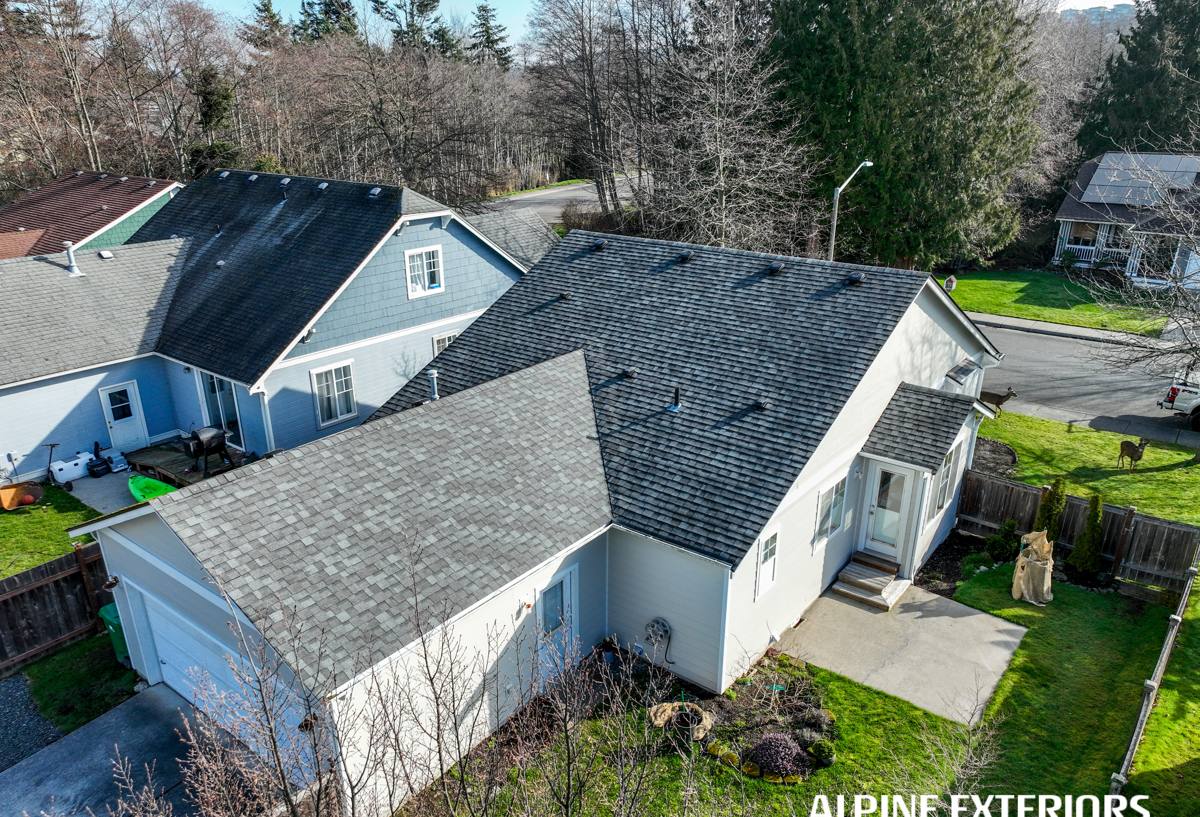
What South Hill's Climate Actually Does to a Roof
Moss and Organic Growth
Tree cover keeps South Hill roofs shaded and damp longer than roofs in open areas of Bellingham. Moss doesn't just look bad — it holds moisture against the roofing material, lifts shingle edges as it grows, and, if left unchecked for years, can work its way under tabs and start rot in the decking below. A new roof installation is the best time to build in moss resistance, because retrofitting it later is much more limited.
Wind-Driven Rain
Bellingham gets a lot of straight-down rain, but South Hill's exposure means it also gets rain that comes in at an angle, especially during fall and winter storms. Wind-driven rain finds weaknesses that vertical rain never would — lifted shingle tabs, marginal flashing laps, undersized valleys. Installation details that would be "good enough" in a calmer climate aren't good enough here.
Salt Air and Corrosion
Being close to Bellingham Bay means airborne salt reaches South Hill roofs, particularly on the sides of the house facing the water. Fasteners, flashing, and any exposed metal need to be rated for coastal exposure. Standard galvanized fasteners can start showing surface corrosion years before they should, which is a small thing that causes big problems if it's holding down flashing at a critical joint.
What a Correct New Roof Installation Involves
A roof is a system, not a single layer of shingles. Every layer has to do its job for the whole thing to perform, and skipping or downgrading any one of them is where most premature roof failures start.
- Tear-off and deck inspection: Full removal of old roofing so the deck underneath can actually be inspected, not guessed at. Any soft, delaminated, or moisture-damaged sheathing gets replaced before anything new goes down.
- Ice and water shield at vulnerable points: Eaves, valleys, and roof-to-wall transitions get self-adhered waterproof membrane, not just felt. These are the spots where wind-driven rain and ice cause the most damage.
- Synthetic underlayment: A high-quality synthetic underlayment across the whole roof gives a second line of defense if any wind-driven rain gets past the shingles, and it holds up better than old-style felt over time.
- New flashing throughout: Step flashing, counter-flashing, chimney flashing, and valley metal all get replaced, not reused. Reusing old flashing to save money is one of the most common shortcuts we see on prior installs, and it's usually the first thing that fails.
- Balanced ventilation: Intake at the eaves and exhaust at the ridge, sized to the attic, so moisture from inside the house doesn't get trapped against the new deck. Poor ventilation shortens the life of any roof, especially under heavy tree cover where the roof surface itself dries out slowly.
- Moss-resistant materials where appropriate: Copper or zinc strips, or shingles with built-in algae/moss-resistant granules, on roofs with heavy shade exposure.
- Corrosion-rated fasteners and metal: Stainless or coated fasteners and flashing on homes with bay exposure, so salt air isn't working against the roof from year one.
Choosing the Right Roofing Material for a South Hill Lot
There's no single "best" roofing material — the right choice depends on how much shade and moisture exposure a specific roof deals with, plus the homeowner's budget and how the roofline is styled. Here's how the common options stack up for South Hill's conditions specifically.
| Material | Moss/Moisture Behavior | Coastal Air Considerations | Typical Lifespan |
|---|---|---|---|
| Architectural asphalt shingles | Good with algae-resistant granules and proper ventilation; still needs periodic moss treatment under heavy shade | Standard fasteners should be upgraded to corrosion-rated on bay-facing slopes | 25-30 years |
| Standing seam metal | Sheds moisture fast, very moss-resistant on steep pitches | Needs a coastal-rated finish and fastener system to avoid long-term corrosion | 40-60 years |
| Composite/synthetic shingles | Strong moisture resistance, doesn't absorb water like older organic-mat shingles | Handles salt air well; check manufacturer warranty terms for coastal zones | 30-50 years |
| Wood shake | Highest maintenance burden in a moss-heavy, shaded environment; requires diligent upkeep | Untreated wood is more vulnerable to the damp/salt combination over time | 20-30 years with upkeep |
We'll walk through these trade-offs honestly during your estimate, based on how your specific roof is oriented, how much shade it gets, and what you're trying to balance between upfront cost and long-term maintenance.
Our Installation Process
- On-site assessment: We look at your current roof, attic ventilation, tree exposure, and which slopes face the bay, so the spec we write actually fits your property.
- Written estimate and material selection: You get a clear breakdown of scope, materials, and cost — no vague allowances or surprise change orders for things we should have caught up front.
- Tear-off and deck repair: Old roofing comes off, the deck gets inspected, and any damaged sheathing is replaced and documented.
- Waterproofing and flashing installation: Ice and water shield, underlayment, and all new flashing go in at every vulnerable point.
- Roofing material installation: Installed to manufacturer specification, with attention to the moss and wind-driven rain details specific to your slope and exposure.
- Ventilation check and final walkthrough: We confirm intake and exhaust ventilation is balanced, then walk the finished roof with you before we consider the job done.
Signs a South Hill Roof Needs Full Replacement, Not a Repair
- Moss has been growing on the same areas for multiple seasons despite cleaning, especially near valleys or eaves
- Shingles are curling, cupping, or losing granules across large sections rather than one isolated spot
- You're seeing staining on interior ceilings or in the attic near roof-to-wall transitions after wind-driven rain events
- The roof is past its expected service life for its material and has had multiple patch repairs already
- Flashing around chimneys, skylights, or dormers is visibly rusted, lifted, or was clearly reused during a prior repair
- Decking feels soft or spongy in spots when walked, which usually means moisture has already gotten past the roofing surface
Why It Matters That We Already Work South Hill
A crew that mainly installs roofs on open, exposed lots elsewhere in the county will spec a South Hill roof the same way they spec everything else — and that's how you end up with moss returning within a year or flashing that corrodes faster than it should. We already know which slopes on this hill hold moisture longest, which orientations catch the worst of the wind off the bay, and which material and fastener choices actually hold up under the tree cover common here. That local pattern recognition is part of what you're paying for, not just the labor and materials.
What Homeowners Should Expect to Invest
Roof replacement costs vary widely based on roof size, pitch, material choice, number of layers to remove, and how much decking repair is needed once the old roofing comes off. Rather than quote a number that won't reflect your actual roof, we provide a detailed written estimate after seeing the property in person — including the specific moss-prevention and corrosion-resistant upgrades that make sense for a South Hill lot, so you can weigh the upfront cost against the maintenance and longevity trade-offs clearly.
If your South Hill roof is showing its age, dealing with persistent moss, or you're just planning ahead, we'd be glad to take a look and put together a free, no-pressure estimate — just fill out the form below to get started.