 Bellingham
 New-Construction Windows Are a Different Job Than Replacement
When people say "new-construction windows," they mean something specific: windows installed into a framed rough opening before the siding goes on, not windows swapped into an existing wall after the fact. The difference isn't just paperwork. It changes how the window ties into the rest of the house, and in a wet climate like ours, that connection is what keeps water out for the next few decades.
Where the Flange Goes and Why That's the Whole Point
A true new-construction window has a nailing flange around the perimeter that gets fastened directly to the sheathing, then integrated into the weather-resistive barrier (WRB) and flashing system in a specific order. Done correctly, water that hits the wall sheds down and over the window, never behind it. Done out of order, that same water gets funneled straight into the wall cavity — and you won't see the problem until there's already rot or mold behind the drywall.
Why Happy Valley Builders Can't Treat This Step Casually
In Happy Valley, this step happens during a build phase when the wall is briefly open to the weather. Framers and window crews are working against the clock, and it's tempting to get windows "in and sealed" quickly so the schedule can move on to siding. We slow down at exactly this stage, because it's the only point in the entire build when the flashing is visible and correctable. Once siding goes up, mistakes here are hidden for good.
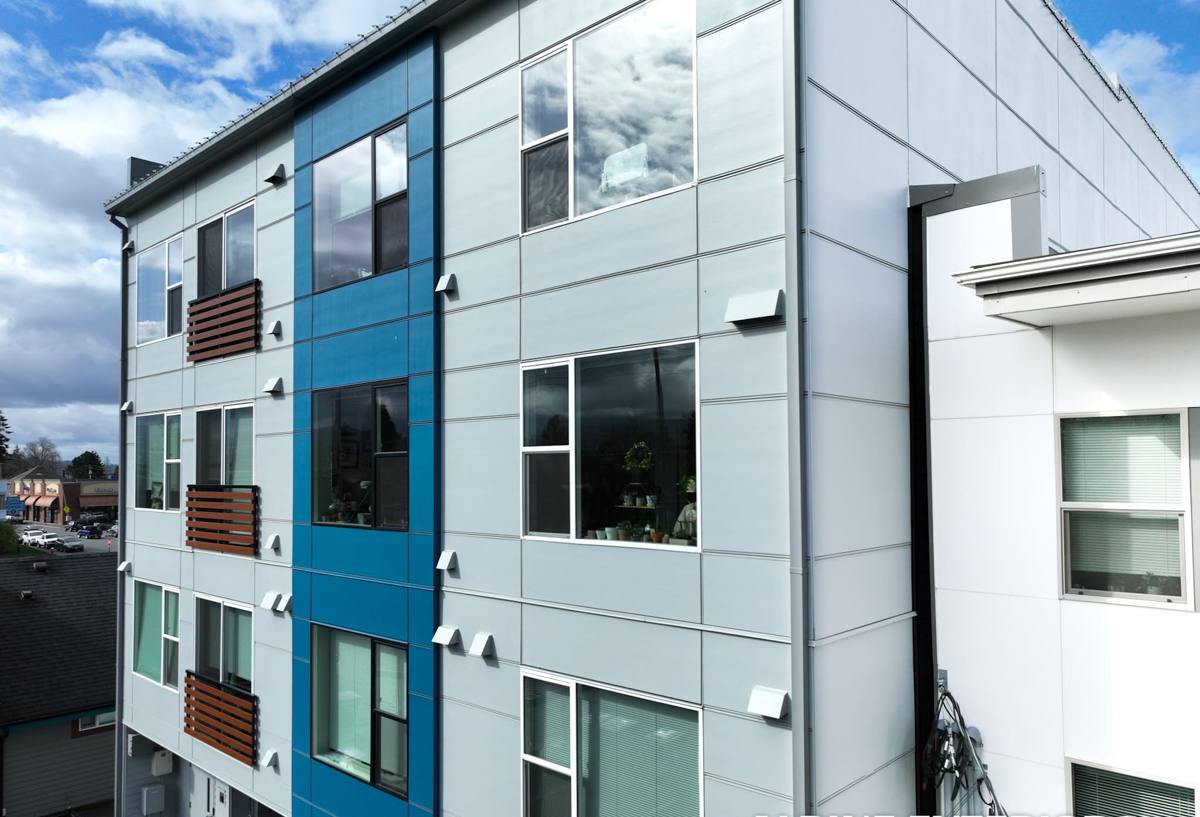
What This Corner of Whatcom County Asks of Every Rough Opening
Bellingham's marine climate doesn't spare any neighborhood, Happy Valley included. Three conditions shape how we approach every new-construction window job here: salt-laden air, wind-driven rain, and a moss season that stretches for much of the year.
Salt Air and Slow Corrosion
Proximity to Puget Sound means airborne salt works its way into fasteners, flashing metal, and window hardware over time. It's a slow process, so it rarely shows up as a callback in year one — it shows up as pitted screws, stained flashing, or a stiff lock mechanism five or ten years down the road. We choose corrosion-resistant fasteners and hardware for exactly this reason.
Driving, Wind-Driven Rain
Rain here doesn't just fall straight down — winter storms push it sideways into wall assemblies. A flashing detail that would be fine in a drier climate can fail here simply because wind pressure drives water uphill against gravity, into any gap that was left as an afterthought.
A Long Moss Season Means Long Exposure
Because our gray, damp stretches run long, any spot on a house that stays wet longer than it should becomes a place where moss, algae, and mildew take hold — including window sills, jambs, and the caulk lines around them. Good flashing and drainage keep those surfaces drying out between storms instead of staying saturated.
Our Installation Process, Step by Step
There's no shortcut version of this that holds up in our climate. Every new-construction window we set follows the same sequence, regardless of brand or frame material.
- Sill pan flashing first. A sloped, sealed pan goes into the rough opening before the window ever touches it, so any water that gets past the window has somewhere to drain — out, not into the framing.
- Setting, shimming, and squaring. The window is set plumb, level, and square in the opening, with shims placed to manufacturer spec so the frame doesn't rack or bind once it's fastened.
- Fastening to the manufacturer's pattern. Flange fasteners go in at the correct spacing and depth — overdriven fasteners can bow a frame just enough to cause operational problems later.
- Tying into the WRB with proper shingle-lap order. Flashing tape and the house wrap are layered so every piece overlaps the one below it, the same way roof shingles do, so water is always directed outward and down.
- Sealing and insulating from the inside. The gap between the frame and the rough opening gets backer rod and low-expansion sealant or insulation, not solid foam, so the frame can move slightly with temperature changes without stressing the seal.
Picking the Right Frame Material for a Marine Climate
Frame material affects how a window handles moisture, temperature swings, and salt exposure over its lifespan. We'll work with whatever a builder specs or a homeowner prefers, but here's how the common options actually compare in this climate.
| Frame Material | Moisture & Salt-Air Resistance | Maintenance | Typical Lifespan |
|---|---|---|---|
| Vinyl | Good — won't corrode or rot | Low — occasional cleaning | 20–30 years |
| Fiberglass | Very good — dimensionally stable in wet/dry cycles | Low | 30+ years |
| Wood-clad | Good exterior protection, but exposed wood interior or cut edges need attention | Moderate — exterior cladding low, wood trim needs periodic finish | 20–30 years with upkeep |
| Bare aluminum | Poor near salt air without added coatings — prone to pitting and thermal condensation | Higher | Varies widely |
Our default recommendation for Happy Valley builds leans toward vinyl or fiberglass for most openings, simply because they shrug off the salt-and-moisture combination with the least ongoing maintenance. That's a practical trade-off call, not a knock on any manufacturer — wood-clad and other options can perform well too, provided the exposed details are protected and maintained.
Where New-Construction Window Jobs Go Wrong
Most window failures we're called to diagnose later trace back to a handful of installation shortcuts, not a bad window itself.
- Skipping the sill pan and relying on caulk alone to keep water out of the sill area.
- Flashing tape applied out of shingle-lap order, so a lower piece overlaps a higher one and channels water inward instead of out.
- Fasteners overdriven or under-driven, distorting the frame enough to affect how the window operates.
- Setting windows during a wet stretch without temporary weather protection, trapping moisture behind the flashing before it's fully sealed.
- Gaps insulated with rigid foam that doesn't allow for normal frame movement, which can crack seals over time.
Every one of these is avoidable with a careful crew and the right sequence — it's a matter of professional standard and patience at a stage most people never see.
Coordinating with Your Builder or General Contractor
New-construction window work doesn't happen in isolation. It sits between the framer and the siding crew on the schedule, and timing matters. We coordinate directly with your GC or builder so windows go in during a dry stretch wherever the forecast allows, and so the WRB and flashing details are inspected and photographed before siding closes everything in. If a building inspector needs to see the rough opening or flashing before it's covered, we plan around that too rather than treating it as a scheduling obstacle.
A Homeowner's Checklist Before the Walls Close Up
If you're building in Happy Valley and want to sanity-check the window work before siding goes on, these are worth asking about or looking for:
- Is there a visible sill pan under each window, sloped to drain outward?
- Does the flashing tape overlap in shingle-lap order — lower pieces under upper pieces?
- Are shims and fasteners installed per the window manufacturer's instructions, not just "snugged in"?
- Is the gap between frame and rough opening filled with a flexible sealant or low-expansion product, not solid rigid foam?
- Has the installer photographed the flashing before it's covered by house wrap and siding?
Energy Performance and Condensation Control in a Marine Climate
Bellingham doesn't see the temperature extremes some regions do, so window performance here is less about surviving deep cold and more about managing moisture and moderate heat loss through a long heating season. Dual-pane, low-E glass with argon fill is a sensible baseline for most new builds in this area — it cuts heat loss and helps keep interior glass surfaces warmer, which reduces condensation on cold, damp mornings. U-factor and the window's air infiltration rating matter more here than solar heat gain, since our climate is defined by clouds and rain far more than direct sun.
Why Local Happy Valley Experience Matters
A window installed correctly on paper can still fail in the field if the crew hasn't accounted for how Bellingham weather actually behaves — the direction storms come from, how long moss and moisture linger on north-facing walls, how salt air ages hardware over years rather than months. Working new builds in and around Happy Valley regularly means we're not guessing at any of that; it's the baseline we install to on every job.
If you're planning new construction or a major addition in Happy Valley and want windows installed right the first time, we're happy to walk the plans with you and provide a free, no-pressure estimate — just fill out the form below.