 Bellingham
 Board & Batten Siding for Lynden's Farmhouse and Craftsman Homes
Board and batten has a long history in Whatcom County. The vertical lines and heritage look fit the barns, farmhouses, and Craftsman-style homes that make up a lot of Lynden's housing stock, and it's one of the few siding profiles that reads as "built for the country" without looking dated. It's also one of the least forgiving profiles to get wrong. Every seam is a potential water path, and in a climate that stays wet for months at a stretch, a board and batten job that's slightly off on flashing or fastening will show it within a few winters.
This page is about that one job, done for Lynden homes specifically: what the local climate asks of a vertical siding system, what a correct installation actually involves, and why we only put James Hardie fiber cement behind that pattern rather than the wood or vinyl versions that are also sold under the "board and batten" name.
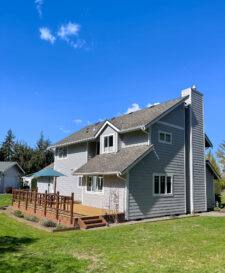
What Lynden's Climate Does to Vertical Siding
Lynden sits inland in Whatcom County's farm country, away from the direct salt exposure that homes closer to Bellingham Bay deal with. That doesn't mean it gets an easy pass. Open farmland gives wind-driven rain a clear run at exterior walls, and the same marine weather pattern that carries salt air along the coast also delivers the long stretches of damp, low-light fall and winter days that let moss and algae take hold on anything that stays wet. Combine that with the batten pattern's narrow board-to-board seams, and you get a siding style that depends almost entirely on the water management behind it, not just the caulk and paint on the surface.
Three things matter most for board and batten in this climate:
- Drainage behind the panel: a wall that traps moisture between the siding and the sheathing will stay wet longer than one that can breathe and drain, especially through a long moss season.
- Fastening at every seam: vertical boards and battens have more vertical joints than a horizontal lap profile, and each one needs to be sealed and fastened to spec, not just close.
- Material stability: wood swells and shrinks with the wet-dry cycle common here; a board and batten system built from a material that doesn't move much holds its seams tighter for longer.
Why We Install This Pattern Only in James Hardie Fiber Cement
Board and batten siding is sold in several materials — cedar or primed spruce boards, engineered wood, vinyl panels made to look like board and batten, and fiber cement. We install James Hardie fiber cement exclusively, in this profile and every other one we offer, and Lynden's climate is a big part of why.
Wood board and batten looks right the day it goes up, but real wood absorbs moisture at cut ends and around fasteners, and in a climate with this much sustained dampness that means recurring paint failure, swelling, and rot risk at the seams — the exact places this profile depends on most. Vinyl board and batten sidesteps rot, but it's a thin material that flexes with temperature swings, which tends to telegraph waviness along the battens and doesn't hold paint if a homeowner ever wants to change the color. Neither is engineered specifically for a wet marine climate.
James Hardie's HZ5 product line is engineered for climates like ours, with moisture and freeze-thaw resistance built into the fiber cement formulation itself, not added on. It doesn't absorb water the way wood does, it doesn't warp or expand the way vinyl does, and it holds a factory-applied ColorPlus finish that's baked on rather than field-painted, which matters a lot when you're relying on a coating to survive a long moss season year after year. It's also non-combustible, which is a real consideration given how many Lynden properties back up to open field or brush. We won't put a board and batten pattern over a substrate we don't trust to hold up here — that's the standard, not a sales pitch.
What a Correctly Installed Board & Batten Job Involves
The pattern is simple to look at, but the assembly behind it is where jobs succeed or fail. A correct installation on a Lynden home includes:
- A drainage plane and rainscreen gap behind the panels, so any moisture that gets past the siding has somewhere to go instead of sitting against the sheathing
- Battens fastened through the panel seams into framing, not just into the panel face, with fastener spacing that matches Hardie's engineering specs for our wind and moisture exposure
- Flashing above every window, door, and horizontal trim break — vertical siding sheds water down the wall, and every horizontal interruption needs a path to kick that water back out
- Proper ground clearance, generally 6 to 8 inches minimum from finished grade, so soil moisture and splash-back don't sit against the bottom of the panels
- Caulk used only where Hardie's install guide calls for it — at trim and penetrations, not sealed solid across every seam, which traps moisture instead of managing it
- Corrosion-resistant fasteners rated for fiber cement, sized and spaced to manufacturer specification
Skip any one of these and the siding can still look right for a season or two. The problems show up later, usually as staining, soft spots at the base, or paint failure around windows — and by then it's a repair job, not a punch-list item.
A Quick Homeowner Checklist
- Ask whether the quote includes a rainscreen/furring gap or a direct-to-sheathing install
- Confirm fastener type and spacing is called out, not left to "standard practice"
- Ask how window and door flashing is being handled before siding goes on, not after
- Get the ground clearance number in writing, especially if the home sits low or near landscaping beds
- Ask which Hardie product line is being quoted — HZ5 is the version engineered for this climate
Board & Batten vs. Other Profiles for This Climate
Board and batten isn't the only option, and it isn't always the right one. Here's how it stacks up against the other common Hardie profiles homeowners in Lynden ask about:
| Profile | Look | Seam exposure | Best fit |
|---|---|---|---|
| Board & Batten | Vertical, farmhouse/Craftsman | More vertical seams to manage | Homes where the heritage look matters and installation is done to spec |
| Lap siding (5.25" or 8.25") | Traditional horizontal | Fewer seams, water sheds down each board | Most straightforward water management of the common profiles |
| Panel siding (large format) | Modern, clean vertical or horizontal | Seams at panel joints only | Larger wall sections, modern or shop-style buildings |
None of these are wrong choices. The point is that board and batten asks more of the installer than lap siding does, which is exactly why the crew matters as much as the material.
Our Process for Lynden Projects
- Walk and assessment: we look at current siding condition, moisture points, ground clearance, and roof drainage before quoting anything.
- Detailed scope: the estimate spells out the Hardie product, the rainscreen approach, flashing details, and fastening — not just a square footage number.
- Prep and moisture check: old siding comes off, sheathing gets inspected for hidden rot before anything new goes up.
- Installation to manufacturer spec: drainage plane, battens, flashing, and fasteners installed per Hardie's requirements for our climate zone.
- Final walk-through: we go over the finished job with the homeowner and confirm clearances, caulking, and trim before calling it done.
Cost Factors for a Board & Batten Project
Every home is different, but these are the variables that move the price on a Lynden board and batten job:
| Factor | Why it matters |
|---|---|
| Wall complexity | More corners, gables, and trim breaks means more cuts and more flashing detail |
| Existing siding removal | Tear-off and disposal of old wood or vinyl adds labor beyond a straight install |
| Sheathing/moisture repair | Hidden rot found during tear-off has to be fixed before new siding goes on |
| Trim and accessory work | Corner boards, window trim, and fascia detail all factor into a board and batten look |
| Access and site conditions | Grade, landscaping, and building height affect scaffolding and staging time |
We give a firm, itemized number after the walk-through — not a rough per-square-foot guess that changes once the old siding comes off.
Maintenance Through a Long Moss Season
A correctly installed Hardie board and batten system is low-maintenance, but "low" isn't "none" in this climate. A soft wash on siding that's showing algae or moss buildup, kept away from pressure-washing that can drive water behind panels, keeps the ColorPlus finish looking right. Keeping gutters clear so roof runoff isn't dumping directly onto a wall section matters more with vertical siding than horizontal, since water tends to track straight down the battens to whatever's below. An annual look at ground-level clearance — mulch, soil, or plantings creeping up over the years — catches the most common slow-motion problem before it becomes a repair.
Why a Crew That Already Works in Lynden Matters
Board and batten done wrong doesn't fail in year one — it fails in year four or five, after the crew that installed it is long gone. A local crew that's already done this work in Lynden knows the wind exposure of open farmland lots, has already dealt with the county's permitting and inspection process, and can get back out to a job site quickly if a question comes up after the fact. That local accountability is worth more on a profile like this one than it is on almost any other siding choice, because the failure points are subtle and the fix is never as simple as caulking a gap.
If you're weighing board and batten for a Lynden home, we're happy to walk the property, look at what's there now, and give you a straight answer on what it would take to do it right — no pressure, no obligation. Use the form below to set up a free estimate.