 Bellingham
 South Hill's Climate Is Harder on Siding Than It Looks
South Hill sits above Bellingham Bay, and that elevation and exposure come with a trade-off. Homes up here catch salt-laden air off the water, take driving rain straight off the Strait during winter storms, and — on the more tree-covered, north-facing lots common in this neighborhood — stay damp for days after a storm passes. Add Whatcom County's long, gray moss season and you have a combination that punishes any siding material with a weak spot in its finish, its fasteners, or its water management.
None of that is unique to South Hill. But the neighborhood's mix of older homes, hillside lots, and mature tree canopy means siding here works harder, longer, than siding on a newer, more open lot across town. That's the lens we bring to every fiber cement job we quote in this area.
What Fiber Cement Siding Needs to Do Here
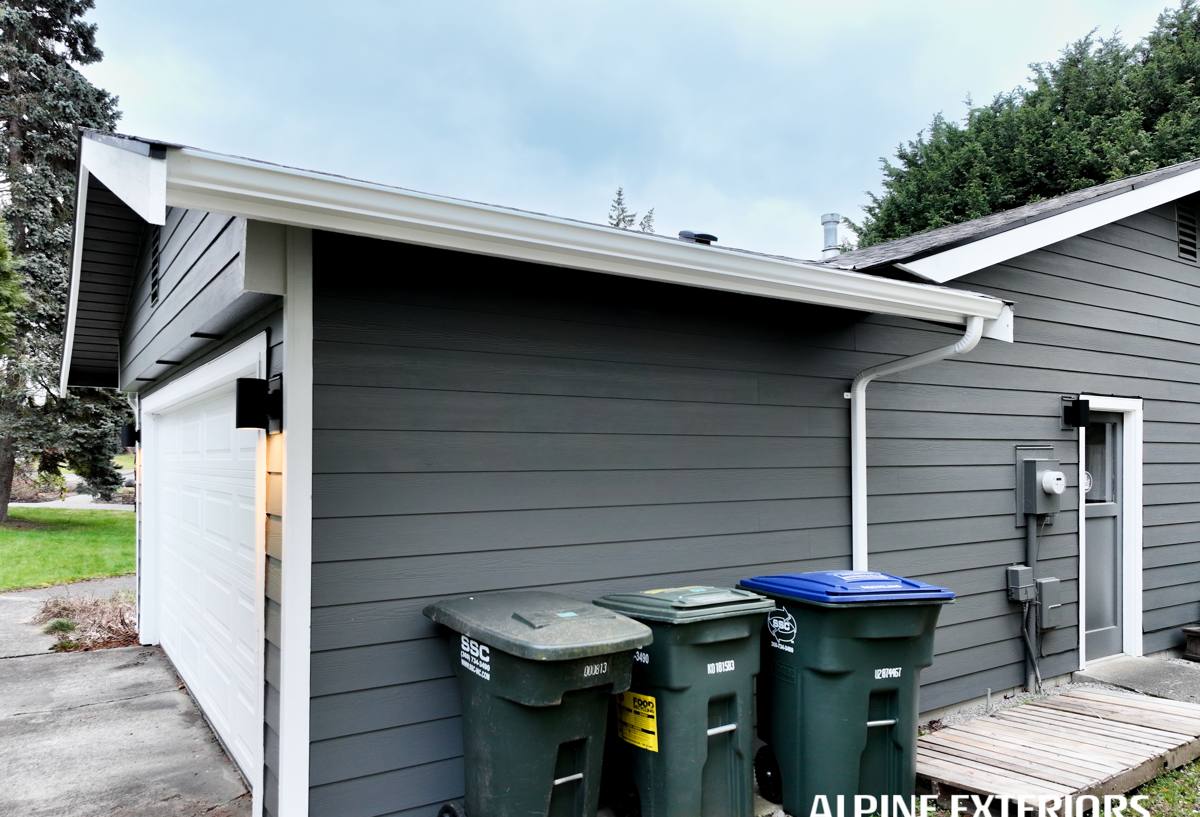
Fiber cement is already a strong choice for the Pacific Northwest — it doesn't rot, it resists moisture intrusion far better than wood, and it holds paint or factory finish without the swelling and cracking that plagues softer materials. But "fiber cement" isn't one product; the plank thickness, the core formulation, and — critically — the factory finish all vary between manufacturers, and those differences show up fastest in a climate like ours.
On a South Hill home specifically, siding needs to:
- Shrug off repeated wetting and drying cycles without the finish checking or peeling
- Resist mildew and moss growth on shaded, north- and east-facing walls
- Hold its color under salt air without chalking or fading unevenly
- Manage bulk water at every joint, corner, and penetration — not just shed rain off a flat wall
- Stand up to wind-driven rain at gable ends and exposed upper stories, which are common on this hillside
Why We Only Install James Hardie
We don't install LP SmartSide, vinyl, Cemplank, Allura, primed spruce, or cedar, and that's a deliberate standard, not an oversight. Each of those products has real strengths — LP SmartSide is a capable engineered wood option, cedar looks beautiful when it's new, vinyl is inexpensive up front — but each also carries a trade-off we're not willing to put our name behind in this climate: engineered wood is still wood at its core and depends entirely on an unbroken factory coating to keep moisture out; vinyl can warp and fade and does nothing to add real fire resistance; cedar demands a maintenance commitment most homeowners underestimate until they're repainting every few years.
James Hardie fiber cement is non-combustible, which matters more every wildfire season in Washington. Its ColorPlus factory finish is baked on and warrantied separately from the substrate, which means the color layer is engineered to the same standard as the board underneath it — not applied on-site where weather and technique introduce variables. Hardie also builds its HZ product lines by climate zone; Whatcom County falls in the Northern climate engineering zone, so the boards we install are formulated for the freeze-thaw and moisture cycles our winters actually produce, not a generic national spec. Backed by a strong transferable warranty, it's the one product we're comfortable standing behind on a South Hill home for the next several decades.
What "Climate-Engineered" Actually Means
It's not a marketing phrase. Hardie's Northern-zone formulation and finish system are built around the same conditions South Hill deals with every winter: prolonged damp, freeze-thaw swings, and salt-influenced air near the water. That's part of why we don't treat fiber cement as a commodity — the same-looking plank from a different manufacturer, or Hardie's Southern-zone product installed up here, doesn't get you the same performance.
What a Correct Installation Actually Involves
Fiber cement siding fails almost exclusively because of installation mistakes, not material defects. The board itself is durable; water finds its way in at seams, fastener holes, and flashing details that were rushed or skipped. On a South Hill job, we pay particular attention to:
- Weather-resistive barrier and rainscreen gap — a drainage plane behind the siding so any moisture that does get past the surface has somewhere to go
- Flashing at every horizontal joint, window, and door — the single most common failure point on homes we've re-sided in this area
- Correct fastener placement and spacing — per Hardie's published installation specs, not "close enough"
- Proper clearance from grade, decks, and roof lines — critical on hillside lots where grading and drainage are already doing extra work
- Caulking only where Hardie's install guide calls for it — over-caulking traps moisture just as badly as under-caulking lets it in
- Factory-cut and painted edges wherever possible — field cuts get sealed with touch-up product so the exposed core doesn't wick water
Skip any one of these and you can end up with a house that looks right for a year or two before the underlying problems show up as swelling, staining, or paint failure — the same visible symptoms that show up on a badly installed board of any material.
Common Problems We Find on Older South Hill Homes
A fair number of houses on South Hill predate current siding and flashing standards. When we're called out to look at failing siding — whatever the material — the pattern is usually the same: no rainscreen gap, missing or improperly lapped flashing above windows, and siding installed too close to grade or roof-to-wall intersections. Combine that with the tree cover and slower dry-out time common on shaded lots up here, and you get accelerated moss growth and moisture damage well before the siding's expected service life is up.
This is also where a hillside lot adds its own wrinkle: drainage and grading around the foundation directly affect how much water siding at the lower courses has to deal with. We look at that as part of any siding estimate, because new siding installed over an existing drainage problem just moves the timeline on the next failure.
What Fiber Cement Siding Costs to Install
Every home is different, and we'll only give you real numbers after walking your property, but the factors below are what actually move the price on a South Hill job.
| Cost Factor | Why It Matters Here |
|---|---|
| Wall area & home height | Multi-story homes with hillside exposure need more scaffolding and access work |
| Existing siding removal | Tear-off and disposal of old cedar, wood, or vinyl adds labor |
| Sheathing & framing condition | Rot found once old siding comes off is common on older South Hill homes and must be repaired before new siding goes on |
| Trim, corners & accessory details | Hardie trim, soffit, and corner boards add cost but keep the whole system consistent |
| Plank profile & color | Lap width, shingle-style panels, and ColorPlus color selection affect material pricing |
| Site access | Steep or narrow hillside lots can add setup and staging time |
Our Process, Start to Finish
- Free on-site estimate — we walk the exterior, check existing siding and sheathing condition, and note drainage or grading issues specific to your lot
- Written scope and quote — clear line items, no surprise add-ons once work starts unless we find hidden damage
- Tear-off and sheathing inspection — any rot or water damage gets addressed before a single new board goes up
- Weather barrier and rainscreen installation — the drainage system that does the real long-term work
- Hardie siding, trim, and flashing installation — installed to manufacturer spec, not shortcuts
- Final walkthrough — we go over the finished job with you before calling it done
Signs Your Siding May Already Be Past Its Point
- Soft or spongy spots when you press on the siding
- Persistent moss or dark staining that comes back soon after cleaning
- Visible cracking, buckling, or gaps at seams and corners
- Paint that's peeling or bubbling rather than just fading
- A musty smell near exterior walls inside the house
Living With Fiber Cement Through a Long Moss Season
Correctly installed Hardie siding needs far less attention than wood or engineered wood, but it isn't zero-maintenance in a climate like ours. Rinsing off accumulated grime and moss spores once or twice a year, keeping gutters clear so water isn't sheeting down the wall, and trimming back vegetation that keeps a wall shaded and damp all go a long way. Because the ColorPlus finish is factory-applied and warrantied, you're not signing up for a repainting cycle every few years the way you would with field-finished materials — that's one of the practical reasons this product holds up well on shaded, tree-covered South Hill lots specifically.
Why a Crew That Knows This Neighborhood Matters
Flashing details, rainscreen requirements, and grading considerations aren't theoretical on South Hill — they're the difference between siding that's still doing its job in twenty years and siding that's failing in five. A crew that's worked this hillside, dealt with its drainage patterns, and installed to Hardie's specification in Whatcom County's weather knows what to check for before problems start, not after. That's the standard we hold every job to, on South Hill and everywhere else we work.
If your South Hill home's siding is showing its age — or you're planning ahead rather than reacting to a problem — we're happy to take a look and give you a straightforward, no-pressure estimate using the form below.