 Bellingham
 Board & Batten Siding for Barkley Homes
Board and batten shows up a lot in Barkley — the vertical lines suit both the newer construction in the neighborhood and the older homes getting a refresh, and it reads as clean and current without looking out of place next to more traditional lap siding next door. What often gets missed in the excitement over the look is that board and batten is really a joint system. Every place a batten covers the seam between two boards is a spot where wind and water are going to test the installation, year after year. In a climate like Whatcom County's, with salt-tinged air, rain that rarely falls straight down, and moss that has most of the year to establish itself on a shaded wall, that joint detail is what separates a board and batten job that looks good on day one from one that still looks good after a decade of Bellingham winters.
We install James Hardie fiber cement board and batten exclusively, and every seam, fastener, and flashing detail on a Barkley job gets built around what this specific climate does to a vertical wall over time — not around what passes a quick look on install day.
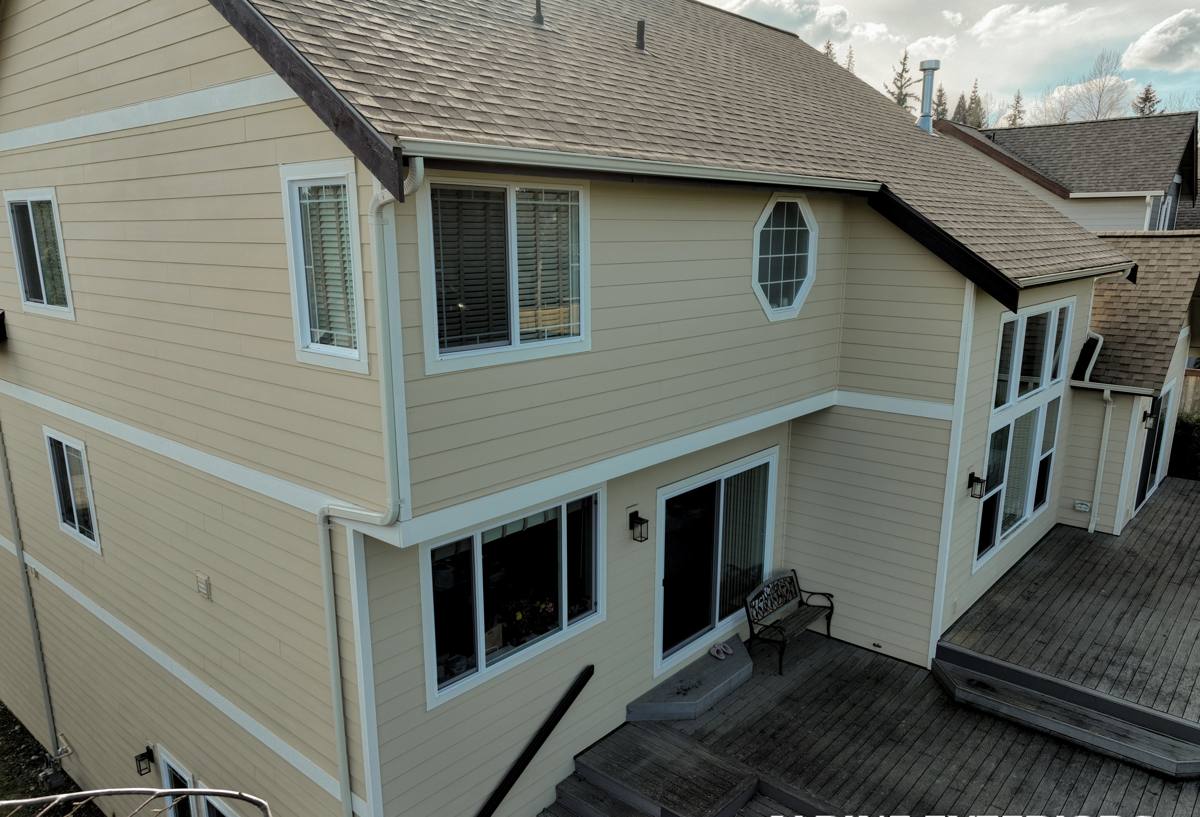
What Barkley's Climate Asks of a Vertical-Seam Wall
Barkley sits within Whatcom County's marine-influenced climate, which means the same core conditions that shape exterior work across Bellingham apply here too: salt-tinged air, wind-driven rain, and a moss season that runs long on any wall that doesn't get much direct sun. Board and batten doesn't change those conditions, but it does change how much they matter, because a vertical profile has more seam length and more exposed fastener points per square foot than a standard horizontal lap.
Wind-Driven Rain and Vertical Joints
Rain in this part of Washington usually arrives at an angle, not straight down, and a wall built out of vertical boards and battens gives that wind-driven rain a long run of joint to work against. A batten that's caulked tight against its board instead of properly lapped and set with the clearance the manufacturer calls for doesn't shed that water — it holds it right against the seam, which is the opposite of what the detail is supposed to do.
Salt Air and Fastener Life
Board and batten also uses more fasteners than most other siding profiles, since both the boards and the battens covering their seams need to be secured independently. That's a bigger deal in a climate where salt-tinged air steadily works on any exposed metal. Getting the fastener spec right — correct alloy, correct length, correct spacing — carries more weight on a profile with this many fastener points than it does on a simple lap wall.
A Long Moss Season on Shaded Walls
Trees, fences, and the way a lot has been built out all affect how much sun a given wall gets, and shaded or north-facing walls in Barkley stay damp well into the year. A batten seated tight against its board with no room to breathe traps that moisture right where it can't dry, which is a slow road toward staining, softened substrate, and paint failure right along the seam line — often long before the rest of the wall shows any wear.
Why We Install Only James Hardie Board & Batten
We don't offer LP SmartSide, vinyl, Cemplank, Allura, primed spruce, or cedar for board and batten work. That's a standard we hold ourselves to, not a comment on every contractor who installs those products competently. Board and batten simply amplifies whatever a material's weak points already are, because so much more of its surface area is seam. A profile built on constant moisture cycling and a heavy fastener count isn't the place to gamble on a material that depends on field-applied coatings or expands and contracts enough to open its own joints over time.
James Hardie's fiber cement core is dimensionally stable — it doesn't swell, cup, or feed moss the way wood-based products can, and that stability matters most exactly where board and batten puts the most strain: at the seam. Hardie's ColorPlus finish is baked on at the factory rather than applied on site, so the parts of the wall we're relying on to hold color and shed water for decades aren't dependent on field paint quality. Paired with Hardie's climate-specific HZ formulations and a strong transferable warranty, it's the one board and batten system we trust to perform through a full Bellingham year, not just look right when the crew packs up.
What We Ask Homeowners to Weigh Before Choosing Something Else
None of the alternatives are dishonest products, and plenty of homes elsewhere carry them without issue. But on a seam-heavy profile in a climate this consistently wet, the maintenance that gets deferred at installation — sealing edges, repainting, replacing warped panels — tends to come due within a decade or two, usually right at the battens first.
What a Correct Board & Batten Install Involves in Barkley
The finished look of board and batten is simple: vertical boards, battens over the seams. What holds that look up for thirty years is everything underneath it. On a Barkley job, that means:
- House wrap or weather-resistive barrier installed and correctly lapped before the first board goes up
- A drainage gap or rainscreen behind the siding so moisture that gets past the surface can dry out instead of sitting against the sheathing
- Corrosion-resistant fasteners at the spacing James Hardie's install spec calls for on both boards and battens, not a generic fastener schedule
- Battens set with real clearance rather than caulked flush, so the wall can shed water instead of holding it at the seam
- Flashing properly lapped at every window, door, corner, and the base of the wall, where a vertical run of siding meets a horizontal surface
- Field-cut edges primed before installation so the factory ColorPlus finish stays the rule across the wall, not the exception
Skip any one of these and the wall can still look right for a season or two. The problems that come from skipping them — staining at the seams, soft spots near the base, paint pulling away along a batten — take a few wet Bellingham winters to show up, which is exactly why a corner-cutting install can get away with it until the homeowner is the one paying for the repair.
Comparing Board & Batten Material Options
Homeowners planning a board and batten project in Barkley have usually already come across the alternatives, so it's worth laying out how they actually behave on this specific profile rather than treating the material choice as settled.
| Material | Behavior at Batten Seams | Maintenance in This Climate |
|---|---|---|
| James Hardie fiber cement | Dimensionally stable; doesn't swell or cup at the joint | Low — factory finish holds up against sustained damp and salt exposure |
| LP SmartSide (engineered wood) | More sensitive to moisture at cut edges and fastener points | Moderate — edge sealing and coating upkeep matter more here |
| Vinyl | Can warp or gap at battens through temperature swings and wind-driven rain | Low upfront, but hidden moisture problems are harder to catch early |
| Primed spruce or cedar | Absorbs moisture readily at every seam without regular sealing | Highest — recurring repainting, caulking, and moss treatment |
This isn't a claim that every other material fails outright — it's why our own standard, for a seam-heavy profile in this particular climate, is fiber cement installed to spec rather than a material that trades a lower price today for a heavier maintenance load down the road.
What Drives the Cost of a Board & Batten Project in Barkley
Board and batten generally costs more than standard lap siding on the same home, mostly because of the added board and fastener count. A few factors move the number more than homeowners usually expect:
| Factor | Why It Affects Cost |
|---|---|
| Board and batten width and spacing | Narrower reveals mean more boards, more battens, and more labor per square foot |
| Existing substrate condition | Rot or water damage found once old siding comes off adds repair work before new siding goes up |
| Wall height and roofline complexity | Multiple gables, dormers, or a tall second story add cutting and staging time |
| Trim, corner, and transition detail | Board and batten meeting windows, doors, and other siding profiles needs more custom flashing work |
| Site access | Tight lots or limited equipment access in some parts of the neighborhood can add labor time |
We'll walk your specific home and give you real numbers rather than a rough per-square-foot figure — two Barkley homes of similar size can land at very different totals depending on how many of these factors are actually in play.
Our Process for Barkley Board & Batten Projects
- A free, no-pressure walkthrough of the home, looking at wall orientation, existing siding condition, and how sun and shade fall across the property
- A written estimate that spells out board and batten width, color, and the flashing and drainage detail specific to your walls
- Removal of existing siding and an honest look at the sheathing underneath, with any needed repairs flagged before new siding goes up
- Weather-resistive barrier and drainage gap installation, followed by James Hardie boards and battens fastened to spec
- Flashing and sealing at every window, door, corner, and base transition, then a final walkthrough with you before we call the job done
Why a Crew That Already Works Barkley Matters
A lot of what makes board and batten hold up here comes down to judgment calls a crew unfamiliar with this specific area tends to get wrong: how much wind-driven rain a given wall orientation actually takes on through the winter, which walls in a neighborhood like this stay shaded long enough to grow moss first, and how much batten clearance is actually needed given how consistently damp the air stays. A crew that works Bellingham exteriors regularly starts to recognize those patterns from one property to the next, and that familiarity shows up in the small decisions — where a batten needs a touch more clearance, where flashing is non-negotiable versus where a bead of sealant is enough — that homeowners rarely see directly but absolutely feel in how the siding performs over the following winters.
If you're weighing board and batten for a home in Barkley, we're glad to walk the property, talk through what your specific walls need given their orientation and exposure, and put together a straightforward estimate with no pressure attached. There's a form below — reach out and we'll set up a time to take a look.