 Bellingham
 Sehome sits close enough to Bellingham Bay to catch salt-laden air off the water, but it's also shaded and cooled by the tree canopy around Sehome Hill Arboretum and the older, tightly built streets near Western Washington University. That combination — coastal moisture plus shade plus mature trees dropping needles and leaves into gutters and wall cavities — is a tougher environment for exterior siding than most homeowners realize. Whatcom County's wet season runs long, and Sehome's terrain and tree cover mean siding here stays damp longer after a storm than it would on an open, sun-exposed lot. Whatever material goes on the wall next has to handle that reality for decades, not just look good on installation day.
Why Sehome Homes Take a Beating From the Elements
Three things work against exterior siding in this neighborhood at the same time. First, proximity to the bay means a steady low level of salt air moving through the area, which accelerates corrosion on fasteners and trim and breaks down lower-grade paint finishes faster than inland Whatcom County properties experience. Second, Bellingham's driving rain doesn't fall straight down — wind-driven rain hits walls at an angle and finds any gap in flashing, caulking, or panel seams. Third, the shade from Sehome Hill and the neighborhood's mature street trees keeps wall surfaces from drying out quickly between storms, which is exactly the condition moss and algae need to take hold. Put those three together and you get a long moss season that can run most of the year on north- and west-facing walls that don't get much direct sun.
None of this means siding fails quickly here — it means siding that isn't engineered for moisture and isn't installed with the right details fails faster than it should, often through rot at butt joints, corner boards, and trim before the field of the wall shows any obvious damage.
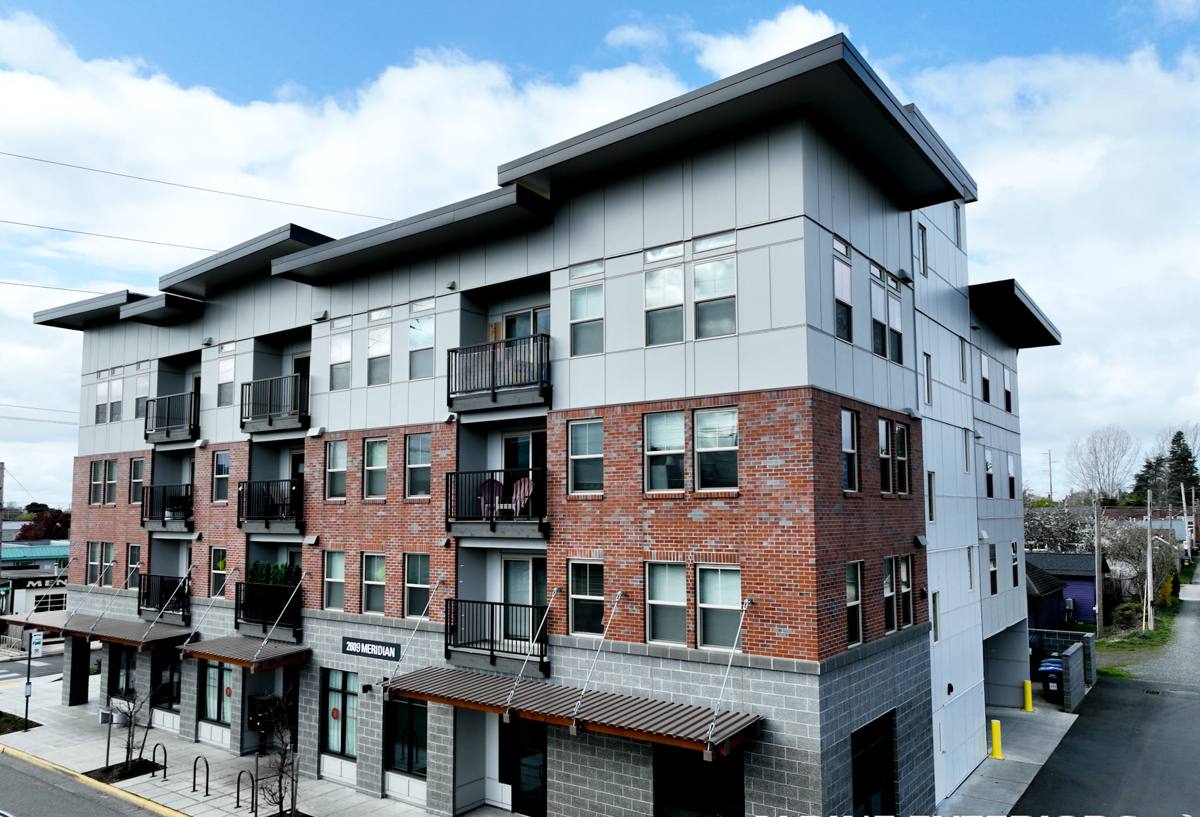
What Fiber Cement Siding Needs to Do in This Climate
Fiber cement, done right, is built for exactly this kind of weather. It's a cement, sand, and cellulose fiber composite that doesn't absorb and swell the way wood-based products can, doesn't feed pests the way wood does, and is non-combustible, which matters increasingly in Washington's wildfire risk conversations. But not all fiber cement is engineered the same way, and not all installations account for a wet, shaded, salt-exposed site. In Sehome specifically, siding needs to:
- Resist moisture absorption at cut edges and panel joints, where most real-world failures start
- Hold a factory-applied finish that doesn't need repainting every few years just to keep up with UV and moisture cycling
- Shed wind-driven rain rather than trap it behind the cladding
- Resist mildew and algae growth on shaded elevations without constant homeowner upkeep
- Stay dimensionally stable through the freeze-thaw and wet-dry swings typical of a Puget Sound winter
Why We Only Install James Hardie
We install James Hardie fiber cement exclusively, and it's a deliberate standard, not a default. We don't install vinyl siding, LP SmartSide, Cemplank, Allura, or primed wood products like spruce or cedar. Each of those has legitimate uses in the right setting, but for Whatcom County's wet, shaded, coastal-influenced conditions, we've settled on Hardie because of three specific things: the HardieZone engineered product lines built for regions like ours, the ColorPlus factory finish system, and a warranty structure backed by a manufacturer that engineers specifically for climate exposure rather than a one-size-fits-all national spec. HardieZone HZ5 products are formulated for the Pacific Northwest's combination of moisture and moderate freeze-thaw cycling, which is a meaningfully different environment than the hot, dry Southwest or the humid Southeast. ColorPlus finish is baked on and cured at the factory under controlled conditions, which produces a harder, more UV- and moisture-resistant surface than field-applied paint typically achieves, and it carries its own finish warranty separate from the substrate warranty. For a neighborhood dealing with salt air and a long wet season, that combination — the right substrate engineering plus a factory finish that isn't the weak point — is what tips the decision.
Signs Your Sehome Home's Siding Needs Attention
Because Sehome's tree cover and shade patterns hide a lot of moisture damage, it's worth knowing what to look for before a small problem becomes a structural repair. Walk the exterior, paying particular attention to north- and west-facing walls and anywhere trim meets a horizontal surface:
- Persistent green or black staining that returns within weeks of cleaning
- Soft or spongy spots when you press on siding near the bottom courses or around window trim
- Paint that's bubbling, peeling, or chalking heavily, especially on shaded elevations
- Visible gaps or separation at butt joints, corner boards, or where siding meets trim
- Warping, cupping, or bowing panels, particularly on older wood or composite siding
- Rust streaking from fasteners, which usually signals the wrong fastener type was used originally
- Any musty smell or interior wall staining that could indicate moisture getting behind the cladding
Any one of these on its own might be minor. Several together, especially on a home more than 15-20 years old with its original siding, usually means it's time for a real assessment rather than another round of caulk and paint.
What a Correct Fiber Cement Install Involves
Fiber cement siding is only as good as the installation behind it. Most of the failures we see on older homes trace back to installation shortcuts, not the product itself.
Flashing and the Weather-Resistive Barrier
Before a single piece of siding goes up, the wall needs a continuous weather-resistive barrier, properly lapped and sealed, with flashing integrated at every window, door, and horizontal transition — not caulk used as a substitute for flashing. In a neighborhood exposed to wind-driven rain, this layer is what actually keeps water out of the wall assembly; the siding itself is the second line of defense, not the only one.
Gaps, Fastening, and Clearances
James Hardie's install specifications call for specific gaps at butt joints and trim, proper fastener type and placement to avoid splitting or overdriving, and minimum clearance from grade, decks, and roof lines so siding isn't sitting in standing water or splashback. Skipping these details is invisible on installation day and shows up as rot two or three winters later.
Finish and Caulking
ColorPlus panels are designed to be face-nailed or blind-nailed with touch-up paint matched to the factory finish at cut edges — every cut edge that isn't sealed is a point where moisture can wick into the panel. Caulking should be used at trim transitions per manufacturer spec, not as a general-purpose gap filler across the whole wall.
| Detail | Correct Practice | Common Shortcut That Fails Here |
|---|---|---|
| Weather barrier | Continuous, properly lapped, integrated flashing at all penetrations | Barrier installed but flashing skipped or replaced with caulk |
| Cut edges | Sealed with manufacturer touch-up finish before installation | Left raw, allowing moisture wicking at joints |
| Bottom clearance | Minimum clearance held from grade, decks, and roofing | Siding installed tight to grade or roofline, holding moisture |
| Fasteners | Corrosion-resistant type, correct depth and placement | Standard fasteners overdriven, cracking the panel over time |
| Caulk use | Limited to specified trim transitions per manufacturer detail | Used broadly to mask gaps, trapping moisture behind it |
Our Process From Estimate to Finished Job
The process starts with an in-person look at the home, not a phone estimate. We check the condition of the existing siding, sheathing, and trim, look for signs of moisture damage that would need to be addressed before new siding goes on, and talk through which HardiePlank, panel, or trim profile fits the home. From there:
- Written estimate covering material, labor, and any sheathing or trim repair identified during the walkthrough
- Removal of existing siding and inspection of the wall assembly underneath for hidden rot or moisture issues
- Repair of any damaged sheathing or framing found before new material goes up — this is not optional, and it's flagged and priced honestly if discovered mid-job
- Installation of a continuous weather-resistive barrier with proper flashing at every window, door, and penetration
- Installation of James Hardie siding, trim, and accessories to manufacturer specification, including gaps, fastening, and clearances
- Sealing of all cut edges and trim transitions with the correct finish-matched products
- Final walkthrough with the homeowner before the job is considered complete
Choosing a Contractor Who Already Works in Sehome
Sehome's housing stock skews older and more tightly spaced than a lot of newer Bellingham neighborhoods, with narrower lots, mature trees close to structures, and homes that have often been added onto or re-sided at least once already. A contractor who's worked in the neighborhood already knows what that usually means: sheathing conditions that vary house to house, trim details from prior renovations that don't match current code, and the value of protecting mature landscaping during tear-off and material staging on a tighter lot. Whatcom County permitting and Bellingham's local requirements also apply, and a crew that pulls permits regularly here moves through that process faster than one working from out of the area. Local familiarity isn't a marketing line — it's the difference between a crew that's guessing at what's behind the old siding and one that's seen the pattern before.
Cost Factors for a Sehome Siding Project
Every siding job is priced on its own specifics, but the same handful of factors drive most of the variation between a straightforward job and a more involved one:
| Factor | Why It Matters |
|---|---|
| Home size and number of stories | More wall area and taller elevations increase material, labor, and equipment needs |
| Condition of existing sheathing | Hidden rot found during tear-off adds repair scope before new siding can go on |
| Siding profile and trim complexity | Lap siding, panel systems, and detailed trim work carry different labor requirements |
| Access and site conditions | Tight lots, mature trees, and limited staging space slow tear-off and installation |
| Existing material removal | Removing old vinyl, wood, or composite siding adds labor versus building on new construction |
| Finish selection | Standard ColorPlus colors versus premium color or texture options affect material cost |
We walk through these factors during the in-person estimate so there aren't surprises once work begins, and any sheathing repair found mid-project is priced and discussed with the homeowner before we proceed.
Living With Fiber Cement Through a Long Moss Season
One advantage of a correctly installed James Hardie system in a shaded, damp neighborhood like Sehome is how little upkeep it demands compared to wood or lower-grade composite siding. It won't rot, and the factory finish resists the algae and mildew growth that stains shaded walls year after year. That said, no siding is completely maintenance-free in this climate. A periodic gentle wash to clear moss spores and organic debris before they establish, keeping gutters clear so overflow doesn't run down the wall face, and trimming back vegetation that keeps a wall permanently shaded and damp will all extend the life of the finish well beyond what the material would achieve on its own.
If your Sehome home's siding is showing its age, or you're planning ahead of a renovation, we're happy to take a look and give you a straightforward, no-pressure estimate — no obligation, just an honest read on what your home needs. The form below is the easiest way to get started.