 Bellingham
 Cordata Homes Face a Specific Kind of Weather Wear
Cordata sits in north Bellingham, tucked back from Bellingham Bay but still squarely inside the marine weather system that defines Whatcom County. That means salt-laden air carried in off the Salish Sea, long stretches of driving rain through fall and winter, and a moss season that can run from October well into spring. Siding in this neighborhood isn't just a cosmetic layer — it's the one system standing between your framing and a climate that rarely lets a wall dry out completely for months at a time. When we replace siding in Cordata, we're not just swapping old boards for new ones. We're closing the specific gaps that let Bellingham's weather do damage over years: wind-driven water at laps and corners, moss holding moisture against north-facing walls, and salt air accelerating corrosion on fasteners and trim. This page walks through what that actually looks like — what the climate does to siding here, what a correct replacement job involves, and why we install only James Hardie fiber cement on every home we touch, in Cordata and everywhere else we work.
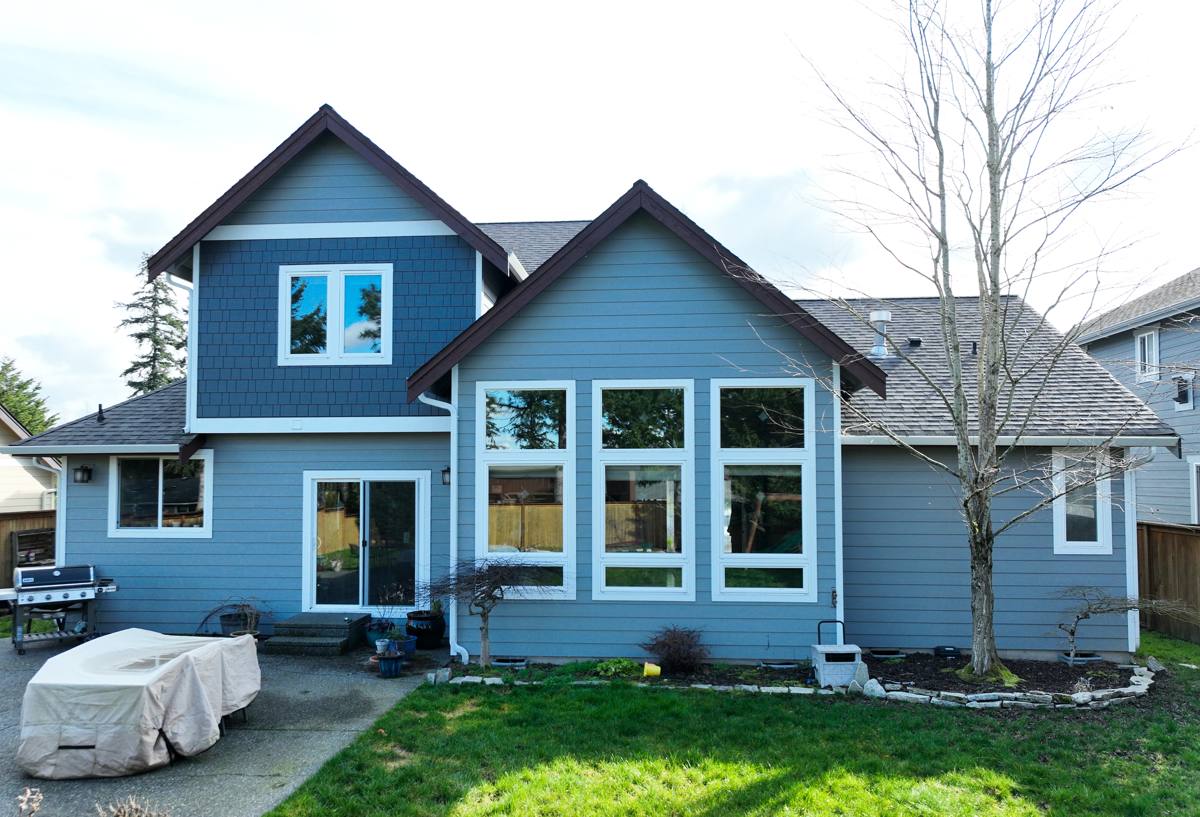
What Bellingham's Climate Does to Siding Over Time
Salt Air and Slow Corrosion
Even set back from the waterfront, Cordata homes sit within a few miles of Bellingham Bay, and the marine air that moves through the county carries fine salt particles with it. Over years, that salt settles on exterior surfaces and works into any exposed metal — nail heads, flashing edges, trim fasteners — accelerating corrosion in ways homeowners further inland never have to think about. Siding materials that rely on paint film alone for protection are more exposed to this; the finish has to hold up against salt exposure on top of everything else the weather throws at it.
Driving Rain and Wind-Driven Water
Whatcom County doesn't just get a lot of rain — it gets rain pushed sideways by wind coming off the water, which means water finds its way into laps, seams, and butt joints that would stay dry in a calmer climate. A siding system is only as good as its weakest lap joint or fastening pattern. Get those details wrong, and driving rain will eventually find the plywood or OSB sheathing behind the siding, no matter how good the surface material looks from the curb.
Moss, Shade, and a Season That Doesn't End
Cordata's mix of mature trees and closely built lots means a lot of siding stays shaded for long stretches of the year, especially on north- and east-facing walls. Combine that shade with Whatcom County's damp fall-through-spring stretch, and you get a moss season that can last six months or more. Moss doesn't just look bad — it holds moisture directly against the siding surface, keeps that surface from drying between rain events, and, on materials that swell or soften when wet, can accelerate rot and finish failure right at the point of contact.
Signs a Cordata Home Needs Siding Replacement, Not Just Repair
Not every siding problem calls for a full replacement, but in Bellingham's climate, small problems compound faster than they would somewhere drier. Here's what we look for when we walk a property in Cordata:
- Soft or spongy spots when you press on the siding, especially near the bottom courses and around window trim
- Persistent moss or dark staining that comes back within weeks of being cleaned off
- Visible gaps, cupping, or warping in lap siding, particularly on walls that take the most weather exposure
- Peeling, bubbling, or chalking paint that keeps failing even after repainting
- Rust streaks below nail heads or trim fasteners
- Interior signs — musty smells, damp drywall, or peeling paint on interior faces of exterior walls
- Original siding on a home built in the 1990s or 2000s that has never been replaced
Any one of these on its own might just need a repair. Several of them together, especially on a home that's never had its siding replaced, usually means the water-resistive barrier and sheathing behind the siding have been absorbing moisture for a while — and that's a replacement conversation, not a caulk-and-patch one.
Why We Install Only James Hardie Fiber Cement
A Non-Combustible Core
James Hardie siding is fiber cement — sand, cement, and cellulose fiber, engineered under heat and pressure. It doesn't burn, which is one less variable to worry about on the exterior of a home over decades of ownership, regardless of what else the Pacific Northwest climate throws at it.
ColorPlus Factory Finish
Most of the paint failure we see on older siding comes down to the same problem: field-applied paint doesn't cure the same way a factory finish does, and it's the first thing to give up against sun, salt air, and repeated wet-dry cycles. Hardie's ColorPlus finish is baked on in a controlled factory environment before the boards ever reach a job site, and it carries its own finish warranty separate from the substrate warranty. That matters in a climate this hard on paint.
Engineered for This Climate — HZ5
James Hardie makes region-specific formulations under its HZ program, and the Pacific Northwest falls under the HZ5 line — engineered for climates with sustained moisture and freeze-thaw cycles, as opposed to the HZ10 formulation built for hot, humid regions. That's not a marketing detail; it's the reason the product is built to perform here rather than being a generic board sold everywhere the same way.
A Warranty Built to Transfer
Hardie backs its siding with a long, transferable limited warranty, which matters to homeowners in Cordata who may sell within the warranty period — it's a selling point for the next owner, not just the current one, and it's part of why we don't hedge our recommendation with alternatives that carry shorter or non-transferable coverage.
What a Correct Siding Replacement Actually Involves
Full Tear-Off and a Real Inspection
We don't side over old siding. Every job starts with a full tear-off down to the sheathing, because that's the only way to actually see what Bellingham's weather has done underneath — soft sheathing, rusted-through building paper, or framing that's been slowly absorbing moisture behind siding that looked fine from the driveway. Any damaged sheathing or framing gets repaired before a single new board goes up.
Water-Resistive Barrier and Flashing First
The siding itself is the least important waterproofing layer in the wall system — the water-resistive barrier and the flashing details around windows, doors, and penetrations are what actually keep driving rain out. We install a continuous weather-resistive barrier, flash every window and door opening properly, and make sure kick-out flashing directs water away from the wall at rooflines instead of behind the siding. This is the part of the job that doesn't show up on a walk-around after it's finished, and it's the part that determines whether the siding lasts twenty years or fails in five.
Fastening, Clearances, and Manufacturer Spec
James Hardie publishes specific installation requirements — fastener type and spacing, minimum clearances from grade, decks, and roof lines, and gapping at butt joints — and those specs exist because the manufacturer's warranty depends on following them. We install to that spec on every job, which is also why we won't warranty work on a home where a previous crew cut corners on clearances or fastening.
How a Cordata Siding Replacement Works With Us
Every home is different, but the sequence stays consistent:
- An on-site estimate where we look at your current siding, trim, and any moisture or moss patterns specific to your lot and sun exposure
- A written scope covering tear-off, sheathing repair allowances, water-resistive barrier, flashing details, and the specific Hardie product and color selected
- Permitting where required, and coordination around Whatcom County or City of Bellingham requirements for the project
- Tear-off, sheathing inspection and repair, and barrier and flashing installation
- Hardie siding and trim installation to manufacturer spec
- A final walkthrough before we consider the job done
We keep the job site protected from Bellingham's rain at every stage — sheathing doesn't sit exposed overnight if we can help it, because a few unplanned wet days shouldn't undo the point of keeping moisture out for the next twenty years.
Comparing Siding Materials Cordata Homeowners Consider
We only install James Hardie, but homeowners researching siding replacement usually come across the same handful of alternatives. Here's how they stack up on the factors that matter most in this climate:
| Material | Moisture Behavior | Finish Durability | Fire Rating | Typical Warranty |
|---|---|---|---|---|
| James Hardie fiber cement | Doesn't rot or swell; engineered for moisture-heavy climates | Factory-baked ColorPlus finish | Non-combustible | Long, transferable |
| Vinyl | Doesn't absorb water, but can warp or crack with temperature swings and impacts | Color runs through, but fades over time and can't be repainted easily | Combustible | Varies widely by manufacturer |
| LP SmartSide (engineered wood) | Wood-based; vulnerable to moisture intrusion at cut edges and joints if not sealed correctly | Field or factory paint, sensitive to installation quality | Combustible | Often shorter, conditions apply |
| Cedar | Natural material; absorbs and releases moisture, needs ongoing maintenance | Requires repeated refinishing to hold up | Combustible | No manufacturer warranty (natural product) |
This isn't a knock on any homeowner who's chosen one of these products — each has real advantages, from vinyl's low upfront cost to cedar's natural appearance. It's why, after weighing moisture behavior, finish durability, and long-term maintenance against Bellingham's specific climate, we standardized on Hardie for every home we side.
What Drives the Cost of a Siding Replacement in Cordata
Every home is priced individually after an on-site look, but the same factors move the number up or down on almost every project:
| Factor | Why It Matters Here |
|---|---|
| Sheathing condition | Years of trapped moisture behind old siding can mean hidden repairs discovered at tear-off |
| Home size and wall complexity | Dormers, multiple gables, and cut-up wall planes take more labor and trim work than a simple rectangle |
| Siding profile and accessories | Lap width, trim boards, and any accent panels affect both material cost and install time |
| Access and lot conditions | Mature trees, tight side yards, and slope common on Cordata lots can affect staging and scaffolding needs |
| Existing moisture damage | Moss-related rot found during tear-off adds sheathing and framing repair to the scope |
We walk through all of this in the estimate itself rather than handing over a number with no explanation behind it — you should know exactly what's driving your price before you decide anything.
Why Hiring a Crew That Already Works in Cordata Matters
Siding installation is unforgiving of shortcuts, and a crew that already works this specific corner of Whatcom County has already seen how local weather patterns play out on real homes — which walls take the worst of the driving rain, which lots hold onto moss the longest, where flashing details tend to get skipped on production-built homes from Cordata's main development years. That experience shows up in the small decisions: how flashing gets lapped at a window head, where control joints go, how clearances get handled at grade and at decks. It also means we aren't learning Whatcom County's permitting requirements for the first time on your project, and we're already positioned to service the warranty on your home for as long as you own it, without a return trip across the state to reach you.
If your Cordata home is showing any of the signs above — or you're just planning ahead for a replacement in the next year or two — we'll come take a look and give you a straight, no-pressure estimate. There's no cost and no obligation to have the conversation.