 Bellingham
 Why Fairhaven Is Hard on Ordinary Siding
Fairhaven sits close to Bellingham Bay, and that proximity to saltwater changes what a home's exterior has to put up with year after year. Salt-laden air carries moisture and fine mineral particles that settle on exterior surfaces, and combined with the near-constant damp of a Pacific Northwest winter, it accelerates corrosion on fasteners, breaks down cheap paint films faster than manufacturers advertise, and gives mold and moss a head start on any surface that stays wet for more than a day or two. Add in driving rain that comes sideways off the water during winter storms, and siding here isn't just a weather shield — it's dealing with wind-driven moisture intrusion at seams, laps, and penetrations that a drier inland neighborhood rarely sees.
Then there's moss season, which in Whatcom County isn't really a season so much as most of the year. Shaded north- and west-facing walls, tree-lined lots, and the region's long stretch of overcast, wet months give moss and algae plenty of time to establish themselves on any siding material that holds moisture at the surface. Once moss gets a foothold, it holds water against the wall longer, which is exactly the condition that rots wood-based siding and delaminates weak paint systems. A siding product and installation that can't shed water fast and resist that biological growth is fighting a losing battle in Fairhaven from day one.
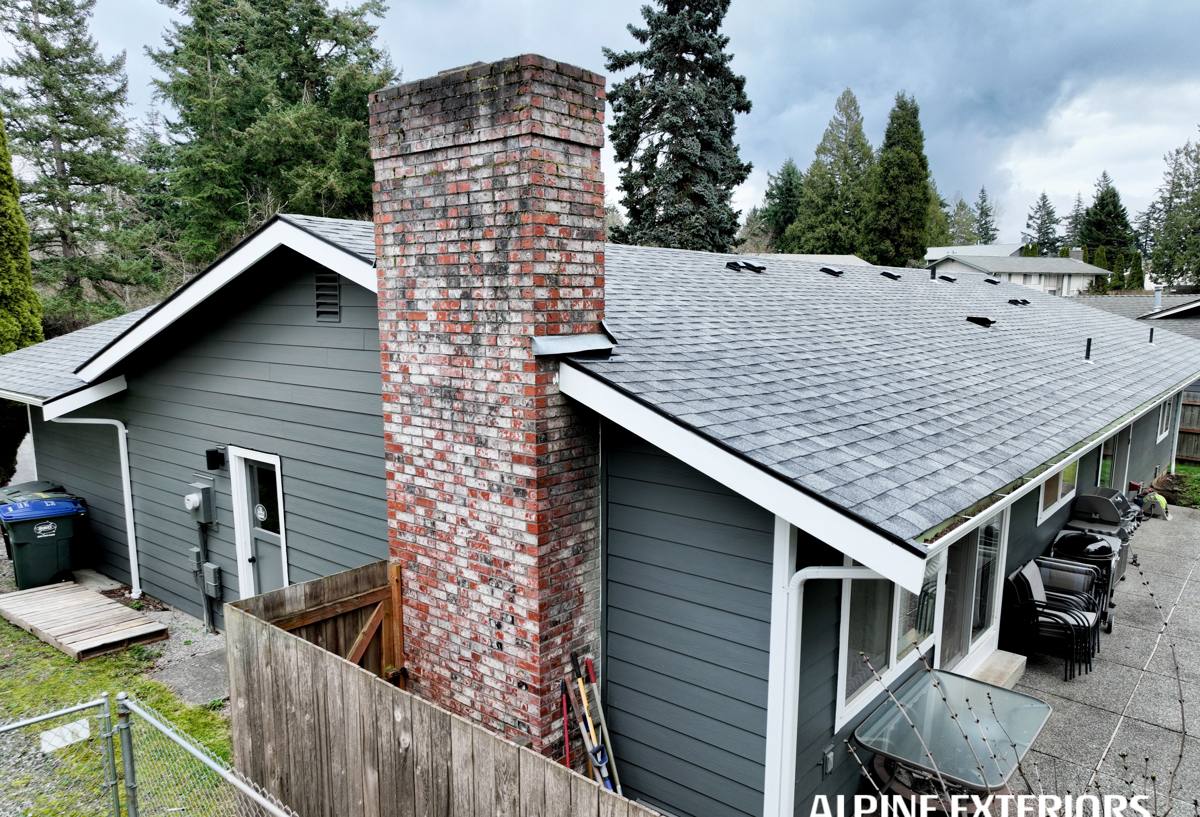
Why We Install Only James Hardie Fiber Cement Siding
We made the decision years ago to install James Hardie fiber cement exclusively, and we don't deviate from that for Fairhaven jobs or any other. We don't install vinyl, LP SmartSide, cedar, primed spruce, or lower-cost fiber cement alternatives like Cemplank or Allura. That's not a marketing position — it's a practical one, built around what actually holds up in this climate.
Fiber cement is non-combustible, which matters given the wildfire smoke seasons the whole region has seen more of in recent summers, and it's dimensionally stable in a way wood and wood-composite products aren't — it doesn't swell, cup, or split the way real wood can when it cycles between soaked and dry all winter. Hardie's ColorPlus factory-applied finish is baked on under controlled conditions rather than field-applied with a brush or sprayer, which gives it more consistent coverage and better long-term color retention against UV and salt exposure than most site-applied paint jobs achieve. Hardie also engineers specific product lines — its HZ5 and HZ10 formulations — for wetter, more humid climate zones, which the Whatcom County coastline qualifies for. We'd rather install one product system correctly, understand its behavior in this exact climate, and stand behind it, than juggle multiple product lines with different moisture tolerances and warranty terms.
What This Means for a Fairhaven Homeowner
In practice, it means every quote we give for a Fairhaven home is for the same engineered product system, backed by a manufacturer warranty that's transferable if the home sells, and installed by a crew that has done this specific product on this specific coastline repeatedly — not a one-off.
What a Correct Fiber Cement Installation Actually Involves
Fiber cement siding is only as good as the assembly behind it. A huge share of the siding failures we get called out to inspect in Bellingham aren't material failures — they're installation shortcuts that let water get behind the siding, where fiber cement can't do its job.
The Water-Resistive Barrier and Flashing
Before a single board goes up, the wall needs a continuous water-resistive barrier (WRB) with all seams properly lapped and taped, and flashing integrated at every window, door, and penetration so water is directed out and down rather than trapped behind the cladding. On a coastal-adjacent property like Fairhaven, we treat this layer as non-negotiable — it's the actual waterproofing system; the siding is the weather-facing layer over the top of it.
Fastening and Gapping
James Hardie specifies exact fastener types, spacing, and placement for each product line, and those specs assume corrosion-resistant fasteners — important given the salt exposure near the bay. Boards also need proper gapping at butt joints and terminations, caulked with a high-quality sealant rated for the exposure, so the siding can move slightly with temperature and humidity swings without cracking its finish or opening a water path.
Clearances at Grade and Roof Lines
Fiber cement siding needs a minimum clearance from grade, roofing, decks, and walkways so it isn't sitting in standing water or getting constant splash-back — a detail that matters even more where moss-covered surfaces and long wet spells keep ground-level moisture elevated for weeks at a time.
Choosing the Right Hardie Product Line for a Fairhaven Home
Not every Hardie profile fits every home style, and part of doing this job right is matching the product line to the house and its exposure. Here's how the common options compare for a property in this area:
| Hardie Product | Best Fit | Notes for This Climate |
|---|---|---|
| HardiePlank Lap Siding | Traditional and craftsman-style homes | Most common choice; available in HZ5/HZ10 formulations engineered for wetter regions |
| HardieShingle | Accent gables, dormers, cottage-style homes | Mimics cedar shingle look without the moisture uptake of real wood |
| HardiePanel | Modern builds, accent walls, board-and-batten look | Larger sheet coverage; seam detailing matters more in driving-rain exposure |
| HardieTrim | Corners, fascia, window and door surrounds | Paired with siding for a fully non-combustible, moisture-stable exterior system |
We walk each Fairhaven homeowner through which combination fits their home's architecture and exposure before we ever write a quote — a north-facing wall that stays shaded most of the day gets treated differently in our planning than a south-facing wall that dries out between storms.
Our Process, Start to Finish
1. On-Site Assessment
We look at the existing siding, the wall assembly underneath where accessible, trim and flashing condition, and any signs of moisture already working its way in — soft spots, staining, or bubbling paint are all clues we check for before quoting.
2. Removal and Wall Inspection
Once the old siding is off, we inspect the sheathing for rot or water damage. This is often where problems that were invisible from the outside actually get found and addressed, rather than sealed back up behind new siding.
3. Water-Resistive Barrier and Flashing Installation
We install a continuous WRB and integrate flashing at every window, door, and penetration before any siding goes up, following manufacturer specifications rather than shortcuts.
4. Fiber Cement Installation
Boards are cut, fastened, and gapped to James Hardie's published specifications for the specific product and climate zone, with corrosion-resistant fasteners appropriate to the salt exposure near the bay.
5. Trim, Caulking, and Final Detailing
Trim work, sealant at joints and terminations, and touch-up of any factory-finished edges cut on site are handled last, so the finished wall sheds water cleanly from top to bottom.
6. Walkthrough
We walk the finished job with the homeowner, point out anything they should know for maintenance, and make sure the work matches what was quoted.
Problems We Commonly Find on Fairhaven Homes
Because we work this specific area regularly, certain patterns show up often enough to be worth mentioning:
- Moss and algae staining concentrated on shaded north- and west-facing walls, especially under tree cover
- Paint delamination on older wood or composite siding where the finish couldn't keep up with repeated wet-dry cycling
- Rot at the bottom courses of siding where clearance from grade, decks, or walkways was never adequate
- Rusted or failing fasteners on older installations, especially closer to the water
- Caulk failure at trim joints and window returns, opening small gaps that let wind-driven rain track behind the wall
None of these are unusual for the climate — they're exactly what this kind of exposure does to siding over time. The point of a correct installation is minimizing how much of this shows up, and how fast.
Living With Fiber Cement Siding in This Climate
Fiber cement is low-maintenance compared to wood, but "low-maintenance" isn't "no-maintenance," especially with Fairhaven's moss season and salt exposure working against any exterior surface. A simple annual routine keeps a Hardie installation performing the way it's designed to:
- Rinse siding gently once or twice a year to clear salt residue, pollen, and surface grime — a garden hose is usually enough; avoid high-pressure washing directly at seams and joints
- Trim back vegetation and tree limbs that keep walls shaded and damp longer than necessary
- Check caulking at trim, window, and door joints annually and have gaps resealed before they let water in
- Watch for moss or algae starting on shaded walls and address it early with a gentle, siding-safe treatment rather than letting it establish
- Have gutters and downspouts checked so overflow isn't running down or splashing back onto siding
What Fiber Cement Siding Costs in Fairhaven
Pricing depends on the size and complexity of the home, the product lines chosen, how much of the existing wall assembly needs repair once old siding comes off, and trim detailing. Broad factors that move the number:
| Cost Factor | Why It Matters |
|---|---|
| Home size and wall complexity | More corners, gables, and dormers mean more cutting, flashing, and labor time |
| Sheathing condition underneath old siding | Rot or water damage found during tear-off requires repair before new siding can go on |
| Product line and profile mix | Combining lap siding with shingle accents or panel sections adds material and labor variety |
| Trim and detail work | Full HardieTrim packages and custom detailing add cost over minimal trim approaches |
| Site access | Tight lots, second stories, and limited staging space affect labor time |
We give every Fairhaven homeowner a written estimate after an on-site assessment rather than a ballpark number over the phone, since the wall condition underneath the old siding is often the biggest variable.
Why Hiring a Crew That Already Works Fairhaven Matters
Siding contractors who don't work this specific coastline regularly can underestimate how much salt exposure and driving rain actually demand from fastener choice, flashing detail, and clearance planning. A crew that already handles Fairhaven and the surrounding Bellingham waterfront knows which walls on which orientations tend to hold moisture, where moss takes hold first, and how the local building department and inspectors expect flashing and WRB work to be documented. That local familiarity shows up in fewer callbacks and a siding system that's actually built for the conditions it has to survive, not just a generic installation dropped into a coastal climate.
If you're weighing a siding replacement or repair in Fairhaven, we're glad to take a look and give you a straightforward, no-pressure estimate based on what your home actually needs — just fill out the form below.