 Bellingham
 Why Birch Bay Decks Wear Out Faster Than You'd Expect
Birch Bay sits right on the water, and that changes what a deck goes through year after year compared to a deck a few miles inland. Salt-laden air corrodes fasteners, hardware, and any exposed metal connectors. Onshore wind drives rain sideways into railings and ledger boards that a more sheltered deck would never see. And Whatcom County's long, wet moss season coats every horizontal surface in a film that holds moisture against the wood or composite decking for months at a stretch. None of this is dramatic on its own, but it adds up. A deck that would last two or three decades in a drier climate can start showing structural problems in half that time out here if it wasn't built with these conditions in mind.
We work on decks throughout Bellingham and Whatcom County, and Birch Bay properties consistently show a specific pattern of wear: rusted or corroded fasteners before the boards themselves fail, soft spots at the ledger board where it meets the house, and moss buildup on north-facing or shaded sections that never fully dries out. If your deck is showing any of these signs, it's worth understanding what's actually happening underneath before deciding whether to repair or replace.
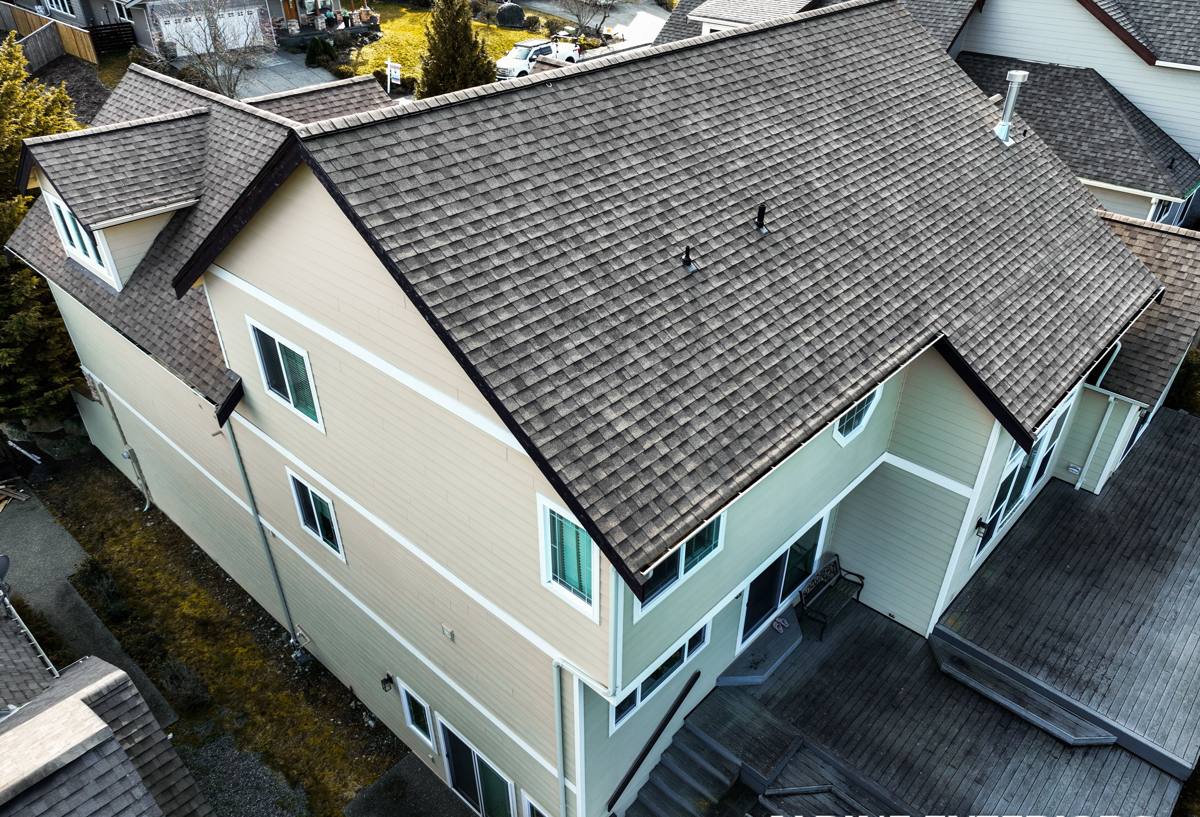
What Salt Air and Moisture Actually Do to a Deck
Fasteners and Hardware
Standard deck screws, nails, and joist hangers are often rated for general outdoor use, not for a marine or near-marine environment. In Birch Bay's salt air, uncoated or lightly coated fasteners corrode from the inside out — meaning the deck can look fine on the surface while the connections holding it together are quietly failing. This is one of the most common reasons we recommend full replacement rather than patching an older deck: once fastener corrosion sets in, you can't just swap a few boards and call it solved.
Moss, Algae, and Trapped Moisture
Whatcom County's moss season typically runs from fall through spring, and a deck with poor drainage or tight board spacing gives moss and algae exactly the damp, shaded conditions they need to take hold. Beyond being slippery and unattractive, moss holds water against the decking surface long after a dry day should have let it evaporate. On wood decking, that sustained moisture is what drives rot. On composite decking, it's mostly a surface and slip-hazard issue, but it still signals a drainage problem worth fixing during a replacement.
Driving Rain and Ledger Board Rot
The ledger board — where the deck attaches to the house — is the single most important structural connection on most decks, and it's also the most common failure point we find. Wind-driven rain off the water pushes moisture into any gap in the ledger flashing, and once water gets behind the board, rot can progress for years without being visible from outside. A correct deck replacement always includes proper ledger flashing, not just a fresh board bolted back onto the same connection.
Signs Your Birch Bay Deck Needs Replacement, Not Repair
- Fasteners that are rusted, backing out, or show orange staining around the screw heads
- Soft, spongy, or springy spots anywhere in the decking, especially near the house
- Visible gaps or separation at the ledger board where the deck meets the siding
- Persistent moss or algae that returns within weeks of cleaning
- Railings that wobble or posts that have any give when pushed
- Structural framing (joists, beams, posts) with visible rot, splitting, or insect damage
- A deck original to a home more than 20-25 years old, especially one that's never been resealed or inspected structurally
If you're only seeing one or two of these and the framing underneath is sound, a repair may genuinely be the right call — we'll tell you that honestly if it's the case. But once fastener corrosion or ledger rot is involved, board-by-board patching almost always costs more over time than doing the replacement right the first time.
What a Correct Deck Replacement Involves
A deck replacement built for Birch Bay's conditions isn't just pulling up old boards and screwing down new ones. The parts that don't show — flashing, fastener grade, framing condition, drainage — are what determine whether the new deck lasts.
1. Full Structural Assessment
We start by checking the framing: joists, beams, posts, and footings. Decking is only as good as what's underneath it, and reusing sound framing while replacing the surface can be the right call on some jobs — but only after we've actually confirmed it's sound, not assumed.
2. Ledger Board and Flashing
Any deck attached to the house gets new or inspected ledger flashing as part of the job. This is the single detail most responsible for long-term deck failures in wet climates, and it's not optional on our jobs.
3. Corrosion-Resistant Fasteners and Hardware
Given the salt air exposure in Birch Bay, we use fasteners and structural hardware rated for coastal or high-moisture environments — typically hot-dip galvanized or stainless steel connectors, and coated deck screws matched to the decking material. This costs more upfront than standard hardware and is the difference between a deck that holds up and one that needs hardware repairs in five years.
4. Proper Drainage and Board Spacing
Correct board spacing and a slight slope away from the house let water shed instead of pooling. This single detail does more to prevent moss buildup than any cleaning product will after the fact.
5. Decking Material Installed to Spec
Whether you choose wood or composite, every material has an installation spec from the manufacturer covering fastener spacing, gapping for expansion, and ventilation underneath. Skipping these specs to save time is a common shortcut that shows up as cupping, gapping, or premature wear within a few seasons — we follow them as written.
Choosing Decking Material for a Birch Bay Property
There's no single right answer here — it depends on your budget, how much upkeep you want to take on, and how close you are to the water. Here's how the common options actually compare in this climate:
| Material | Salt Air Performance | Maintenance | Typical Lifespan |
|---|---|---|---|
| Pressure-treated wood | Good if fasteners and hardware are corrosion-resistant; wood itself handles moisture reasonably well when sealed | Annual cleaning and resealing recommended | 15-20 years |
| Cedar | Naturally moisture and insect resistant; still needs protection from fastener corrosion | Periodic sealing to maintain color and moisture resistance | 15-25 years |
| Composite decking | Excellent — doesn't rot, and most brands resist staining from salt residue | Occasional washing; no sealing or staining | 25-30+ years, varies by brand warranty |
| PVC decking | Excellent — fully synthetic, unaffected by salt or moisture | Lowest maintenance of the group | 25-30+ years, varies by brand warranty |
We'll walk through the real trade-offs for your specific situation rather than pushing one material. Composite and PVC cost more upfront but largely eliminate the moss-and-moisture maintenance cycle that's such a factor this close to the water. Wood costs less initially and can look great, but it asks more of you in ongoing care — and in Birch Bay specifically, that care matters more than it would a few miles inland.
Our Process for a Birch Bay Deck Replacement
- On-site assessment — We inspect the existing deck's framing, ledger connection, and fastener condition to determine the actual scope of the job, not just what's visible from the surface.
- Honest scope and estimate — You get a clear breakdown of what needs replacing versus what can be reused, with material options and their real trade-offs explained plainly.
- Demolition and disposal — Old decking, framing where needed, and debris are removed and hauled off; we protect your landscaping and siding during teardown.
- Framing repair or replacement — Any compromised joists, beams, or posts are addressed before new decking goes down — never covered over.
- Ledger flashing installed correctly — This step doesn't get skipped or shortcut on any job we do.
- Decking installation to manufacturer spec — Proper fastener pattern, spacing, and ventilation, using coastal-grade hardware throughout.
- Railings, stairs, and final details — Built to current code, matched to your home, and checked for solid, wobble-free connections.
- Final walkthrough — We go over the finished deck with you and answer any maintenance questions before we consider the job done.
Permits and Code Considerations
Most deck replacements in Whatcom County — particularly anything involving structural framing, railings, or a deck attached at a certain height — require a building permit. This isn't a step worth skipping even if the previous deck wasn't permitted. We handle the permit process as part of the job so the finished deck is built to current code, which matters both for safety and for resale down the road. If your property is close to the water, there may also be setback or shoreline considerations worth checking early, before demolition starts.
Maintenance Checklist for a New Deck in a Salt Air Environment
A well-built deck still needs some seasonal attention in this climate, especially in Birch Bay. This is a realistic list, not a sales pitch for products you don't need:
- Rinse salt residue and debris off the deck surface a few times a year, especially after storms
- Sweep or blow off moss and leaf debris before it has a chance to sit through a wet stretch
- Check railing and stair connections annually for any looseness
- For wood decking, plan on resealing every 1-2 years depending on sun and salt exposure
- Keep gutters and downspouts clear so runoff isn't draining directly onto or under the deck
- Trim back vegetation that shades the deck and keeps it from drying out between rains
Why It Matters to Hire a Crew That Already Works This Area
Deck construction standards don't change town to town, but the conditions a deck has to survive do. A crew that mostly works drier, inland projects may not default to coastal-grade hardware or think twice about ledger flashing details that matter more here than they would twenty miles east. We work on homes throughout Bellingham and Whatcom County, including the salt air and moss conditions specific to Birch Bay, and we build every deck replacement to hold up to what this particular stretch of coastline puts it through — not to a generic standard that happens to work fine somewhere drier.
If your deck is showing rust, soft spots, moss that won't quit, or it's simply reaching the age where a proper inspection makes sense, we're happy to take a look. Fill out the form below for a free, no-pressure estimate — we'll give you an honest read on whether you're looking at a repair or a full replacement, and what that would actually involve.