 Bellingham
 Building a Deck That Actually Holds Up in Birch Bay
Birch Bay sits close enough to the water that a deck here lives a different life than one built ten miles inland. Salt-laden air, wind-driven rain off the Strait, and a moss season that can run from October through May all work on wood, fasteners, and finishes faster than most homeowners expect. A deck built to a generic spec sheet will often show problems within a few years — corroding hardware, cupped boards, slick green growth in the shade, soft spots where water sat too long. A deck built with this specific stretch of Whatcom County in mind can go decades before it needs more than routine care.
This page covers what actually matters for a Birch Bay deck build: material choices, framing and fastener decisions, moisture management, and the maintenance realities of a marine climate. It's written for homeowners deciding what to build and who to hire, not as a sales pitch for one product.
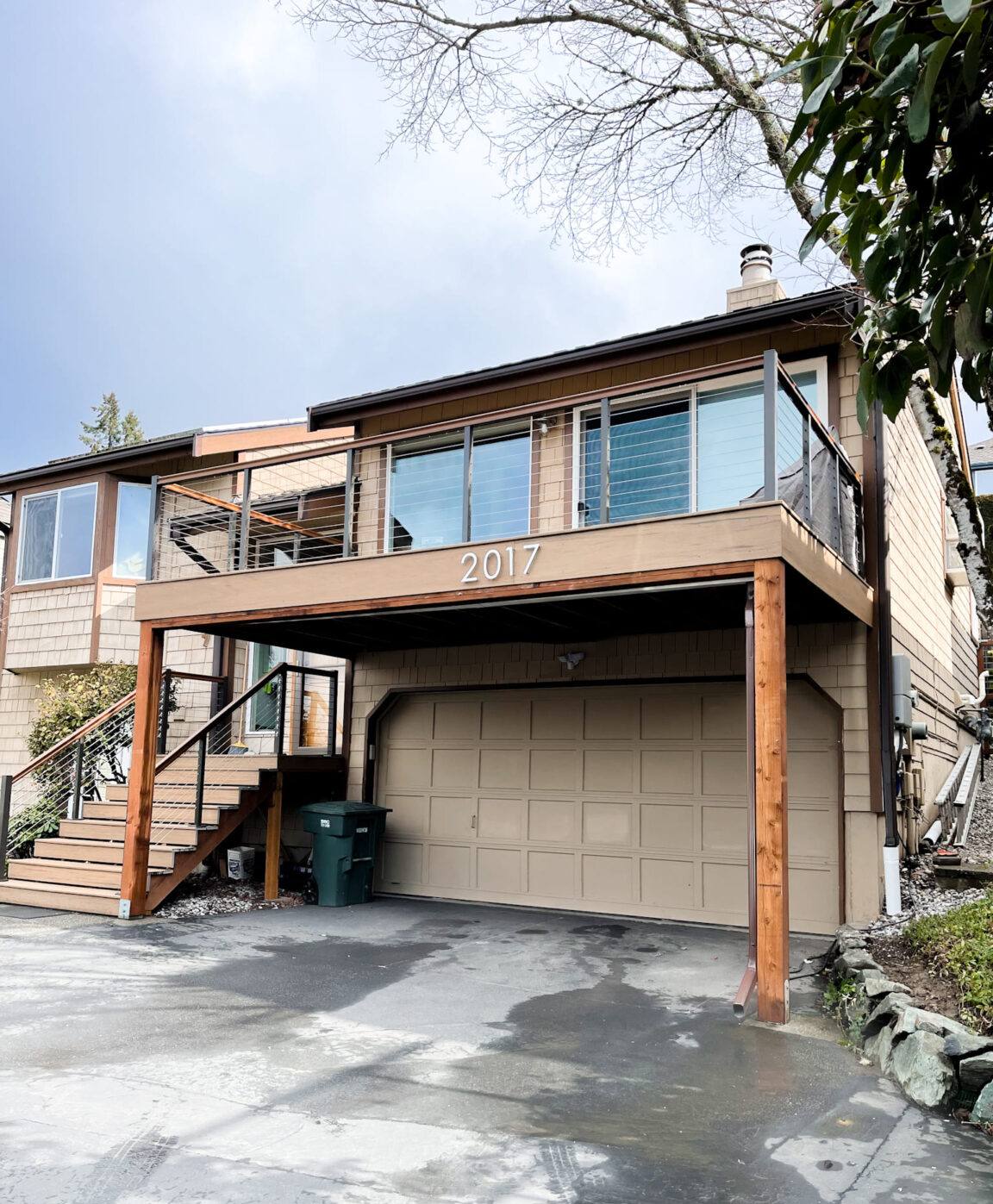
What Salt Air and Driving Rain Actually Do to a Deck
Two climate factors do most of the damage to decks in this area, and they compound each other.
Salt Air and Metal Fasteners
Airborne salt accelerates corrosion on any exposed metal — nails, screws, joist hangers, structural connectors. Standard electro-galvanized hardware, which is fine in a lot of the country, corrodes noticeably faster within a mile or two of Birch Bay's shoreline. Once a fastener starts rusting, it loses holding strength long before the rust is visible from the surface, which is exactly why fastener spec matters more here than the decking material itself.
Driving Rain and Wind Direction
Rain here doesn't just fall — it comes in sideways during winter storms, which means water gets pushed into joints, under boards, and behind rim joists that would stay dry in a calmer climate. Decks with weak flashing details or gaps that trap water tend to rot from the inside, often well before any surface damage is visible.
Moss and Algae
Cool, damp, and shaded conditions for much of the year make Whatcom County a strong environment for moss and algae growth on any horizontal wood or composite surface. Beyond looking bad, moss holds moisture against the decking surface and creates a genuinely slippery walking surface, which is a real fall hazard on stairs and ramps.
Choosing a Decking Material for a Near-Water Property
There's no single "best" decking material — the right choice depends on budget, how much upkeep the homeowner wants to do, and how close the property sits to salt spray. Here's how the common options actually compare in this climate.
| Material | How it handles salt air & rain | Moss/algae behavior | Maintenance |
|---|---|---|---|
| Pressure-treated fir/pine | Good if fasteners and flashing are correct; wood itself is the weak point over time | Prone to growth without regular cleaning | Annual cleaning, periodic sealing |
| Cedar | Naturally rot-resistant, handles moisture well if finished and maintained | Still needs cleaning, but resists rot longer than fir | Regular oiling/sealing to maintain appearance |
| Composite decking | Doesn't rot or absorb water; hardware and framing still need marine-grade spec | Can still grow moss on the surface film; easier to scrub off than wood | Low — periodic washing, no sealing |
| PVC decking | Fully water-resistant surface material | Similar to composite; smooth types shed moss more easily | Low — occasional washing |
Composite and PVC decking have become popular near the water specifically because they remove wood rot from the equation. That said, the framing underneath — the part nobody sees — still has to be built to marine-grade standards no matter what decking surface goes on top. A beautiful composite deck built over undersized, poorly fastened framing is still a deck with a short lifespan.
Framing and Fasteners: The Part That Determines How Long a Deck Lasts
Most deck failures we're called out to inspect in this area aren't decking-surface problems — they're framing and fastener problems that took a few years to become visible. In a salt-air environment, we treat hardware selection as a structural decision, not an afterthought:
- Stainless steel or heavy hot-dip galvanized fasteners in areas with direct salt exposure — standard electro-galvanized hardware corrodes too quickly this close to the water
- Joist hangers and structural connectors rated for the same exposure level as the fasteners holding them
- Treated lumber rated for ground contact on any framing member close to grade or exposed to standing water
- Proper spacing between deck boards to allow drainage and airflow underneath, reducing trapped moisture
- Ledger board flashing that actually sheds water away from the house rim joist, not just a bead of caulk
- Post bases that keep wood off concrete and standing water, rather than posts set directly into wet soil or slabs
None of this is exotic — it's standard best practice for coastal and marine-exposure construction. The issue is that it costs more in materials and labor than a basic inland build, so it's an easy thing to shortcut on if a crew isn't used to building for this specific environment.
Ledger Attachment and Moisture Management
The ledger board — where the deck attaches to the house — is the single most common point of failure on decks we inspect anywhere in Whatcom County, and driving rain makes it worse in Birch Bay specifically. Water that gets behind an improperly flashed ledger doesn't just damage the deck; it can rot the house's rim joist and sheathing behind it, turning a deck repair into a structural repair.
A correct ledger installation uses proper flashing that directs water out and away from the house, not into the wall assembly, along with the right fasteners set at the correct spacing to carry the structural load. This is one of the areas where it's worth asking a contractor to explain their flashing detail specifically — it's not something you can verify by looking at a finished deck, only by knowing how it was built.
Moss, Algae, and Long-Term Deck Maintenance in This Climate
Even a well-built deck in Birch Bay needs a maintenance rhythm suited to the local moss season. A few realistic guidelines:
- Sweep debris and standing organic matter off the deck surface regularly, especially in fall when leaves and needles accumulate
- Clean the deck surface at least once a year — more often on shaded sections — to remove moss and algae before it embeds itself
- Check stairs and any shaded walking surfaces more frequently, since these areas are the most common source of slip hazards
- Re-oil or reseal wood decking on the manufacturer's recommended schedule; skipping this shortens the wood's life significantly in a wet climate
- Inspect fastener heads and structural hardware periodically for early signs of corrosion, particularly on decks close to the water
None of this is difficult, but it does need to actually happen. A lot of the "premature" deck failures we see are decks that were built reasonably well but never got the seasonal cleaning this climate requires.
Our Deck Building Process
We approach every Birch Bay deck build the same structured way:
- On-site assessment — we look at sun/shade exposure, wind and rain exposure relative to the water, drainage around the build site, and the condition of the house structure where the deck will attach.
- Material and design discussion — we walk through decking material options honestly, including upkeep expectations, so the homeowner picks a deck that fits how they actually want to maintain it, not just what looks best on day one.
- Permitting — deck projects of a certain size or height typically require a permit through Whatcom County or the applicable local jurisdiction; we handle that process as part of the build.
- Framing built to marine-exposure standards — correct fasteners, hardware, ledger flashing, and drainage spacing, regardless of which decking surface goes on top.
- Decking installation and finish work — installed to manufacturer spec, with attention to board spacing and drainage.
- Final walkthrough — we go over the maintenance schedule that fits the specific materials used, so there are no surprises a year or two in.
Why a Crew That Already Works Birch Bay Matters
Deck-building fundamentals don't change from town to town, but the exposure conditions do. A crew that mostly builds decks in drier, inland parts of Washington may default to standard hardware and standard flashing details that simply aren't rated for the salt exposure and driving rain a Birch Bay property sees. A crew that regularly works this stretch of the coast already knows to spec stainless or heavy-galvanized hardware, already accounts for wind-driven rain in flashing details, and already sets homeowner expectations correctly around moss-season maintenance.
We're based in Bellingham and work throughout Whatcom County, including Birch Bay, so this isn't an occasional job for us — it's a climate we build for regularly. That familiarity shows up in the parts of the deck you can't see once it's finished, which is exactly where the long-term durability actually comes from.
Get a Straightforward Estimate
If you're planning a new deck or replacing one that's showing its age, we're happy to take a look and walk you through material and construction options suited to your specific spot in Birch Bay. There's no pressure and no obligation — just a straight assessment and an honest estimate. Use the form below to get started.