 Bellingham
 Sunnyland's Climate Is Harder on Siding Than It Looks
Sunnyland sits close enough to Bellingham Bay that homes here deal with a different mix of weather stress than siding manufacturers assume in a lot of their generic installation guidance. It's not one big storm that causes problems — it's the daily grind. Moist, salt-tinged air off the water works into seams and fastener heads. Driving rain, pushed sideways by wind coming off the Sound, hits siding at angles that a lot of installation details never account for. And Whatcom County's long, gray, wet stretch from fall through spring keeps north- and shade-facing walls damp for weeks at a time, which is exactly the environment moss and algae need to take hold.
None of that means siding is doomed here. It means the material and the installation details have to be chosen for this climate specifically, not for a national average. That's the whole basis for how we approach a fiber cement job in this neighborhood: we're not installing siding for a spec sheet, we're installing it for a house that's going to sit a short distance from salt water through another forty Whatcom County winters.
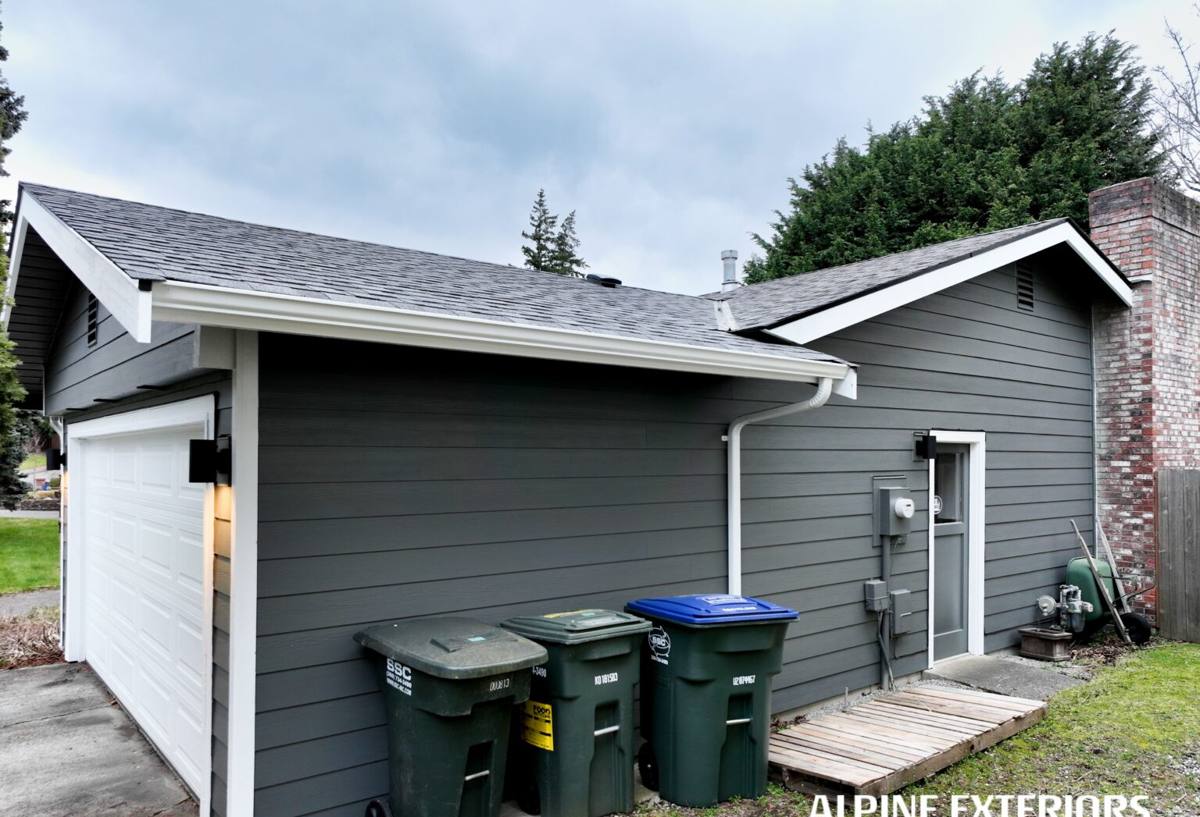
What Correct Fiber Cement Installation Actually Involves
Fiber cement is a genuinely good product in this climate, but it is not a "nail it up and move on" material. Most of the siding failures we get called out to inspect in older Bellingham-area installs aren't a materials problem — they're an installation-detail problem. Water got behind the siding and had nowhere to go, or a joint wasn't sealed correctly, or fasteners were driven wrong. Fiber cement is forgiving of the Northwest's rain load only when the details underneath it are done right.
The Drainage Plane and Rainscreen Gap
Every fiber cement installation should start with a continuous weather-resistive barrier over the sheathing, lapped correctly at every seam so water is always directed outward and down, never sideways or in. In a climate like Sunnyland's, we also build in a rainscreen gap — a small drainage space between the back of the siding and the water barrier — so that any moisture that does get past the siding face can drain and the wall can dry out between rain events instead of staying saturated. On a coastal-influenced property, skipping this gap is one of the most common reasons siding looks fine for a few years and then starts failing from behind.
Flashing, Fasteners, and Clearances
Every window, door, and roof-to-wall transition needs flashing detailed to shed water past the siding, not into it. Fasteners need to be the corrosion-resistant type James Hardie specifies, driven flush (not overdriven, which cracks the board's edge and opens a path for water), and placed at the correct spacing and distance from panel edges. Siding also needs proper clearance off roof lines, decks, and grade — typically a couple of inches minimum — so it isn't sitting in standing water or snowmelt. These aren't optional refinements; they're the difference between siding that holds up through Whatcom County winters and siding that needs board replacement in year six.
Why We Install Only James Hardie Fiber Cement
We don't install vinyl, LP SmartSide, cedar, primed spruce, or other fiber cement brands like Allura or Cemplank. That's a deliberate standard, not a sales preference. James Hardie is the fiber cement manufacturer that engineers products specifically for regional moisture conditions, backs them with a factory finish warranty, and has the long installed track record in wet Pacific Northwest climates that we want behind our name when we put siding on a Sunnyland home.
HZ5 Engineered for Wet, Coastal-Influenced Climates
James Hardie makes region-specific product lines, and for Whatcom County's damp, moisture-heavy conditions we use their HZ5 formulation, engineered for wetter climate zones. It's more resistant to moisture-related damage than a generic fiber cement board, which matters directly for a neighborhood dealing with salt air and a long wet season every year.
ColorPlus Factory Finish
Rather than field-painting siding after installation, Hardie's ColorPlus finish is baked on at the factory in multiple coats, and it comes with its own finish warranty. In a climate that puts a lot of UV-and-moisture cycling stress on exterior paint, a factory-cured finish holds color and resists fading and peeling meaningfully longer than most job-site paint jobs. It also means less repainting maintenance for the homeowner over the life of the siding.
We're upfront that other products get some things right — vinyl is cheap and low-maintenance in mild climates, cedar looks great when new. But vinyl can warp and doesn't hold up to the flying-debris and impact demands of Northwest storms as well as fiber cement, and wood products need an ongoing maintenance commitment (staining, sealing, moisture monitoring) that most homeowners underestimate until they're several years in. For a house near Bellingham Bay, we think the trade-offs land clearly in Hardie's favor.
Siding Options Compared for Sunnyland Homes
| Factor | James Hardie Fiber Cement | Vinyl | Wood / LP SmartSide |
|---|---|---|---|
| Moisture tolerance in coastal, wet climates | High — HZ5 engineered for wet zones | Moderate — can warp under heat/cold cycling | Lower — vulnerable to swelling, rot without diligent upkeep |
| Fire resistance | Non-combustible | Combustible | Combustible |
| Finish durability | Factory ColorPlus finish, long fade resistance | Color molded in, can fade and become brittle over time | Field-applied paint/stain, needs periodic reapplication |
| Maintenance | Occasional washing | Low, but repairs are visible patch jobs | Regular painting, sealing, moss/mildew treatment |
| Typical lifespan when installed to spec | Multiple decades | 15–25 years | Varies widely with maintenance |
| Warranty structure | Strong transferable manufacturer warranty | Varies by manufacturer | Varies; often shorter or maintenance-dependent |
Installation quality affects every row in that table. A poorly installed Hardie job can underperform a well-installed alternative, which is exactly why we treat the install details above as non-negotiable, not optional upsells.
Signs Your Sunnyland Home's Siding Needs Attention
A lot of siding problems in this climate show up gradually, and homeowners often chalk them up to "just Bellingham weather" before realizing there's an underlying issue. Worth checking for:
- Persistent green or black staining on north- or shade-facing walls that pressure washing only temporarily removes
- Soft spots, bubbling, or visible warping in existing siding boards or panels
- Paint that's peeling, cracking, or chalking faster than expected between repaints
- Visible gaps opening up at seams, corners, or around window and door trim
- Musty smell or damp drywall on interior walls that back onto exterior siding
- Fastener heads rusting, bleeding rust streaks, or backing out of the siding face
- Siding that flexes or feels hollow/spongy when pressed near the base of the wall
Any one of these on its own isn't necessarily an emergency, but they're worth a professional look before the next wet season, especially on walls that face prevailing wind and rain.
Our Installation Process
The process is the same discipline whether it's a full re-side or a targeted section, adjusted for the specific exposure of each wall:
- On-site assessment of existing siding, sheathing condition, and moisture history on each elevation of the home
- Removal of old siding and inspection of the sheathing underneath for any hidden rot or water damage before anything new goes up
- Repair of any compromised sheathing found during tear-off — this gets flagged and discussed before we cover it back up
- Installation of a continuous weather-resistive barrier and rainscreen drainage gap
- Flashing installed at all windows, doors, and roof-to-wall intersections
- James Hardie panels or lap siding installed per manufacturer fastening specs, with correct clearances at grade, roof, and deck lines
- Final walkthrough and cleanup, including job-site debris and nail sweep
We don't skip the tear-off inspection step even when it slows a job down. Covering damaged sheathing with brand-new siding just hides a problem that gets worse, and in a climate this wet, hidden moisture problems don't fix themselves.
Living With Fiber Cement in a Moss-Prone, Salty Climate
Fiber cement is genuinely low-maintenance compared to wood, but "low-maintenance" isn't "no-maintenance" in a place with Sunnyland's moss season and salt air. An occasional gentle wash — garden hose and soft brush, or a low-pressure rinse — keeps organic growth from establishing on shaded walls and keeps salt residue from building up on faces closer to the water. We recommend homeowners keep an eye on caulking at trim joints and touch it up if it starts to crack, since caulk is a maintenance item on any siding system, Hardie included. Gutters and downspouts also deserve attention: keeping them clear prevents overflow from running down the siding face and creating the kind of constant dampness that feeds moss and mildew.
Why Local Experience in Sunnyland Matters
A lot of siding contractors work from a generic install manual that assumes a drier, milder climate than Whatcom County actually has. A crew that's worked on homes in and around Sunnyland already knows which elevations take the worst of the wind-driven rain, how much moss pressure to expect on shaded walls, and how the salt air off the bay tends to accelerate wear on fasteners and trim compared to siding jobs done further inland. That local pattern recognition shows up in small decisions — where to add extra flashing attention, which walls need a closer look at the rainscreen detail, how to sequence a job around the wet season — that a generalist crew might not think to make.
It also matters for permitting and code familiarity specific to Bellingham and Whatcom County, and for simply being reachable and accountable if a question comes up two years after installation, not just on move-out day.
If your Sunnyland home needs new siding, a repair on an existing section, or you just want an honest read on what shape your current siding is in, we're happy to take a look and put together a straightforward, no-pressure estimate using the form below.