 Bellingham
 Storm Damage in Fairhaven: What a Bay-Front Neighborhood Deals With
Fairhaven sits close enough to Bellingham Bay that a windstorm here doesn't behave the way it does a few miles inland. Wind coming off open water tends to arrive harder and more directly at roof lines, and it usually brings rain with it that's being pushed sideways rather than falling straight down. Add in a long moss season and a steady drift of salt-tinged marine air, and you get a roof that's already working harder than most before a single storm ever hits it. That's the backdrop for almost every storm damage call we get in this neighborhood: it's rarely just "a storm happened." It's a storm landing on a roof that's been slowly weathered by Whatcom County's coastal climate for years already.
That distinction matters for repair, not just description. A roof that's already got degraded sealant, some early moss intrusion at the edges, or fasteners starting to show rust from salt exposure is going to take storm damage differently than a newer, well-maintained roof inland. A correct repair has to account for both the acute damage from the storm and the condition the roof was already in before it.
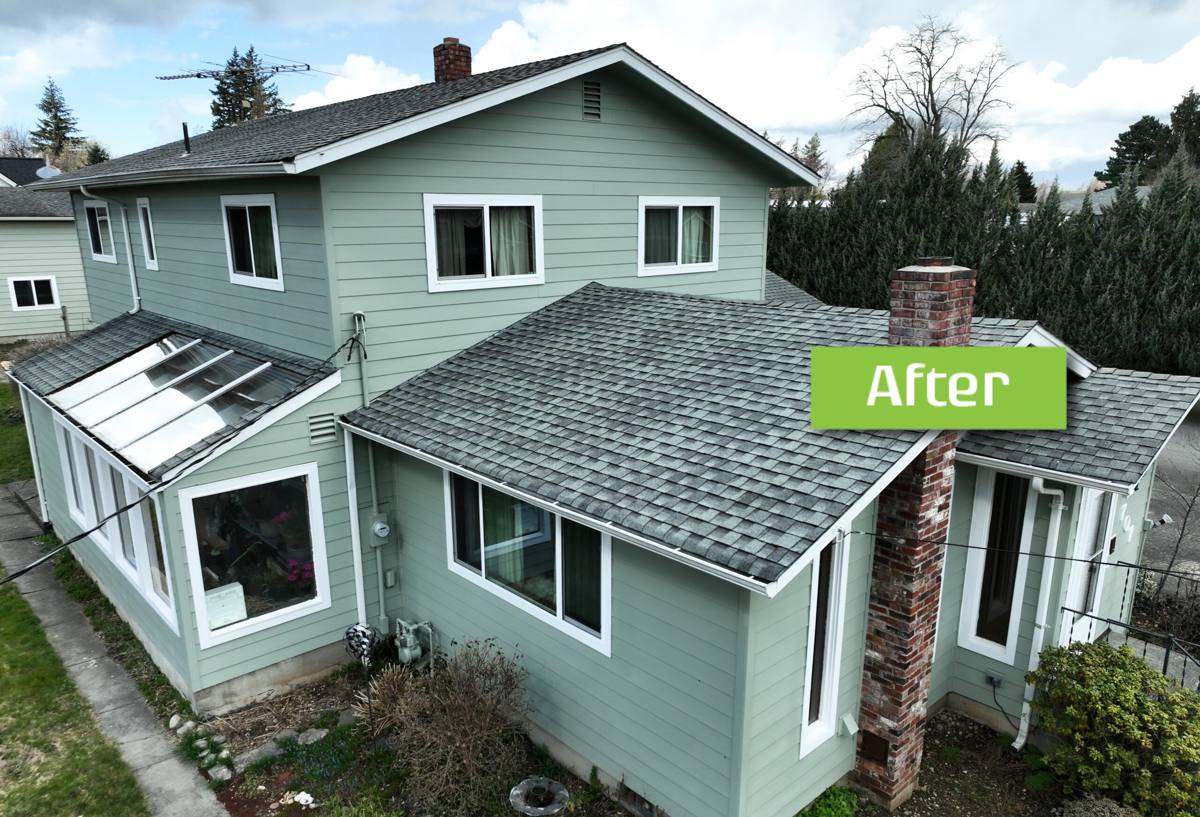
How Wind and Rain Actually Damage a Roof Here
Wind Uplift at Edges and Ridges
Shingles are designed to seal down flat under normal conditions, but sustained or gusting wind off the bay can get underneath an edge, at a rake, eave, or ridge, and start working it loose. Once a shingle's seal strip breaks, it doesn't always blow off outright. Often it just lifts slightly and re-seats, over and over, each cycle weakening the seal a little more until it finally tears, cracks, or comes off completely, sometimes weeks after the storm that actually caused the damage.
Wind-Driven Rain at Flashing and Laps
A roof built to shed rain falling straight down can still leak when that same rain is being pushed sideways or even slightly upward by wind. That's exactly the condition Fairhaven's bay-facing exposure creates. Water finds its way under shingle laps, around step flashing at walls and chimneys, and into valleys that would otherwise handle normal rainfall without issue. This is why storm leaks often show up at flashing points rather than out in the open field of the roof.
Falling Limbs and Debris Impact
A lot of Fairhaven's older residential lots have mature tree cover, which is part of what gives the neighborhood its character, but it also means storms bring down branches and debris that asphalt shingles and flashing weren't built to absorb. Impact damage can range from an obvious puncture to something as subtle as a cracked shingle mat that won't show a leak until months later.
What a Correct Storm Damage Repair Actually Involves
Stopping the Bleeding First
If a roof has an active leak or exposed decking after a storm, the first job is temporary protection, typically a tarp secured well enough to survive the next weather system, not just draped over the damage. This buys time to do the actual repair properly instead of rushing it in bad conditions.
Finding the Real Entry Point
Water doesn't always drip straight down from where it enters. It can travel along the underside of the decking or run down a rafter before showing up on a ceiling several feet away from the actual damage. A correct repair means tracing the leak back to its source on the roof, whether that's a lifted shingle, a failed flashing seam, or a puncture, rather than just patching the spot that's dripping inside the house.
Restoring the Whole Water-Management System
Storm repair isn't just swapping out damaged shingles. It means checking and, where needed, replacing the underlayment and flashing underneath, since those are doing the actual water-shedding work once a shingle has already failed. We also match replacement shingles to the existing roof as closely as the product line allows, though some fading and color variation between older and newer shingles is normal and can't always be fully avoided on a partial repair.
Repair or Replace? How We Make That Call
Not every storm-damaged roof needs to come off. The right call depends on a handful of factors we walk through in person rather than guess at from the ground.
| Factor | What We Look At | Why It Matters |
|---|---|---|
| Extent of damage | Isolated section vs. widespread lifting or impact damage across multiple slopes | Isolated damage on an otherwise sound roof is usually a straightforward repair |
| Age and condition of the rest of the roof | Remaining shingle life, existing moss or granule loss, prior repairs | Repairing a roof that's already near the end of its service life often just delays a bigger job |
| Decking condition underneath | Soft spots, rot, or long-term moisture staining found once shingles are pulled back | Damaged decking changes the scope regardless of how the shingles look from the ground |
| Material availability | Whether the existing shingle line and color are still produced | Discontinued products can make a seamless repair impossible, which affects the repair-vs-replace decision |
| Insurance scope | What the claim covers and whether it's written as repair or full replacement | Affects timeline and what's realistic to complete under the claim |
We'll always tell you plainly when a repair is the honest answer and when it isn't, rather than pushing toward whichever job is bigger.
Our Process for a Fairhaven Storm Call
Inspection and Documentation
We walk the roof in person, photograph the damage, and identify both the storm-caused damage and any pre-existing wear that's relevant to the repair. This documentation matters for your own records as much as for any insurance claim.
Temporary Protection
If there's an active leak or exposed decking, we get it tarped and secured the same visit whenever conditions allow, so the damage doesn't get worse while a full repair is scheduled.
Scope and Estimate
You get a written estimate that spells out exactly what's being repaired, replaced, and why, not just a total number. That's especially important for storm work, where it's easy for a scope to quietly expand or contract without a clear paper trail.
Repair and Follow-Up
Once the work is done, we walk it with you and are available if anything comes up afterward, whether that's a question about the repair or a new issue during the next heavy rain.
Working With Your Insurance Company
Most homeowners going through storm damage repair are also dealing with an insurance claim for the first time in years, and the process is more manageable when the documentation is solid from the start. We photograph damage before and after repair, provide a detailed written scope, and can walk the roof with an adjuster if that's useful to your claim. What we won't do is inflate a scope to match a settlement number or claim damage that isn't actually there. Our job is to give you an honest assessment; how that lines up with your policy and adjuster is between you and your insurer, though we're glad to answer technical questions along the way.
Signs Your Fairhaven Roof Took Storm Damage
- Shingles that look lifted, curled, or creased, especially along edges and ridges
- Granules collecting in gutters or at downspout outlets after a windstorm
- New or worsening water stains on ceilings or upper interior walls
- Visible gaps or damage at flashing around chimneys, vents, or wall intersections
- Dented, bent, or detached gutters and downspouts
- Branches or debris resting on the roof after a storm, even if no damage is obvious from the ground
- A musty smell in an attic or upper closet that wasn't there before the storm
What to Check Before Hiring a Storm Repair Contractor
Storms bring out traveling crews looking for fast work, and Whatcom County isn't exempt from that. A few checks go a long way toward avoiding a bad outcome.
- Confirm an active Washington state contractor license and current liability insurance
- Be wary of anyone going door-to-door immediately after a storm claiming to have spotted damage from the street
- Get a written scope of repair, not just a verbal quote or a total dollar figure
- Ask whether they'll still be a phone call away in a year if something needs a warranty follow-up
- Avoid any contractor pushing you to sign the same day under pressure of a supposed insurance deadline
Why a Local Whatcom County Crew Matters After a Storm
A crew that works Fairhaven and the surrounding Bellingham area regularly knows how bay-driven wind and rain actually behave on real roofs here, not just how a shingle performs on a spec sheet. That shows up in practical judgment calls: which flashing details need extra attention on a bay-facing slope, how much of the damage is fresh versus how much was already building from salt air and moss exposure, and whether a repair will actually hold through the next storm season or just buy a year. That kind of judgment comes from working this specific stretch of coastline repeatedly, not from a single storm-season visit.
If your Fairhaven roof took damage in a recent storm, or you just want an honest look at whether older wear is starting to catch up with it, we're happy to come out. Reach out using the form below for a free, no-pressure estimate.