 Bellingham
 Roof Repair in Silver Beach: A Job That Starts With the Lake
Silver Beach sits along Lake Whatcom, and that setting shapes what a roof here actually needs from a repair. It's a mix of older cottages built close to the shoreline and newer homes set higher on the slope for the lake view, and both ends of that range deal with the same core problem: air that stays damp longer than it does a few miles inland, rain that gets driven directly into lake-facing roof planes, and shaded, tree-covered lots where moss gets a long head start every year. A repair approach that works fine somewhere drier and more open doesn't automatically hold up here, and that gap is what this page is meant to close.
This page focuses specifically on roof repair — not a full replacement — for homes in Silver Beach: what typically causes the damage, how to tell a real repair candidate from a roof that's past that point, what a correct repair actually involves, and why a crew that already works this stretch of shoreline handles the job differently than one seeing it for the first time.
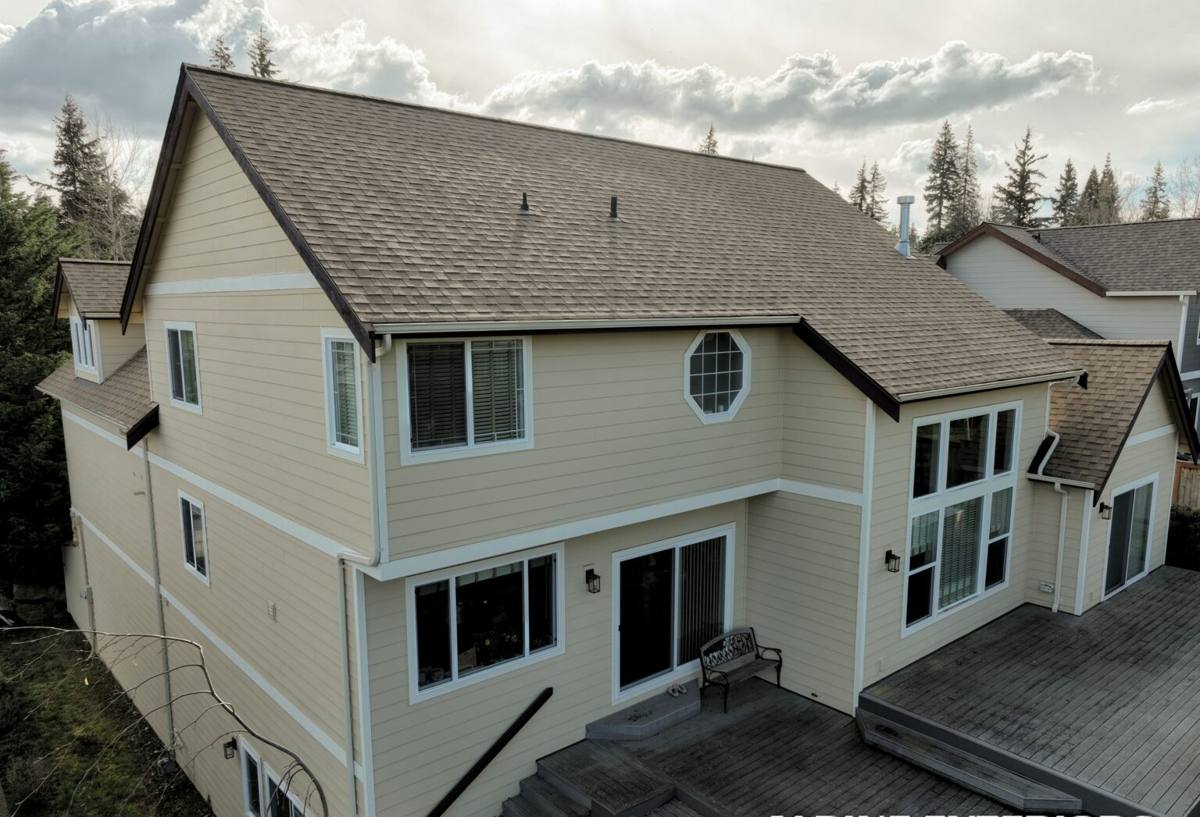
What Actually Causes Roof Damage Around Lake Whatcom
Most of the roof repair calls we get in Silver Beach trace back to the same handful of conditions, layered on top of each other rather than acting alone.
Marine Air and Corroding Metal
Air moving inland off Bellingham Bay and the Strait of Georgia carries a mild salt content that settles into the Lake Whatcom basin along with the lake's own humidity. That combination works slowly on exposed roofing hardware — nail heads, flashing metal, vent boots — corroding lower-grade material years before a leak ever shows up on the ceiling below. By the time a stain appears inside the house, the metal that failed has usually been degrading for a while already.
Wind-Driven Rain Off the Water
Wind moving across open lake water picks up speed and drives rain into a lake-facing roof plane harder than the same storm delivers to a sheltered, tree-covered slope. On a lot where one side of the roof faces the water directly and the other sits in the shelter of the hillside, those two planes can be dealing with genuinely different amounts of stress — part of why a repair scoped for "the roof" in general sometimes misses the specific plane that's actually failing.
A Moss Season That Doesn't Let Up
Between lake humidity, regular Whatcom County rainfall, and tree cover on many Silver Beach lots, north-facing and shaded roof planes rarely get a long dry stretch. Moss and algae take hold in that window and, left alone, work their way under shingle tabs and hold moisture against the roof deck long after the surrounding area has dried out. A lot of the repair work we do in this neighborhood is really moss-related damage that had months, sometimes years, to develop quietly before it became visible as a leak.
Signs a Silver Beach Roof Needs Repair Now
Roofs rarely fail all at once. They give warning signs first, and catching them early is usually the difference between a straightforward repair and a much bigger job later.
- Water staining on an interior ceiling or in the attic, especially near a valley, chimney, or lake-facing wall
- Moss that keeps coming back on the same shaded slope shortly after it's cleaned off
- Shingles that are curling, cracking, or lifting at the edges, particularly on the lake-facing plane
- Granules collecting in gutters or at the base of downspouts
- Visible daylight or soft, spongy spots in the attic decking near a penetration or roof-to-wall transition
- Flashing around a chimney, skylight, or vent that looks rusted, lifted, or gapped
Any one of these on its own doesn't necessarily mean a full replacement. It does mean the roof is telling you something, and it's worth having a real inspection before the next stretch of heavy weather turns it into an active leak.
Repairable Damage vs. What Points to Replacement
Not every roof problem in Silver Beach needs the same answer, and the honest read depends on how far the damage has spread and what shape the rest of the roof is in.
| What We Find | Usually Repairable | Often Signals Replacement |
|---|---|---|
| Isolated flashing failure at one chimney or valley | Yes | Only if surrounding shingles are also failing |
| A handful of cracked or missing shingles | Yes | Not on its own |
| Moss damage limited to one shaded slope | Often, if the deck underneath is still sound | If moss has held moisture long enough to soften the deck |
| Granule loss across most of the roof | Rarely | Yes — signals the shingles are near the end of their service life |
| Widespread curling or brittle shingles across multiple slopes | Rarely | Yes |
| Soft or spongy roof decking found during inspection | Localized sections, sometimes | Yes, if the damage is widespread |
A repair only makes sense when the surrounding roof has enough useful life left to justify it. We'll tell you plainly when a repair is the right call and when it's really just delaying a replacement — one you'll end up paying for anyway, a few years down the road, with more damage attached to it by then.
How We Diagnose a Leak Before Recommending Anything
A repair estimate is only as good as the inspection behind it. On a Silver Beach roof, that means checking more than the spot where a stain showed up inside, since water often travels along the underlayment or deck before it finds its way through the ceiling.
- Tracing the interior stain or damage back to its actual entry point on the roof, which is often several feet from where the water shows up inside
- Checking flashing at every valley, chimney, skylight, and roof-to-wall transition, since that's where most leaks in this area actually start
- Probing the roof deck around the suspected leak for soft spots that indicate moisture has already been sitting there
- Looking at moss and algae growth patterns to identify slopes that are staying damp longer than they should
- Checking attic ventilation, since poor airflow traps moisture against the deck from underneath at the same time weather works on it from above
We walk through what we actually find with you before recommending a scope, including on the occasions when the honest answer is that a small, targeted repair is all the roof needs right now.
What a Correct Roof Repair Actually Involves
Matching Materials to What's Already There
A repair should blend into the existing roof, not stand out as an obvious patch. That means sourcing a shingle profile and color reasonably close to what's already installed, and being upfront when an older roof's exact shingle is no longer available. In that case, a slightly visible patch is usually the honest trade-off against tearing off more of a still-serviceable roof than the job actually requires.
Flashing Repaired as a System, Not Sealed Over
The fastest way to make a flashing leak temporarily disappear is to smear sealant over it. The correct way to fix it is to re-lap the flashing properly with the underlayment and shingles around it, replacing corroded metal rather than caulking over what's already failing. Sealant has its place as a small finishing detail, but it's not a substitute for flashing that's properly integrated into the roof system, and a repair that leans on caulk alone tends to fail again within a season or two.
Addressing the Cause, Not Just the Symptom
A leak is a symptom. Moss holding moisture against the deck, a ventilation imbalance, or a flashing detail that was never lapped correctly in the first place is usually the actual cause. On moss-related repairs, that means treating and clearing the affected slope as part of the job, not just patching the spot where water got through — otherwise the same repair is often needed again within a couple of seasons.
Emergency and Temporary Repairs
When a leak shows up during a storm and a full repair has to wait for a dry window to do the job correctly, a temporary measure — tarping or a targeted patch — can protect the interior of the home in the meantime. We're upfront that this is a stopgap, not a fix, and we schedule the permanent repair as soon as weather allows rather than letting a temporary patch quietly become the long-term solution.
Cost Factors Worth Understanding
Roof repair estimates can look very different from one contractor to the next, and the difference is usually real scope rather than one bid simply being padded.
| Factor | What It Affects |
|---|---|
| Cause of the leak vs. its symptom | Whether the repair addresses the actual source or just the visible damage |
| Extent of deck damage found | Whether the fix is a shingle-and-flashing repair or includes deck replacement |
| Flashing material and scope | How long the repair holds up against wind-driven rain and marine air |
| Shingle match availability | Whether the repair blends in or requires a broader patch area |
| Roof pitch and access | Labor time and staging, especially on steeper or elevated lake-facing lots |
| Moss treatment and cleanup | Whether the underlying cause of moss-related damage gets addressed, not just the leak |
A written estimate that breaks these out separately tells you far more than a single lump-sum number. It's worth asking any contractor exactly what's included before comparing two bids that may not be scoped the same way at all.
Our Repair Process
- On-site inspection: We get on the roof and into the attic ourselves rather than estimating from photos or a description over the phone.
- Honest diagnosis: We trace the damage to its actual cause and explain what we found in plain terms, including on the occasions when the repair is smaller than expected.
- Written estimate: A clear scope covering flashing, shingles, deck repair if needed, and moss treatment where relevant — not one vague line item.
- Scheduling around weather: We build reasonable flexibility into the timeline, since waiting for a dry window is a normal part of doing repair work correctly in this region.
- The repair itself: Flashing, shingles, and any deck sections are addressed to the same standard we'd use on new construction, not a lesser scope just because it's a repair.
- Final walkthrough: We review the completed repair with you and do a site cleanup, including a check for loose debris and old materials, before calling the job done.
Why Hiring a Crew That Already Works Silver Beach Matters
Two roofs a few houses apart in Silver Beach can be dealing with very different exposure — one facing directly across the lake and taking the brunt of wind-driven rain, another shaded most of the day under trees on the slope above and fighting moss instead. A crew that regularly works this shoreline has already seen that variation play out repeatedly, and adjusts flashing details, fastener choice, and moss treatment plane by plane instead of applying one generic approach to the whole roof. That's the kind of judgment that's hard to fake on a first visit to a neighborhood.
It also matters after the repair is finished. A workmanship warranty is only as good as the company still being reachable when a question comes up a couple of years later, and a contractor with an ongoing, established presence in the area is easier to hold to that than one that's already moved on to the next region.
A Practical Checklist Before You Hire for Roof Repair
- Does the estimate explain the cause of the leak, not just describe the visible damage?
- Is flashing work specified by material and scope, not just "repair as needed"?
- Do they inspect the attic and roof deck, not just the roof surface from outside?
- Do they carry current WA contractor licensing and active liability insurance?
- Can they speak specifically to lake-facing exposure and moss patterns in Silver Beach?
- Is the workmanship warranty separate and clearly explained from the material warranty?
If you're dealing with a leak, a stubborn patch of moss, or just want a straight read on what your Silver Beach roof actually needs, we're glad to take a look and give you an honest answer — including on the occasions when the answer is that it doesn't need much yet. Use the form below to request a free, no-pressure estimate.