 Bellingham
 Siding Replacement for Birchwood Homes
Birchwood is one of Bellingham's established residential neighborhoods, and a lot of the siding on Birchwood homes has been doing its job for decades — often longer than the material was really built to last. The weather it's up against hasn't gotten any easier in that time. Whatcom County's marine climate puts three specific stresses on exterior siding: salt-tinged air drifting in off the water, wind-driven rain that rarely falls straight down, and a moss season that, on shaded lots, can run most of the year. Combine that with the mature tree canopy common to older neighborhoods like Birchwood, and you end up with siding that spends a lot of its life damp, shaded, and slow to dry out between storms.
Siding replacement is not a project most homeowners take on casually, and it shouldn't be. Done right, it's a once-a-generation investment that protects the structure underneath for thirty-plus years. Done with the wrong material, or installed without the right details for this climate, it's a problem that resurfaces in five to ten years — usually as rot, staining, or paint failure that costs more to trace and fix than it would have cost to do right the first time. This page covers what Birchwood homes specifically need from a siding replacement, what a correct job actually involves, and why we install exclusively James Hardie fiber cement siding on every replacement we do.
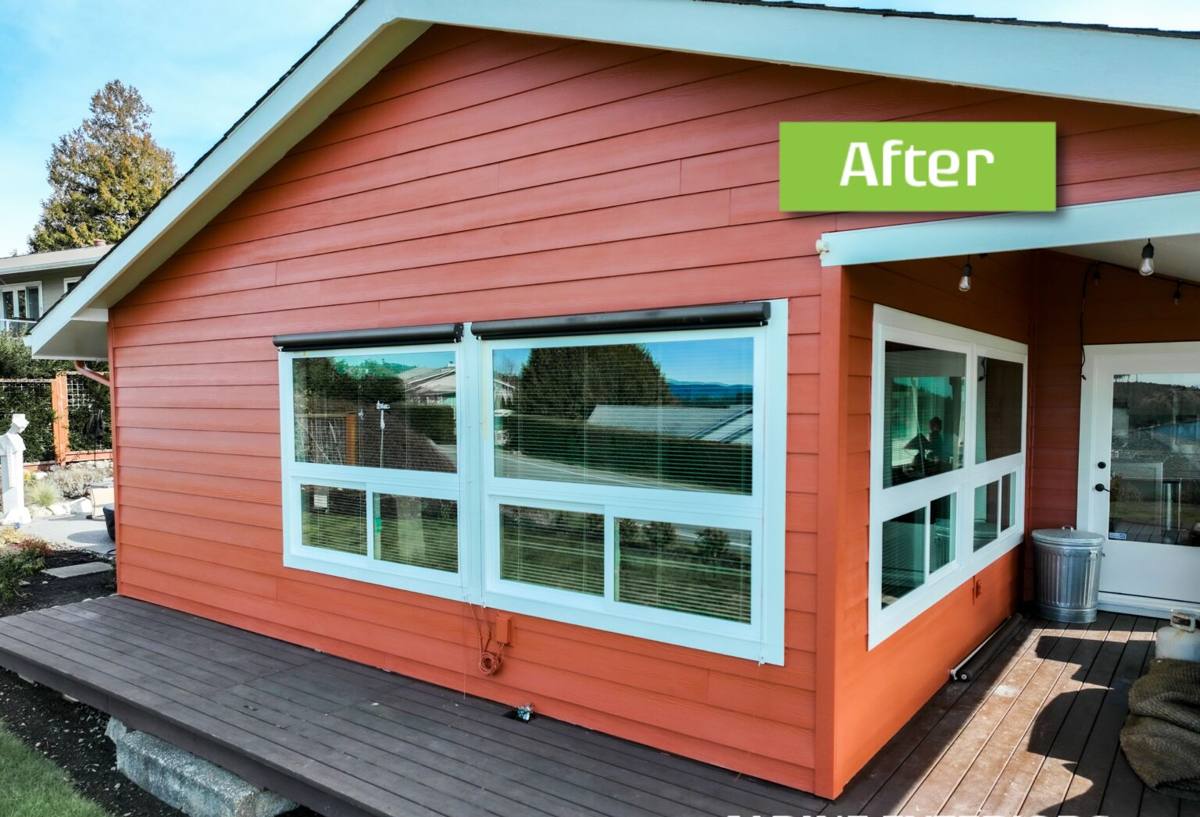
What Birchwood's Climate Does to Old Siding
Salt Air and Slow Corrosion
Even away from the immediate waterfront, Whatcom County's marine air carries enough salt to accelerate corrosion on exposed fasteners, flashing, and trim over time. On older homes this often shows up first as faint rust streaking below nail heads or staples — a sign the fastener underneath has already started to fail, not just a surface stain. By the time that streaking is visible, the fastener has usually been compromised for a while, and whatever it was supposed to be holding tight is starting to work loose.
Wind-Driven Rain
Rain in this part of Washington rarely falls straight down. Wind pushes it sideways against exterior walls, which means horizontal laps, corner joints, and trim transitions all take more direct water pressure than they would in a calmer inland climate. Siding installed with minimal overlap, gapped joints, or loose flashing can look fine for a couple of dry summers before that wind-driven rain finally finds its way behind the surface.
Moss Season and Shaded Walls
The mature trees that give neighborhoods like Birchwood their character also cast shade that keeps north- and east-facing walls damp longer after every rain. That extended dampness is exactly what moss, algae, and mildew need to take hold, and once established on a wall, they hold even more moisture against the surface — a cycle that speeds up whatever damage was already underway underneath the growth.
Signs a Birchwood Home Needs Siding Replacement, Not Just Repair
Some siding problems are genuinely a repair — a cracked board, a loose piece of trim. Others are a sign that the material underneath has reached the end of what it can protect, and patching one spot just delays a bigger conversation. A few things worth checking on your own:
- Soft or spongy spots when you press on the siding, especially near the bottom courses or below windows
- Paint that keeps failing within a year or two of repainting, even after proper surface prep
- Persistent moss or dark staining that returns within a few months of cleaning
- Visible gaps, warping, or cupping in individual boards or panels
- Rising energy bills with no other clear explanation, which can point to a compromised weather barrier behind the siding
- Original siding on a home built more than 25 to 30 years ago, especially if it's a wood-based product
Any one of these on its own might still be a repair. Several together, especially on a wall with real sun and shade exposure differences, usually mean the material itself has reached the end of its service life rather than just needing a patch.
Why We Install Only James Hardie Fiber Cement
We standardized on one siding system rather than offering several, and that decision comes down to how each material actually behaves once it's been through repeated Bellingham winters — not how it looks in a showroom sample.
| Material | Behavior in This Climate | Maintenance Burden | Realistic Lifespan |
|---|---|---|---|
| James Hardie fiber cement | Dimensionally stable; doesn't swell, cup, or rot from repeated wetting | Low; factory finish resists moss and fading | 30+ years with proper install |
| LP SmartSide (engineered wood) | Sensitive to moisture at cut edges and fastener holes over time | Moderate; edge sealing needs periodic upkeep | 15-25 years, climate-dependent |
| Vinyl | Can warp, fade, or gap in cold and sun cycling; hides moisture issues behind it | Low visible upkeep, but problems underneath go unseen | 20-30 years, variable |
| Cedar | Absorbs moisture readily without regular sealing or repainting | High; recurring sealing or repainting cycle | 15-25 years with consistent upkeep |
James Hardie's fiber cement core doesn't expand and contract with moisture the way wood-based products do, which matters most on a climate that keeps siding damp for long stretches at a time. The factory-applied ColorPlus finish also means field-cut edges are the only place we're priming on site — unlike products where the whole wall's finish depends on paint quality holding up outdoors year after year. LP SmartSide, vinyl, Cemplank, Allura, primed spruce, and cedar are legitimate products, and other contractors install them competently. We made a professional decision to stand behind one system we trust completely rather than offer options that shift long-term maintenance risk back onto the homeowner.
What a Correct Siding Replacement Actually Involves
Tear-Off and Wall Inspection
Removing the old siding is also the only real chance to see what's happening behind it. We inspect the sheathing, framing, and any existing weather barrier for rot, moisture staining, or insect damage before anything new goes up. Covering a hidden problem with new siding doesn't fix it — it just buys it a few more years to get worse out of sight.
Weather-Resistive Barrier and Drainage
A correctly lapped house wrap, and a drainage gap or rainscreen behind the new siding, gives any moisture that does get past the surface a way to dry out instead of sitting against the wall. This step is invisible once the project's finished, which is exactly why it's one of the easiest things for a corner-cutting install to skip.
Fastening and Flashing to Spec
Corrosion-resistant fasteners at the manufacturer's specified spacing, and properly lapped flashing at every window, door, corner, and roofline transition, are what actually keep wind-driven rain out. Generic fastening patterns might hold the siding up, but "holding up" and "keeping water out" are two different standards.
Factory Finish, Not a Field Paint Job
Hardie's ColorPlus boards arrive with a baked-on factory finish, so the only painting we do on site is priming field-cut edges before they go up. That's a meaningfully different maintenance picture than a product that depends on the quality of a field-applied paint job to hold color and shed water for the next decade.
Our Process for a Birchwood Siding Replacement
Walkthrough and Assessment
We look at the specific walls involved — which ones face weather directly, which are shaded and slow to dry under tree cover, and whether there are early signs of moisture damage that should factor into the plan before tear-off starts.
Material and Color Selection
We walk through Hardie's product lines and ColorPlus color options and help you land on a combination that fits the home and the budget, without pushing you toward add-ons the project doesn't need.
Installation to Manufacturer Spec
Every fastener, gap, and flashing detail follows James Hardie's published installation requirements for this climate zone, not a generic national standard. That's what keeps the manufacturer's warranty intact and what keeps the wall performing the way it's supposed to for decades, not years.
Final Walkthrough
We walk the finished job with you, explain what little maintenance the material actually needs, and make sure you know what a healthy wall looks like if you ever want to check on it yourself down the road.
Why Hire a Crew That Already Works Birchwood
Siding replacement rewards local, climate-specific experience in ways that aren't obvious until something goes wrong. A crew that's worked Birchwood and the surrounding neighborhoods through multiple wet seasons already knows which wall orientations need extra drainage detail because of shade and tree cover, how much clearance a given profile actually needs in a climate this consistently damp, and where a rainscreen gap earns its keep versus where it's optional. That's judgment built from seeing how installs in this exact area hold up over years, not from a spec sheet — and it's the difference between a wall that looks and performs the same in fifteen years and one that's showing staining and soft spots by year five.
Cost Factors for Siding Replacement in This Area
Full siding replacement costs vary more than most homeowners expect, mostly because so much of the price is driven by what's found once tear-off starts, not just square footage. A few things that move the number on a given Birchwood home:
| Factor | Why It Matters |
|---|---|
| Existing wall condition | Rot or moisture damage found during tear-off needs repair before new siding goes up |
| Home size and wall complexity | More corners, dormers, and transitions mean more cuts and flashing details |
| Siding profile chosen | Lap, board and batten, and shingle-style profiles differ in material and labor |
| Trim and window detailing | More openings mean more flashing and finish work around each one |
| Access and site conditions | Tree cover, slope, and tight lot access can add labor time |
We'll walk your specific home and give you real numbers rather than a rough estimate based on square footage alone — two homes of similar size in the same neighborhood can land at very different price points depending on how many of these factors are actually in play.
Getting It Right the First Time
Siding replacement is not a project worth redoing. Once the old material is off and new siding is up, correcting a bad install usually means tearing back down to the sheathing rather than a simple patch — which erases most of the savings a cheaper install promised in the first place. That's why we treat the assessment and planning phase of every project as seriously as the install itself, especially on a home that's going to be living through another thirty years of Bellingham weather afterward.
If you're weighing a siding replacement for a home in Birchwood, we're happy to take a look, talk through what your specific walls need given their exposure and condition, and give you a straightforward, no-pressure estimate. There's a form below — reach out and we'll set up a time to come by.