 Bellingham
 Why Deck Replacement Works Differently in Puget
Puget sits close enough to the water that homes here take a different kind of beating than decks further inland. Salt-laden air off Bellingham Bay accelerates corrosion on fasteners, flashing, and any metal hardware that isn't rated for it. Add Whatcom County's long stretch of driving rain each fall and winter, plus a moss season that can run from October well into April on shaded or north-facing decks, and you have a structure that's under near-constant moisture load for most of the year. A deck built with inland assumptions — standard fasteners, minimal drainage detailing, decking laid tight with no airflow underneath — tends to show its age here faster than the same deck would in a drier part of the state.
That's the starting point for how we think about deck replacement in this neighborhood. It's not just swapping old boards for new ones. It's correcting the details that let salt air, rain, and moss do the damage in the first place, so the next deck actually holds up to the conditions it's built in.
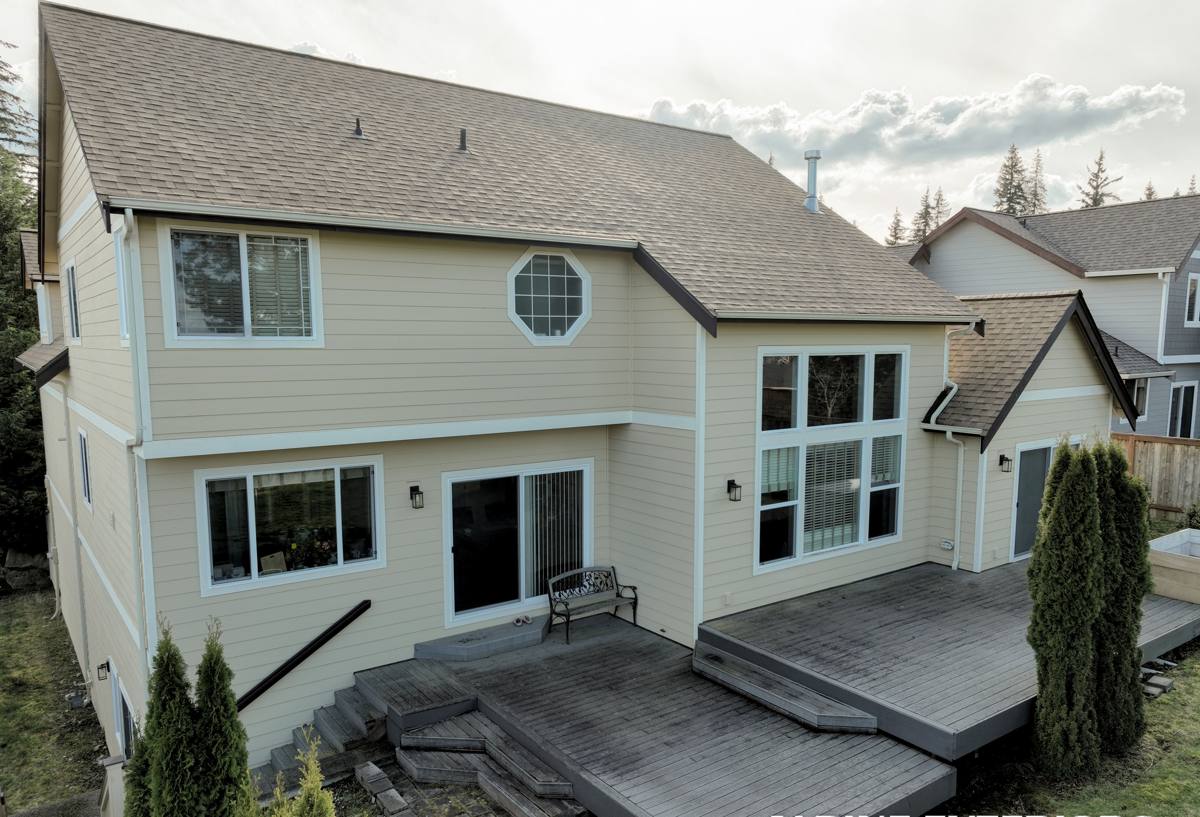
Signs a Puget Deck Needs Replacement, Not Just Repair
Structural Signs
Some problems are worth fixing in place — a handful of cupped boards, a loose railing baluster, a spot of surface mildew. Others mean the deck has moved past the point where patching makes sense. Soft or spongy spots underfoot usually mean the joists or the decking substrate have taken on moisture damage. Rust streaking below fastener heads or around post bases is a sign the hardware is failing, and once that starts it doesn't reverse itself. A ledger board pulling away from the house, or visible gaps opening up at the house connection, is a structural red flag that shouldn't wait.
Surface and Moisture Signs
On the surface, look for wood that stays dark and damp long after the rest of the deck has dried, persistent green or black staining that comes back within weeks of cleaning, and boards that have started to cup or crown noticeably. These are the visible result of the moisture cycle Puget decks go through every wet season — and if the underlying structure has been absorbing that same cycle for years, refinishing the surface won't solve the real problem.
What a Correct Deck Replacement Involves
A deck replacement done right is really several separate systems working together — structure, drainage, fasteners, and surface. Skipping any one of them is usually where premature failures start.
Framing and Structure
We start from the ground up: post footings sized and set to current code, proper joist spacing for the decking material chosen, and blocking where it's needed for stiffness and fire code compliance. In a climate this wet, we also pay attention to airflow under the deck — joists and beams that can't breathe stay damp longer and rot faster, even when they're pressure-treated.
Ledger Board and Flashing
The ledger board — where the deck attaches to the house — is the single most common failure point on any deck, and it's the detail that matters most in a region with this much driving rain. Correct flashing keeps water from working its way behind the ledger and into the house's wall assembly. This is not a place to cut corners, and it's one of the first things we check on any existing deck we're asked to replace.
Fasteners and Hardware
Given the salt air off the bay, we use fasteners and structural hardware rated for coastal or corrosive exposure rather than standard-grade options. Standard hardware can look fine for a season or two before corrosion sets in below the surface — by the time rust is visible, the connection has often already weakened.
Railings and Code Compliance
Railings, guard height, baluster spacing, and stair requirements are all governed by current building code, and code has changed over the years. A full replacement is the right time to bring an older deck up to current requirements rather than carrying forward a railing system that wouldn't pass inspection today.
Choosing a Decking Material for This Climate
There's no single "best" decking material for every home — it depends on budget, maintenance tolerance, and how exposed the deck is to sun, shade, and moisture. Here's how the common options actually perform under Puget's conditions:
| Material | How it handles moisture & moss | Maintenance burden |
|---|---|---|
| Pressure-treated wood | Resists rot well when properly installed and ventilated; still needs sealing to shed moss and staining | Annual cleaning and periodic re-sealing |
| Cedar | Naturally moisture- and insect-resistant, but surface still greys and can hold moss in shaded areas without upkeep | Regular cleaning; sealing or staining every couple years |
| Composite decking | Doesn't absorb water or rot, but moss and algae can still grow on the surface film in shaded, damp spots | Periodic washing; no sealing or staining required |
| PVC decking | Fully resists moisture absorption and rot; best option where shade and dampness are constant | Occasional washing |
Shaded, north-facing decks — common on lots with mature tree cover around Puget — are where moss becomes the deciding factor. On those decks, we lean toward materials and board spacing that shed water quickly and don't give moss anything to hold onto, regardless of which product family the homeowner prefers.
Our Deck Replacement Process
- On-site assessment: we inspect the existing deck's framing, ledger connection, and footings to understand what's failing and why.
- Honest scope discussion: we walk through material options and what fits the budget, without pushing a single product as the only answer.
- Removal: the old deck comes out, and we check the ledger and rim joist behind it for hidden moisture damage before anything new goes up.
- Rebuild: new footings or posts as needed, corrosion-rated hardware throughout, correct ledger flashing, and code-compliant framing and railings.
- Decking and finish: boards installed with proper spacing for drainage and airflow, finished per the chosen material's requirements.
- Final walkthrough: we go over care and maintenance specific to the material installed, so the deck actually gets the lifespan it's built for.
Permits and Code Considerations
Most deck replacements in Bellingham and unincorporated Whatcom County require a permit, particularly when the work involves new footings, structural framing, or railing changes — which is nearly always the case in a full replacement. Permit requirements and inspection timing can shift, so we confirm what applies to a given property before work starts rather than assuming last year's rules still apply. Skipping a required permit can create real problems at resale, so it's worth doing right the first time.
Maintenance That Actually Matters Here
The right maintenance routine depends on the material, but a few habits matter for almost every deck in this climate:
- Clear leaves and debris from between boards before they trap moisture through the wet season
- Treat moss at the first sign of it rather than waiting until it's established — it's far easier to remove early
- Check fastener heads and hardware for early rust or corrosion once a year
- Keep gutters and downspouts near the deck clear so runoff isn't draining directly onto or under it
- Re-seal or re-stain wood decking on the schedule the product calls for, not just when it looks faded
- Watch the ledger board connection for gaps or staining, since that's the first place moisture problems show up
Cost Factors to Expect
Every deck is different, so exact pricing depends on size, height, material, and site access — but a few factors consistently move the number up or down:
| Factor | Effect on cost |
|---|---|
| Decking material chosen | Composite and PVC cost more upfront than wood; pressure-treated is the most budget-friendly |
| Deck height and footing depth | Taller decks and deeper frost-line footings add labor and material |
| Ledger and structural condition | Hidden rot behind the ledger or in the rim joist adds repair scope once uncovered |
| Railing style and code updates | Bringing an older railing system up to current code can add cost on older homes |
| Site access | Decks over slopes, water features, or with limited equipment access take more labor to build safely |
We give a firm, itemized estimate after seeing the site in person — not a phone quote — because the ledger condition and footing situation genuinely change the scope on older decks.
Why Hire a Crew That Already Works in Puget
A contractor who's replaced decks around this specific part of Bellingham already knows which details matter here: how the moisture and moss patterns run on shaded lots, what corrosion-rated hardware actually holds up near the bay, and which framing habits keep a deck from decaying quietly under the surface. That local pattern recognition is the difference between a deck that looks good for one season and one that's still solid a decade from now. We're a Whatcom County crew, and we build every replacement — in Puget and across Bellingham — to hold up to the rain, salt air, and moss this region deals with every year, not to a generic spec sheet.
If your deck is showing rot, rust, or moss that keeps coming back, we're happy to take a look and give you a straight answer on repair versus replacement. Use the form below to request a free, no-pressure estimate.