 Bellingham
 Why Lynden Roofs Take a Different Kind of Beating
Lynden sits inland from Bellingham Bay, but it doesn't escape the weather pattern that defines this corner of Washington. The same marine air that rolls in off the Pacific and through the Strait of Georgia pushes rain across all of Whatcom County, Lynden included, and that rain doesn't come in short bursts — it comes in long, driving spells that can sit over a roof for days at a time. Add in the valley's humidity and the tree cover common around Lynden properties, and you get a moss season that runs far longer than most homeowners expect, sometimes close to nine or ten months out of the year.
That combination — sustained moisture, limited direct sun on north-facing slopes, and moss that never fully dies back — is what actually damages roofs here. It's rarely one dramatic storm. It's water and organic growth working on the same weak points, season after season, until a small issue becomes a leak. A roof repair in this climate has to account for that pattern, not just patch the symptom you can see.
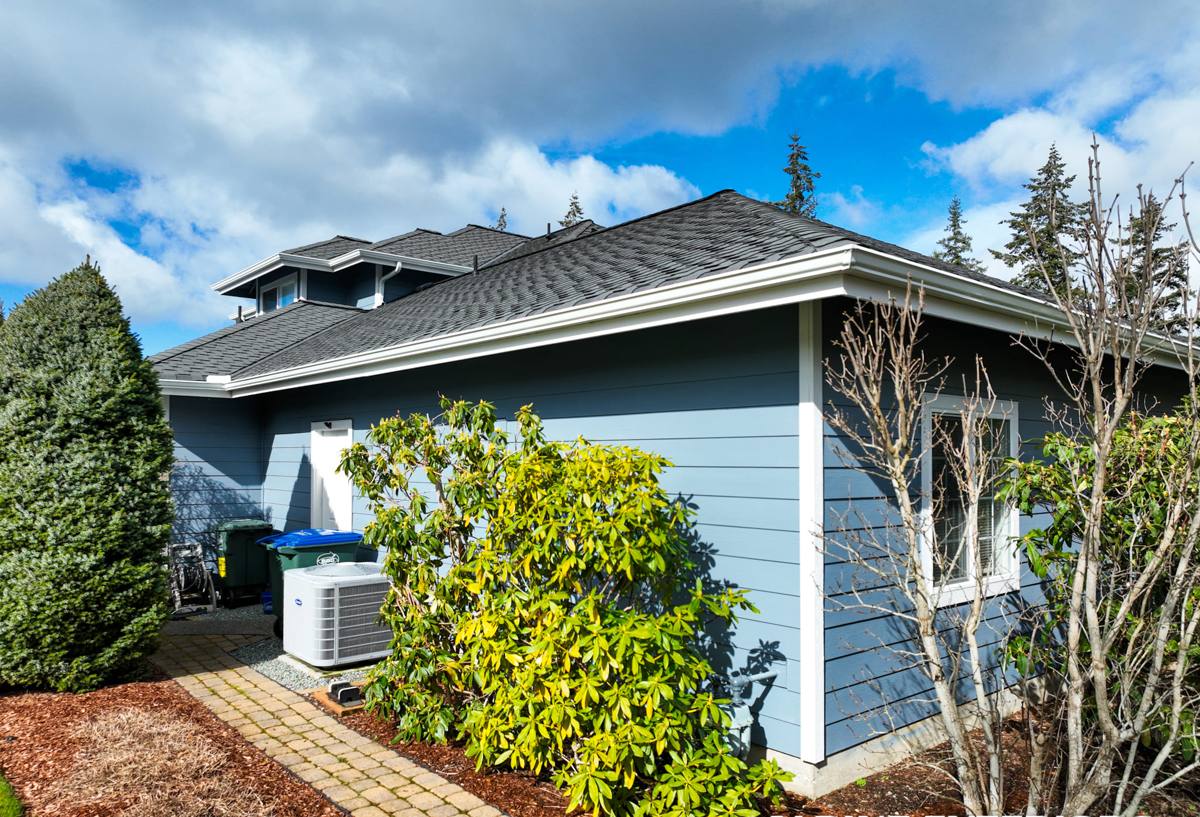
Warning Signs a Lynden Roof Needs Attention
Most roof problems we get called out for didn't start as emergencies. They started small and got missed because they weren't obvious from the ground. Here's what we tell Lynden homeowners to watch for:
- Dark streaking or green-black patches on shingles, especially on shaded or north-facing slopes
- Moss or thick moss "cushions" building up along butt edges and in valleys
- Granules collecting in gutters or at downspout outlets
- Soft or spongy spots underfoot when walking a roof for inspection
- Water stains on interior ceilings, especially near exterior walls or chimneys
- Daylight visible through the attic roof deck
- Curling, cracking, or lifted shingle edges
- Rust streaking or gaps around flashing at chimneys, skylights, and roof-wall intersections
Any one of these on its own might just mean routine maintenance. Two or three together, especially paired with an older roof, usually means it's time for a real inspection.
What a Correct Roof Repair Actually Involves
Moss and Debris Removal Done the Right Way
Moss removal is where a lot of repairs go wrong before they even start. Pressure washing shingles strips granules and shortens the life of the roof — it looks clean for a season and costs you years of material life. We hand-clean moss and debris using soft brushing and low-pressure rinsing, then treat the surface to slow regrowth. This matters more here than in drier climates, because a Lynden roof that gets moss once will get it again unless the underlying moisture problem is addressed too — usually shade, poor airflow, or gutters that hold water against the roof edge.
Finding the Actual Source of a Leak
Water rarely shows up where it enters. It travels along the underlayment or framing before it finds a gap in the ceiling to show through, which means the visible stain is often several feet from the real problem. A proper repair starts with tracing the path — checking flashing, valleys, penetrations, and the roof deck itself — before any shingles or sealant get touched. Repairing the wrong spot means the same leak comes back after the next heavy rain.
Flashing, Valleys, and the Details That Actually Fail First
In our experience, field shingles rarely fail first — the details around them do. Flashing at chimneys, skylights, dormers, and wall intersections is where sealant breaks down, metal corrodes, or original installation was marginal to begin with. In a climate with this much sustained rain, we treat flashing repair as inseparable from shingle repair. Replacing a shingle without correcting the flashing beneath it is a temporary fix at best.
Our Repair Process, Step by Step
- Inspection and diagnosis — we get on the roof (not just the ladder) and physically trace the problem, checking the attic from inside where access allows
- Written scope and honest estimate — what we found, what needs to happen, and what it costs, before any work starts
- Site protection — landscaping, gutters, and walkways covered or protected during the work
- Repair execution — moss and debris cleared, damaged materials removed, deck checked and repaired if needed, new materials matched and installed, flashing corrected
- Cleanup and nail/debris sweep — magnetic sweep of the yard and driveway, full material cleanup
- Walkthrough — we show you what was done and why, in plain terms
We don't upsell a full replacement when a repair will genuinely hold. We also won't tell you a repair is enough when the roof is past the point where patching makes financial sense — we'll explain why, and let you decide.
What Affects the Cost of a Roof Repair
Every repair is different, but the price is generally driven by a handful of factors. This table covers what tends to move the estimate up or down — not exact prices, since that depends on what we find on your specific roof.
| Factor | Why It Matters | Effect on Cost |
|---|---|---|
| Extent of moss/moisture damage | Determines how much of the deck and underlayment, not just shingles, needs work | Moderate to significant |
| Roof pitch and accessibility | Steeper or harder-to-access roofs take longer and need more safety setup | Moderate |
| Age and material match | Older or discontinued materials may need a close match rather than an exact one | Minor to moderate |
| Number of penetrations | Each chimney, vent, or skylight is a separate flashing detail to inspect and seal | Minor to moderate |
| Deck condition | Soft or rotted decking under shingles must be replaced before re-roofing that section | Significant if present |
| Timing/season | Repairs scheduled during a dry weather window go faster and cleaner | Minor |
As a general rule, a straightforward shingle and flashing repair is a modest expense. Anything involving deck replacement or a large area of moss-related deterioration moves into a larger range. We'll always give you the real number after inspection, not a phone-quote guess.
Materials We Commonly Work On Around Lynden
Most homes in this area are roofed in asphalt composition shingles, with a smaller number of cedar shake, metal, and low-slope membrane roofs on additions or outbuildings. Each responds differently to this climate:
- Asphalt composition shingle — the most common material locally; moss and granule loss are the primary aging factors, and repairs are usually straightforward if caught early
- Cedar shake — attractive but higher-maintenance in a wet climate; moss and moisture retention require more frequent inspection and treatment to avoid premature rot
- Metal roofing — sheds moss and water well, but fastener and seam integrity at penetrations still needs periodic checking
- Low-slope/membrane sections — common over porches and additions; seams and drains are the usual failure points and need a different repair approach than sloped shingle roofs
We don't push homeowners toward a particular brand or material during a repair. Our standard is matching what performs well for the specific roof, the specific exposure, and the specific budget in front of us — and being upfront when a product choice will mean more maintenance down the road, not less.
Why a Crew That Already Works in Lynden Matters
A roofer who works this specific area regularly has already seen how the local weather pattern plays out on real roofs — which slopes moss first, how long a valley stays wet after a storm, and which flashing details tend to fail on homes of a certain age. That's not something you can fully substitute with general roofing knowledge. It also means faster response: when a storm comes through Whatcom County, we're not driving in from across the region to get to you. Familiarity with local permitting and typical home construction in the area also keeps repairs moving without unnecessary delays.
Maintenance Between Repairs: What You Can Do
A repair holds longer when it's paired with basic upkeep. None of this replaces a professional inspection, but it slows the return of the problems we fix most often:
- Keep gutters and downspouts clear, especially heading into fall
- Trim back overhanging branches to cut down shade and debris on the roof
- Have moss growth addressed before it builds into thick mats, not after
- Check the attic occasionally for daylight, staining, or musty smell
- Don't ignore a small ceiling stain — get it looked at before the next rainy stretch
- Schedule a roof check after any major windstorm, even if nothing looks obviously wrong
When to Repair and When to Start Planning for Replacement
Not every roof problem in Lynden means a full replacement, and we won't tell you it does. A roof with isolated moss, a few damaged shingles, or a single failed flashing detail is usually a good repair candidate, especially if the roof is under 15-20 years old. A roof with widespread granule loss, multiple leak points, soft decking in more than one area, or shingles that are curling and cracking broadly is often past the point where repair is the economical choice — at that stage, repairs become a short-term patch on a roof that needs replacing anyway. We'll tell you honestly which category your roof falls into, with our reasoning, so you can make the call with real information.
If you're noticing signs of trouble, or it's simply been a while since your roof was checked, we're happy to take a look. Reach out for a free, no-pressure estimate using the form below — we'll assess the roof, explain what we find, and give you a straightforward recommendation either way.