 Bellingham
 Building Decks for Happy Valley's Pacific Northwest Conditions
Happy Valley is one of Bellingham's older, established residential neighborhoods, with mature trees, sloped lots in places, and homes that have weathered decades of Whatcom County winters. A deck out here does a different job than a deck in a dry climate. It has to shed water fast, resist the moss that colonizes anything shaded and damp, and hold up to the salt-laced air that drifts inland off Bellingham Bay. We build decks specifically for these conditions, not a generic design dropped into a wet climate and hoped for the best. A deck detail that holds up fine in a drier inland climate can fail here in a fraction of the time if it wasn't built for this one.
Whether you're replacing a deck that's rotted at the ledger board, adding a first deck to a home that never had one, or expanding an existing deck to make more use of the yard, the same regional realities apply: salt air, driving rain, and a long moss season all take their toll on anything built outdoors here. We treat those three factors as the starting point for every design conversation, not an afterthought once the layout is picked.
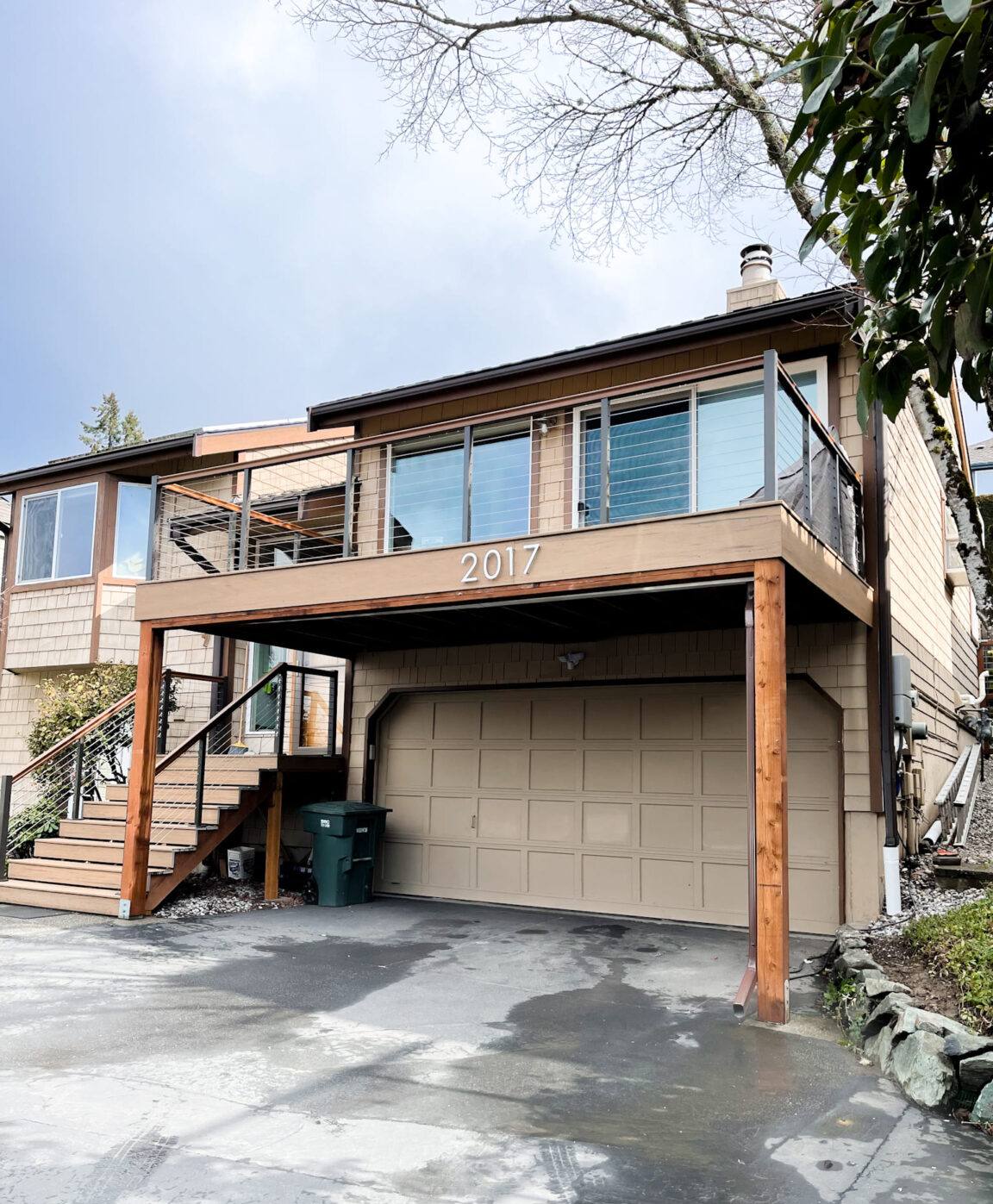
What Happy Valley Homes Need From a Deck
Salt Air and Fastener Corrosion
Bellingham sits close enough to the water that salt-laden air reaches inland neighborhoods like Happy Valley, especially on windy days. Salt air accelerates corrosion in fasteners, brackets, and hardware faster than most homeowners expect. A deck built with standard interior-grade screws or under-rated hardware can show rust streaks and weakening connections within a few years. We spec stainless steel or hot-dip galvanized fasteners and structural hardware rated for coastal exposure, even on inland lots, because the air here doesn't stay put. Cheaper zinc-coated fasteners might look fine for a season or two, but they're usually the first thing to fail, and by the time rust is visible on the surface, the connection underneath has often already weakened.
Driving Rain and Water Management
Whatcom County rain doesn't just fall straight down — wind-driven rain gets pushed sideways into ledger connections, under railings, and into any gap in the decking. Where a deck meets the house, that ledger board is the single most common failure point we see on older decks in this area. Poor or missing flashing lets water track behind the siding and into the rim joist, which rots quietly for years before it becomes visible. Correct flashing detail at the ledger, and proper slope away from the house on the decking surface, are not optional extras — they're the difference between a deck that lasts and one that needs to be rebuilt in ten years.
Moss Season and Surface Traction
Bellingham's moss season runs long, realistically most of the year in shaded or north-facing spots. Moss on a deck surface isn't just a maintenance nuisance, it's a slip hazard, and it holds moisture against the decking material, which shortens the life of wood surfaces in particular. Deck orientation, gap spacing between boards, and material choice all affect how much moss you'll fight later. We factor sun exposure and airflow into the design, not just the layout the homeowner pictures. A deck tucked under a tree canopy on the north side of a house will always need more attention than one that gets afternoon sun, and we'll tell you that honestly during the design conversation rather than let you find out the hard way.
Choosing the Right Decking Material
There's no single "best" decking material — the right choice depends on budget, how much upkeep you're willing to do, and how shaded the site is. Here's how the common options compare for a wet, moss-prone climate like ours.
| Material | Moss & Moisture Behavior | Maintenance | Typical Lifespan Here |
|---|---|---|---|
| Pressure-treated fir/hem-fir | Absorbs moisture, prone to moss and mildew in shade | Annual cleaning, re-staining every 2-3 years | 15-20 years with upkeep |
| Cedar | Naturally rot-resistant, still needs airflow to shed moisture | Regular cleaning, periodic oil or stain | 20-25 years with upkeep |
| Composite decking | Doesn't absorb water into the board, but surface film can still host moss | Periodic washing, no staining or sealing | 25-30+ years, manufacturer-dependent |
| PVC/cellular decking | Fully moisture-resistant board, surface moss is a cleaning issue only | Low — occasional washing | 25-30+ years, manufacturer-dependent |
We install both wood and composite/PVC systems and will walk you through the honest trade-offs for your specific lot — a heavily shaded backyard under mature trees behaves very differently than an open, sunnier site even a few houses away. Neither option is automatically the "right" answer; it depends on how much time you want to spend maintaining it and what look you're after.
Getting the Structure Right
Ledger Attachment and Flashing
The ledger board — where the deck framing bolts into the house — is where we see the most water damage on rebuilds in this area. Correct practice means structural lag bolts or through-bolts, not just nails, a code-compliant flashing detail that directs water out and away from the house framing, and a gap or drainage plane so trapped moisture can escape instead of sitting against the rim joist. This is the detail that's easiest to shortcut and most expensive to fix later, since fixing it means pulling the decking back up.
Footings and Local Permitting
Footing depth and sizing depend on your soil and the load the deck carries, and Whatcom County and the City of Bellingham both have permitting requirements for most new or replacement decks, especially anything attached to the house or built above a certain height. We handle the permit process as part of the job rather than leaving it to the homeowner, and we build to the depth and spacing the local code and your soil actually require — not just what's cheapest to dig. On sloped lots, which are common in this neighborhood, footings sometimes need to be stepped or deepened to reach stable bearing soil, something a design done from a distance, without walking the actual site, tends to miss.
Railings, Stairs, and Guardrail Code
Sloped lots are common in Happy Valley, which means many decks here sit high enough off the ground to trigger guardrail and stair code requirements — baluster spacing, railing height, and graspable handrail profiles are all specified in code, not optional style choices. We build these to pass inspection the first time, not to redo after a failed one.
Our Deck Building Process
We keep the process straightforward and keep you informed at each stage:
- On-site visit to assess the lot, existing structure (if replacing a deck), sun exposure, and drainage
- Design and material discussion, with honest guidance on what fits your budget and your site's moss and moisture exposure
- Written estimate with a clear scope — no vague allowances
- Permit filing and approval through the applicable local jurisdiction
- Demolition of the old deck, if applicable, and disposal
- Framing, ledger flashing, and footing work, built to inspection standard
- Decking, railing, and stair installation
- Final walkthrough and care guidance specific to the material you chose
Cost Factors for a Happy Valley Deck
Every deck is priced on its own scope, but the factors that move the number the most are consistent across most jobs we look at in this neighborhood:
| Factor | Why It Matters |
|---|---|
| Decking material | Pressure-treated costs least up front; composite and PVC cost more initially but less in upkeep over time |
| Height and slope of the lot | Taller decks need more framing, more footings, and code-required stairs and railings |
| Site access | Tight side yards or steep grades slow down material staging and demolition |
| Ledger and flashing condition | If the rim joist behind an old deck has rot, that repair adds scope before decking can even start |
| Railing and stair complexity | Multiple stair runs, custom railing, or built-in benches add labor and material |
| Permit requirements | Larger or higher decks generally require more inspection steps, which affects timeline more than price |
We give a written, itemized estimate before any work starts so you know what's driving the cost — not a single lump number with no explanation.
Signs an Existing Deck Needs Attention
Not every deck needs a full rebuild. Sometimes the frame is sound and only the surface decking, railing, or flashing needs attention. Watch for:
- Soft or spongy spots underfoot
- Gaps opening up around the ledger where it meets the house
- Rust staining running down from screw heads or brackets
- Persistent moss or algae that comes right back after cleaning
- Railings or stair connections that feel loose or move when you lean on them
Catching these early is usually far cheaper than waiting until a board gives way.
Keeping a Happy Valley Deck Moss-Free Year-Round
Whatever material you choose, a few habits go a long way in this climate:
- Sweep leaves and debris off the deck regularly in fall — trapped organic matter is what moss feeds on
- Rinse or wash the surface a few times a year, more often in shaded areas
- Keep gutters and downspouts near the deck clear so water isn't dumping directly onto it
- Trim back overhanging branches to improve airflow and sun exposure where possible
- Check railings and stair connections annually for looseness — a sign fasteners may be corroding
- Re-stain or re-oil wood decking on the schedule the product calls for, not just when it looks faded
Why Hire a Crew That Already Works Happy Valley
A deck built for a dry climate, or built by someone unfamiliar with Whatcom County's permitting and code requirements, tends to show its problems within a few years — moss buildup, a soft spot at the ledger, rusted hardware. We work in Bellingham neighborhoods like Happy Valley regularly, so we already know the kind of lots, drainage patterns, and permitting steps involved, and we build with the region's rain, moss, and salt air in mind from the first design conversation, not as an afterthought. A crew that's only worked in drier climates, or that treats every job the same regardless of site, is more likely to skip the details that matter most here.
When you're vetting anyone to build or repair a deck, ask specifically how they detail the ledger flashing, what fastener grade they use, and whether they pull permits themselves. Those three answers tell you more about the quality of the work than almost anything else on a bid sheet.
Get a Free, No-Pressure Estimate
If you're planning a new deck or need to replace one that's showing its age, we're happy to take a look and give you a straightforward, written estimate — no pressure, no hard sell. Fill out the form below and we'll get in touch to schedule a time.