 Bellingham
 Storm Damage in Blaine Is Its Own Category
Blaine sits right at the water's edge of Whatcom County, with Drayton Harbor and Semiahmoo Bay on one side and open exposure to weather rolling in off the Strait of Georgia on the other. That location shapes what "storm damage" actually means here. It's rarely a single dramatic event. More often it's a combination of wind-driven rain working into a roof over a few hard nights, salt-laden air slowly working on metal components, and a moss season that runs longer than most of the country ever deals with. A roof that would be fine in a drier, calmer climate can take a real beating in Blaine simply from being close to the water.
That's the lens we bring to every storm damage call in this area: it's not just "what broke in the last storm," it's "what condition was this roof already in, and how did the storm expose it." Getting that distinction right is the difference between a repair that holds and one that fails again next winter.
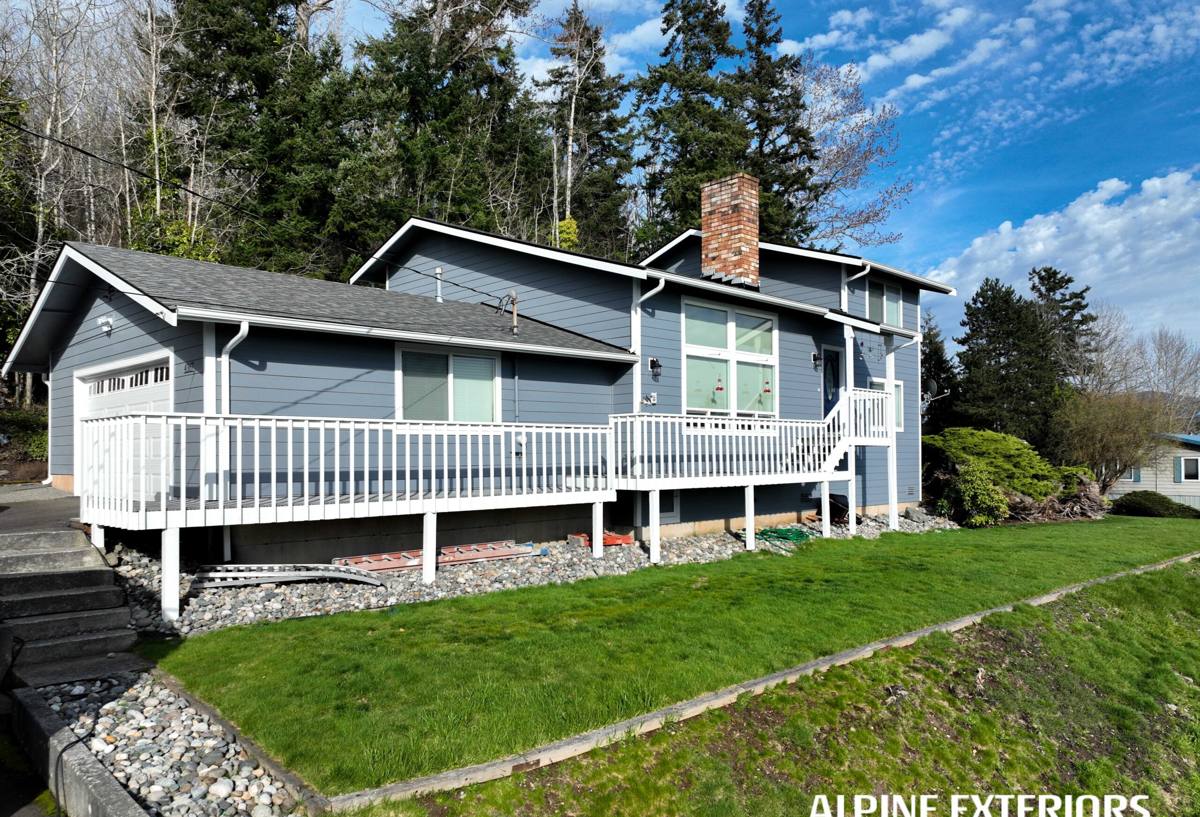
Common Types of Storm Damage We See on Blaine Roofs
Wind-Lifted and Creased Shingles
Sustained wind, especially gusty wind coming off open water or funneling down through the Fraser Valley during cold outflow events, gets under the tab edge of a shingle and lifts it repeatedly. Sometimes it tears off completely and you find it in the yard. More often it just creases the shingle or breaks the seal strip without fully detaching it, which is actually the harder damage to catch from the ground because the roof can look intact while it's no longer sealed.
Wind-Driven Rain Intrusion
Blaine doesn't get the heaviest rainfall totals in the county, but it gets a lot of horizontal rain — the kind that gets pushed sideways under shingle edges, around flashing, and into any gap a calm-weather roof would never notice. This is how a roof that "isn't leaking" during a light rain suddenly leaks during a storm.
Debris and Impact Damage
Branches, cones, and loose debris from nearby trees come down during high wind and can crack shingles, dent metal flashing, or knock granules loose in a concentrated spot. This kind of damage is usually localized and repairable without a full section replacement, if it's caught before repeated rain finds the weak point.
Flashing and Fastener Failure
This one is specific to coastal towns like Blaine. Salt air accelerates corrosion on exposed metal — flashing, nail heads, vent boots with metal collars. A storm doesn't cause this damage directly, but it's often what a storm exposes: flashing that was already thinning from years of salt exposure finally gives way under wind pressure.
Why Salt Air Changes the Repair, Not Just the Damage
A lot of storm repair advice online assumes an inland climate. In Blaine, a repair that ignores salt exposure is a repair you'll be paying for again in a few years. We treat material selection differently for homes close to the water:
- Fasteners and flashing get matched to corrosion resistance, not just to what's cheapest or fastest to source.
- Exposed metal components are inspected for early pitting or thinning even when they weren't the direct point of failure, since salt corrosion is progressive and doesn't announce itself until it fails.
- Sealants and adhesives are chosen with UV and moisture cycling in mind, not just initial bond strength.
- Where the original installation used a lower-grade fastener or flashing that's already showing wear, we'll tell you honestly rather than just patching around it.
None of this is about upselling premium materials for the sake of it. It's about not doing a repair twice because the first one used hardware that wasn't built for a marine environment.
What a Correct Storm Damage Repair Actually Involves
A rushed storm repair and a correct one can look identical from the driveway. The difference shows up in whether the next storm reopens the same spot. A repair done right includes:
- Full-roof inspection, not just the reported spot. Wind and rain damage rarely stays contained to one shingle. We check the surrounding field, ridge, valleys, and penetrations before quoting anything.
- Checking what's underneath. If water got past the shingle layer, the underlayment and decking need to be checked for saturation, not just covered back up.
- Matching materials properly. Shingles, flashing profile, and fastener type should match or reasonably blend with the existing roof system, not just be "close enough."
- Re-sealing and re-flashing correctly, with attention to how water will actually move across that section in the next storm, not just how it looks once it's nailed down.
- A final check for anything the storm exposed but didn't fully break — cracked but not detached shingles, loosened fasteners, compromised sealant — since these are the failure points for the next storm if left alone.
Our Process From Call to Completion
1. Initial Assessment
We start with a straightforward roof inspection focused on what the recent weather actually did to your roof, not a generic checklist. If you called about a specific leak or visible damage, that's our starting point, but we always look at the whole roof before making recommendations.
2. Clear, Honest Findings
You get a plain explanation of what we found — what's storm-related, what's pre-existing wear the storm exposed, and what can wait versus what shouldn't. We're not going to tell you the whole roof needs replacing when a targeted repair will genuinely hold, and we're not going to tell you a patch is fine when the underlying material is already compromised.
3. Documentation
If you're planning to file an insurance claim, we document the damage clearly enough to support that process — photos and a written description of cause and extent. We're not a public adjuster and we don't negotiate your claim for you, but we make sure the roof-side documentation is solid.
4. The Repair Itself
Repairs are scheduled around Whatcom County's weather windows — there's no point starting shingle or flashing work in the middle of another wind and rain system. We work efficiently once conditions allow, and we don't leave a roof in a half-finished, vulnerable state between visits if it can be avoided.
5. Follow-Up
After the repair, we'll walk you through what we did and what to watch for. If a storm exposed one weak point, it's worth knowing whether there are others nearby that are close behind it.
Storm Damage Repair Cost Factors
Every roof and every storm is different, so we don't quote sight-unseen. But these are the main factors that move the price of a storm damage repair up or down:
| Factor | Why It Matters |
|---|---|
| Extent of the damage | A few displaced shingles versus a larger wind-exposed section changes labor and material scope significantly. |
| Roof access and pitch | Steeper or harder-to-access roofs take longer and require more safety setup. |
| Underlying deck condition | If water reached the decking, repair may need to address wood condition, not just the surface layer. |
| Material match | Matching an older shingle color or discontinued profile can add time compared to a straightforward like-for-like repair. |
| Flashing and metal work involved | Corroded or storm-damaged flashing near chimneys, vents, or valleys adds more labor than shingle-only repairs. |
| Roof age | An older roof nearing the end of its service life may reveal that a "repair" is more efficient as a targeted section replacement. |
Insurance Claims for Storm Damage
Many storm-related roof repairs in Blaine do go through homeowners insurance, particularly when the damage is tied to a specific wind or rain event. A few honest points worth knowing going in:
- Insurers generally want to see damage tied to a specific weather event, not general wear — this is why timely inspection after a storm matters.
- Photo documentation taken close to the time of the storm is more useful than documentation gathered weeks later.
- Not every storm-related issue is covered the same way — coverage depends on your specific policy, and we're not in a position to interpret your policy for you.
- We can provide the roofing-side assessment and documentation your adjuster will need, and point out anything we find that's relevant, but the claims decision itself sits with your insurer.
Reducing Future Storm Damage: A Practical Checklist
A lot of storm damage in Blaine is made worse by conditions that built up quietly beforehand, especially moss growth and clogged drainage. Between storms, or heading into the wetter months, it's worth checking:
- Gutters and downspouts are clear so wind-driven rain has somewhere to go instead of backing up under roof edges.
- Moss buildup is being managed before it lifts shingle edges and holds moisture against the roof surface.
- Flashing around chimneys, skylights, and vents shows no visible rust, gaps, or lifted edges.
- Overhanging branches near the roofline are trimmed back before wind season, reducing impact and abrasion risk.
- Attic ventilation is adequate — trapped moisture from the inside makes a roof more vulnerable to damage from the outside.
- Any shingles that already look curled, cracked, or granule-bare are noted, since these are the first to fail in the next windstorm.
Why a Crew That Already Works in Blaine Matters
Storm damage repair isn't just a materials-and-labor job — it's a judgment job. Knowing that a shingle showing minor wear near the coast is more urgent than the same wear inland, knowing which flashing details tend to fail first in this specific climate, knowing how fast moss actually comes back in Whatcom County's wet season — that judgment comes from working roofs in this area repeatedly, not from a generic storm-repair checklist. A crew unfamiliar with coastal Whatcom County conditions can still nail down a shingle, but they're less likely to catch the salt-corroded fastener two feet away or recognize that a "minor" leak pattern is typical of wind-driven rain intrusion specific to homes exposed to open water.
We also know that Blaine homeowners are dealing with a specific mix of conditions — coastal wind exposure, salt air, and a moss season that runs longer than a lot of the country experiences — and we build our repairs around that reality rather than a one-size-fits-all approach.
Get a Straight Answer on Your Roof
If a recent storm left you with a leak, missing shingles, or just some uncertainty about whether your roof took damage, it's worth having it looked at before the next system rolls through. We offer free, no-pressure estimates — you'll get an honest read on what happened, what it'll take to fix it right, and what can reasonably wait. Fill out the form below to get started.