 Bellingham
 Birch Bay's Climate Is Harder on Siding Than Most of Whatcom County
Birch Bay sits right on the water, and that changes what a house needs from its exterior. Homes a few miles inland deal with Pacific Northwest rain and not much else. Homes in Birch Bay deal with that same rain plus a steady dose of salt-laden marine air coming off the Strait, wind that drives moisture sideways into wall assemblies, and a moss and algae season that runs longer than it does farther from the shoreline. None of that is dramatic on its own. It's the combination, repeated year after year, that wears out the wrong siding product faster than most homeowners expect.
Salt air is corrosive to exposed metal fasteners and trim, and it accelerates the breakdown of finishes that aren't engineered to handle it. Driving rain, especially in exposed or waterfront-facing sections of a home, pushes water into any gap, seam, or fastener hole that wasn't sealed or flashed correctly. And moss doesn't just sit on the surface — given enough shade, moisture, and time, it holds water against the siding and starts working on whatever's underneath. A siding product and installation that would be perfectly fine in a drier part of Whatcom County can underperform here.
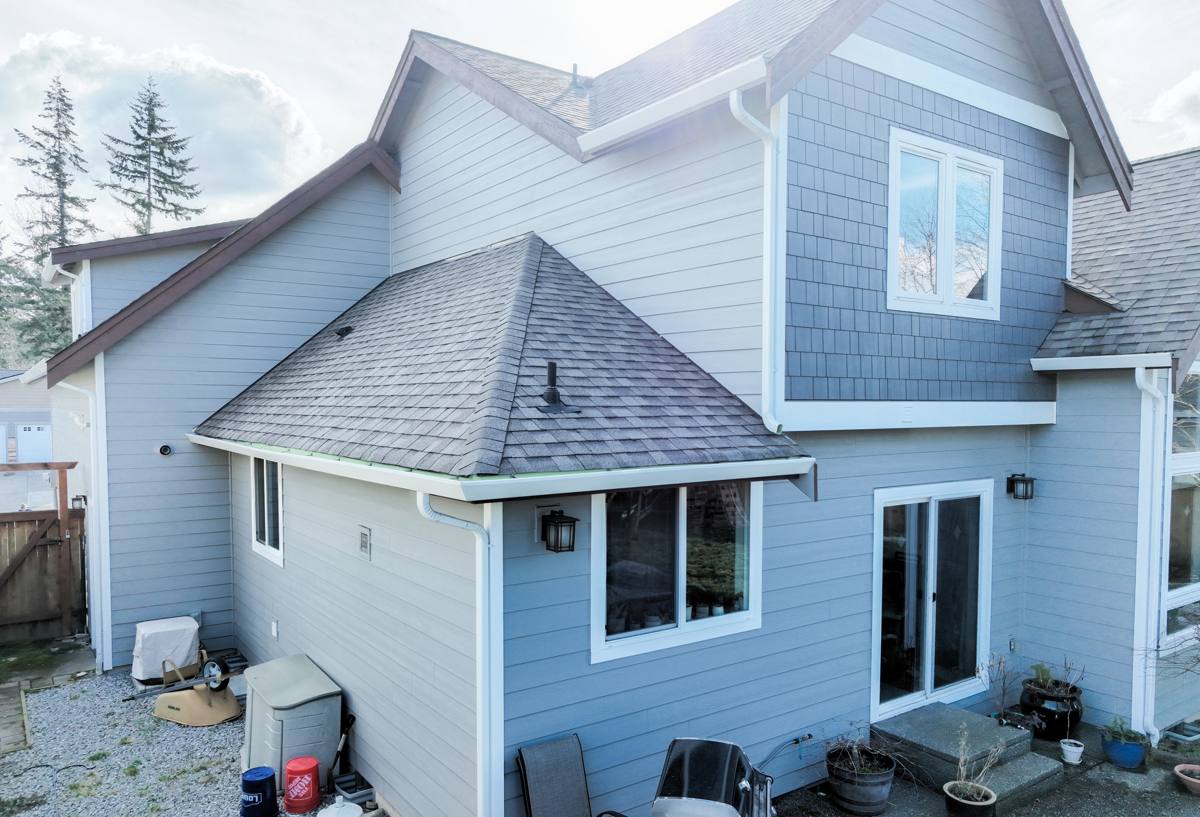
What Birch Bay Homes Actually Need From Their Siding
Given that combination of exposures, the priorities for Birch Bay siding are pretty specific:
- Moisture resistance that doesn't rely on paint alone. The material itself needs to tolerate repeated wetting and drying without swelling, delaminating, or rotting.
- A factory finish built for UV and salt exposure — not a field-applied coat that starts breaking down in a handful of seasons near the water.
- Dimensional stability so panels don't warp, cup, or buckle when they're constantly cycling between wet and dry.
- Correct water management behind the siding — flashing, house wrap, and drainage details that assume some moisture will get past the surface, because near the water, it will.
- Fire resistance is also worth factoring in for wooded and semi-rural stretches around Birch Bay, even though the immediate climate story is about moisture and salt.
This is the lens we use on every Birch Bay siding job — not "what's the cheapest option that looks fine on day one," but "what's still doing its job in fifteen years of this specific exposure."
Why We Install Only James Hardie Fiber Cement
We don't offer a menu of siding brands. We install James Hardie fiber cement siding, full stop — no vinyl, no LP SmartSide, no Cemplank or Allura, no primed spruce or cedar. That's a deliberate standard, not a lack of options.
Vinyl is inexpensive and low-maintenance in the sense that it doesn't need painting, but it's a thin material that can warp in heat, crack in cold, and it isn't the product we'd choose for a home taking on this much wind-driven rain and salt exposure over decades. Wood-based and engineered-wood sidings can look great new, but they're organic materials at their core — they're more sensitive to sustained moisture, and a marine environment with a long moss season is exactly the kind of exposure that punishes any gap in maintenance. Other fiber cement brands exist, and fiber cement as a category is the right call for this climate — but we've standardized on James Hardie specifically for the factory-applied ColorPlus finish, the HardieZone engineering approach, and a warranty structure we're comfortable standing behind on a home a few hundred feet from saltwater.
Here's a straightforward look at how the main categories compare on the issues that actually matter in Birch Bay:
| Factor | Vinyl | Wood / Engineered Wood | James Hardie Fiber Cement |
|---|---|---|---|
| Moisture tolerance | Doesn't rot, but seams and panels can warp under heat/cold cycling | Vulnerable to swelling and decay without diligent upkeep | Engineered to resist moisture damage; won't rot |
| Finish durability in salt air | Color can fade and become brittle over time | Field-applied paint needs regular recoating near the coast | Factory ColorPlus finish backed by its own product warranty |
| Fire resistance | Combustible | Combustible | Non-combustible |
| Dimensional stability | Can expand/contract noticeably | Prone to cupping and warping | Stable across wet/dry and temperature swings |
| Typical lifespan when installed correctly | 20–30 years | Varies widely with maintenance | Multiple decades, with strong transferable warranty coverage |
What a Correct Fiber Cement Installation Actually Involves
The Product Line Matters
James Hardie makes climate-specific HZ product lines, engineered for different moisture and temperature profiles across the country. For a location like Birch Bay, getting the right HZ specification — and the right accessories, fasteners, and trim to go with it — is part of doing the job correctly, not an upsell.
Installation Details That Separate a Good Job From a Problem Waiting to Happen
Fiber cement siding is only as good as the installation behind it. A few details we treat as non-negotiable on every Birch Bay job:
- Proper clearances from grade, decks, roof lines, and other siding-to-surface transitions, so water has somewhere to go instead of wicking into the bottom edge of a panel.
- Correct fastener type, spacing, and depth — over-driven or under-driven nails are one of the most common causes of early siding failure, and it's an easy mistake to make if a crew is moving too fast.
- Flashing at every window, door, and penetration, integrated with the house wrap in the right shingle-lap order so water sheds outward instead of getting trapped.
- Correctly sized gaps and sealant at butt joints and trim, following manufacturer specs rather than a generic caulk-everything approach.
- An intact drainage plane behind the siding — a rain-screen gap or equivalent — so any moisture that does get past the surface has a way to drain and dry instead of sitting against the sheathing.
Every one of these is inspectable, and every one of them matters more in a high-exposure, high-moisture location like Birch Bay than it would on a sheltered inland lot.
Our Process, Start to Finish
- On-site assessment. We look at your home's specific exposure — how much of it faces prevailing wind and rain, where moisture or moss problems already show up, and the condition of what's underneath the current siding.
- Product and color plan. We walk through the right HZ specification and ColorPlus color and texture options for your home, based on that exposure assessment.
- Tear-off and inspection of the wall assembly. Once the old siding is off, we check sheathing, framing, and existing water damage before anything new goes up — this is often the point where hidden moisture problems get caught early instead of sealed in.
- Water management first. House wrap, flashing, and drainage details go in before a single piece of siding is hung.
- Installation to spec. Fastening, clearances, joints, and trim follow manufacturer installation requirements — the details listed above.
- Final walkthrough. We go over the finished job with you directly, including care and maintenance specific to your home's exposure.
Maintenance and Longevity in a Salt Air, High-Moisture Environment
One of the real advantages of James Hardie fiber cement in a place like Birch Bay is how little ongoing maintenance it demands compared to wood-based siding — but "low maintenance" isn't "no maintenance." A rinse-down once or twice a year to knock salt residue and organic buildup off the surface goes a long way, especially on north- or shade-facing walls where moss and algae take hold fastest. Keeping gutters clear and vegetation trimmed back from the siding reduces the amount of standing moisture and shade the surface sees. And an occasional visual check of caulking at trim and penetrations — recaulking if it's cracked or pulled away — keeps your water management details doing their job for the long haul.
None of that is heavy labor. It's the difference between a siding system that looks and performs the same in year fifteen as it did in year two, versus one that needs recoating, patching, or early replacement because moisture found a way in.
Signs Your Birch Bay Home's Siding Needs Attention Now
If you're not sure whether it's time for a closer look, these are the signs we'd want to know about:
- Soft or spongy spots when you press on the siding, especially near the bottom edges or corners
- Visible warping, cupping, or panels that no longer sit flat
- Persistent moss, algae, or dark streaking that comes back shortly after cleaning
- Paint that's peeling, bubbling, or chalking heavily, particularly on wind- and rain-exposed walls
- Cracked, missing, or shrunken caulking at trim, windows, and joints
- Any musty smell or visible staining on interior walls that share an exterior wall with these areas
Catching these early usually means a straightforward repair or a planned replacement on your timeline. Waiting usually means water damage to the sheathing or framing behind the siding, which turns a siding job into a structural repair job.
What Affects the Cost of a Birch Bay Siding Project
| Cost Factor | Why It Matters Here |
|---|---|
| Home size and wall complexity | More corners, dormers, and trim details mean more cutting, flashing, and labor time |
| Condition of the existing wall assembly | Sheathing repair or additional drying time after tear-off adds scope if moisture damage is found |
| HardieZone product line and profile | Panel, plank, and shingle profiles carry different material and labor costs |
| Color and finish selection | Factory ColorPlus finishes vs. primed-for-field-paint options affect both cost and long-term maintenance |
| Site exposure and access | Waterfront-facing walls and tight or sloped lots common around Birch Bay can affect staging and labor time |
We won't quote a number without seeing the home, but we'll always walk you through exactly what's driving your estimate before you commit to anything.
Why Hiring a Crew That Already Works in Birch Bay Matters
Generic siding advice doesn't account for the fact that a waterfront home in Birch Bay and a sheltered home a few miles inland can need meaningfully different water management details, even with the same siding product. A crew that already works this specific stretch of Whatcom County has seen where moss actually takes hold on local homes, which wall orientations catch the worst of the driving rain, and where salt air does the most damage to fasteners and trim over time. That's not something you can fully substitute with a spec sheet — it comes from doing the work here repeatedly and paying attention to what holds up and what doesn't.
If you're weighing a siding replacement or repair for your Birch Bay home, we're happy to take a look and give you a straightforward, no-pressure estimate — no obligation, just an honest read on what your home actually needs. Use the form below to get started.