 Bellingham
 Why Fairhaven's Location Is Hard on Siding
Fairhaven sits close to the water, and that proximity shapes what siding has to survive here. Homes near Bellingham Bay deal with a steady drift of salt-laden air that settles on exterior surfaces and slowly works into anything that isn't built to shed it. Add the driving rain that comes off Pacific storms through the fall and winter, and you have moisture pressure that most siding materials weren't designed to handle year after year.
The tree canopy that gives Fairhaven's streets their character also creates a lot of shade, and shade means slower drying. Siding that stays damp longer grows moss and algae faster, and in Whatcom County that "moss season" can stretch across most of the year rather than a few wet months. Combine salt air, driving rain, and prolonged dampness, and you get a climate that punishes weak seams, poor flashing, and materials that swell, rot, or absorb water — which is exactly why the siding choice and the installation quality matter more here than in a drier inland neighborhood.
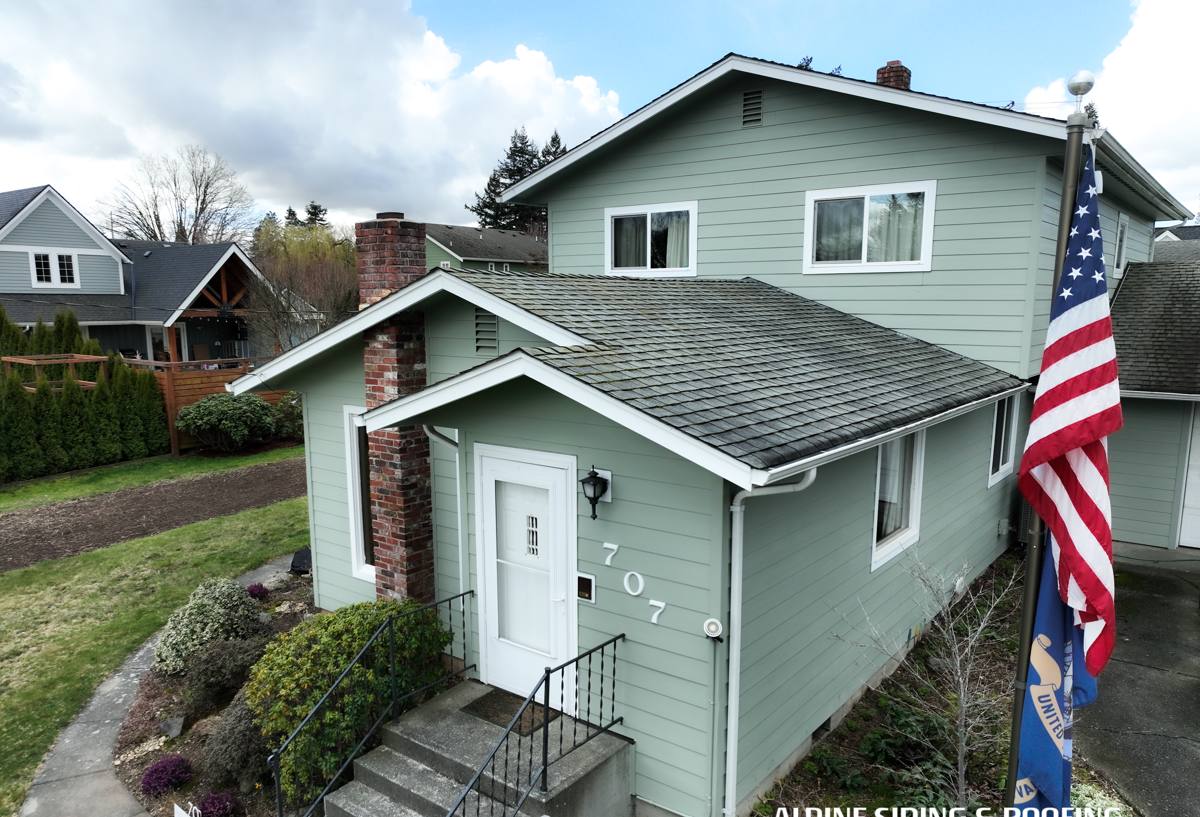
Signs Your Fairhaven Home's Siding Needs Replacing
Siding problems in a marine climate don't always show up as obvious damage right away. A lot of the warning signs are subtle — a soft spot here, a stubborn stain there — and they tend to get written off as "just needs a wash." Here's what actually points to a siding system that's failing, not just dirty:
- Soft, spongy, or crumbling spots when you press on the siding, especially near the bottom courses and around windows
- Persistent moss or algae growth that comes back within weeks of cleaning
- Paint that's peeling, bubbling, or chalking well before its expected repaint cycle
- Visible warping, cupping, or gaps opening up between boards or panels
- Rising energy bills paired with drafts, which often means moisture has compromised the wall assembly behind the siding
- Stained or discolored interior drywall near exterior walls, a sign water is getting past the siding entirely
- Siding that's original to a home built more than 20-25 years ago, particularly wood, engineered wood, or older vinyl products
Any one of these on its own might be a repair. Several at once, especially on a home that's taken the brunt of wind and rain off the water for two decades or more, usually means the siding system itself has reached the end of its useful life.
Why We Install Only James Hardie Fiber Cement Siding
We don't install vinyl, LP SmartSide, or the various fiber cement alternatives on the market — we install James Hardie, and only James Hardie. That's a deliberate standard, not a sales preference, and in a place like Fairhaven the reasoning is straightforward.
Fiber cement is non-combustible and dimensionally stable, meaning it doesn't expand and contract with moisture the way wood-based products do. That matters directly here: a product that swells and shrinks with every wet-dry cycle eventually opens gaps at the seams, and those gaps are exactly where salt-laden rain finds its way in. James Hardie's HZ5 product line is engineered specifically for climates like ours — freeze-thaw cycles, sustained damp weather, and coastal exposure — rather than being a general-purpose product stretched to fit every region in the country.
The ColorPlus factory finish is also worth understanding on its own terms, not just as a color option. It's baked on in a controlled factory environment, which gives it more consistent UV and moisture resistance than field-applied paint, and it carries its own warranty coverage separate from the substrate. On a home exposed to driving rain and salt air, that factory finish is doing real work, not just providing curb appeal.
How Fiber Cement Compares for a Home Like This
Homeowners in Fairhaven often ask us to explain, plainly, why we steer them toward fiber cement instead of the other products they've seen quoted elsewhere. Here's an honest comparison based on how each material actually behaves in a wet, salt-exposed, shaded environment:
| Material | Moisture & Salt Air Behavior | Maintenance Burden | Typical Lifespan Here |
|---|---|---|---|
| Vinyl siding | Can warp or crack in temperature swings; seams are a common water entry point | Low, but limited repair options once damaged | 15-25 years, often less with wind exposure |
| Cedar / primed spruce | Absorbs moisture readily; prone to rot and insect damage without diligent upkeep | High — regular sealing, staining, or painting required | 10-20 years depending on maintenance |
| Engineered wood (LP SmartSide) | Resin-treated but still wood-based; edge swelling is a known failure point if cuts aren't sealed | Moderate — touch-up and caulking as it ages | 20-30 years with consistent care |
| James Hardie fiber cement | Non-combustible, dimensionally stable, engineered for damp/coastal climates (HZ5) | Low — periodic cleaning and repaint per ColorPlus schedule | 30-50 years when installed to spec |
None of these products are without trade-offs, and we're not here to tell you vinyl or wood siding is worthless — plenty of homes around the country carry them just fine. But for a home absorbing salt air and driving rain in a shaded, damp environment, fiber cement's stability and moisture resistance are the properties that actually hold up.
What "Installed to Spec" Actually Means
That 30-50 year figure in the table isn't automatic — it depends entirely on installation quality. Fiber cement siding installed with the wrong fastener pattern, missing flashing, or tight-butted seams will fail well before its potential lifespan, regardless of the product's quality. This is the part most homeowners never see, and it's where a lot of siding jobs quietly go wrong.
What a Correct Siding Replacement Involves
Tear-Off and What's Underneath
Replacing siding isn't just swapping the visible layer. Once the old siding comes off, we inspect the sheathing and framing underneath for rot or water damage — something that's more common than homeowners expect on homes that have taken on driving rain for years. Any compromised sheathing gets addressed before new siding goes up; installing over damaged wall structure just locks the problem behind a new surface.
Water-Resistive Barrier and Flashing
A correctly installed weather-resistive barrier and properly integrated flashing around windows, doors, and penetrations is what actually keeps water out of the wall assembly — the siding itself is the second line of defense, not the first. In a climate that sees this much driving rain, corners cut here are the single biggest cause of premature siding failure, regardless of what material is on the outside.
Fastening, Clearances, and Seams
James Hardie publishes specific fastener spacing, clearance requirements from grade and roofing, and seam treatment guidelines, and following them is what preserves the manufacturer's warranty and the product's real-world performance. That includes maintaining proper gaps for expansion, keeping siding clear of soil and hardscaping contact, and sealing joints correctly rather than just butting boards together.
Our Process for a Fairhaven Siding Replacement
- Inspection and estimate — we walk the exterior, check for moisture damage and rot risk areas, and give you a clear, honest scope before any work starts
- Product and color selection — choosing the right James Hardie line and ColorPlus finish for your home's exposure and style
- Tear-off and structural check — removing existing siding and inspecting sheathing and framing before anything new goes up
- Weather barrier and flashing installation — the moisture-management layer that does most of the real protective work
- Siding installation to manufacturer spec — correct fastening, clearances, and seam treatment throughout
- Final walkthrough — reviewing the completed job with you and covering warranty documentation
Timing and Fairhaven's Character
Weather windows matter for siding work in Whatcom County — installation over saturated sheathing or during extended heavy rain isn't good practice, so scheduling around drier stretches tends to produce a better result. Fairhaven also has a distinct historic character in parts of the neighborhood, and homes there can carry additional design considerations depending on their location; it's worth checking with the City of Bellingham on any permitting or design review requirements that might apply to your specific property before work begins. We factor that into planning rather than treating every Fairhaven home the same as a standard residential replacement.
Why It Matters to Hire a Crew That Already Works Fairhaven
Siding performance in this neighborhood comes down to details that are easy to miss if you're not used to building for this specific exposure — how close a wall sits to prevailing wind and rain, how much shade a given elevation gets through the day, how long moss has time to establish before it gets addressed. A crew that's worked other homes in Fairhaven has already seen how those conditions play out over time, not just in a spec sheet. That local pattern recognition shows up in the small decisions during installation — flashing details, clearance calls, where extra attention to sealing actually pays off — that a generic install wouldn't necessarily catch.
It also means straight answers grounded in what actually happens to siding in this exact setting, not a one-size-fits-all pitch. If you're weighing a siding replacement on a Fairhaven home, we're happy to walk the exterior with you, point out what we're actually seeing, and lay out honest options — no pressure, no hard sell. Reach out for a free estimate using the form below.